
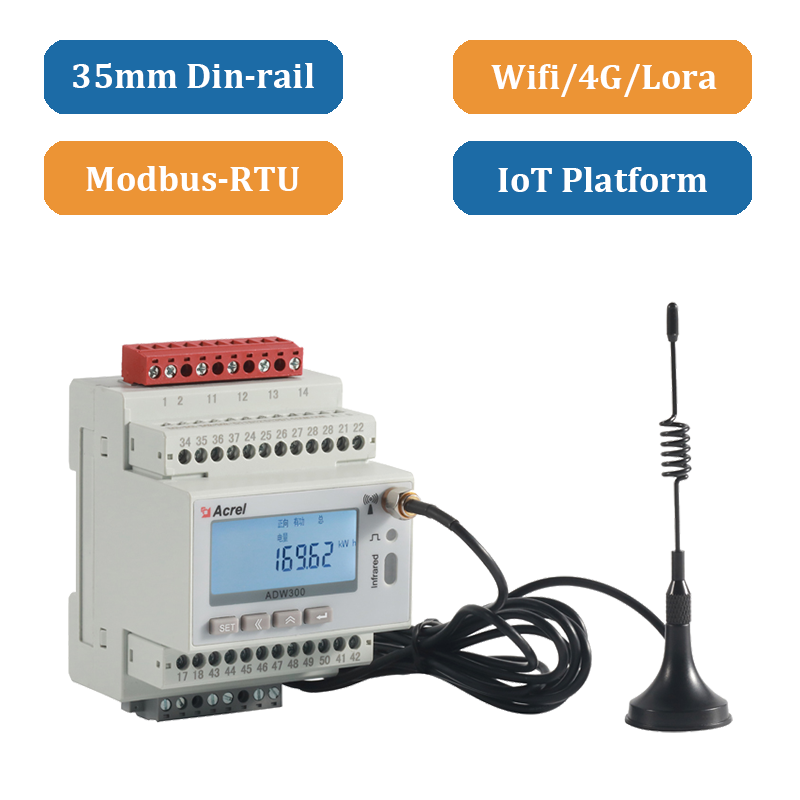
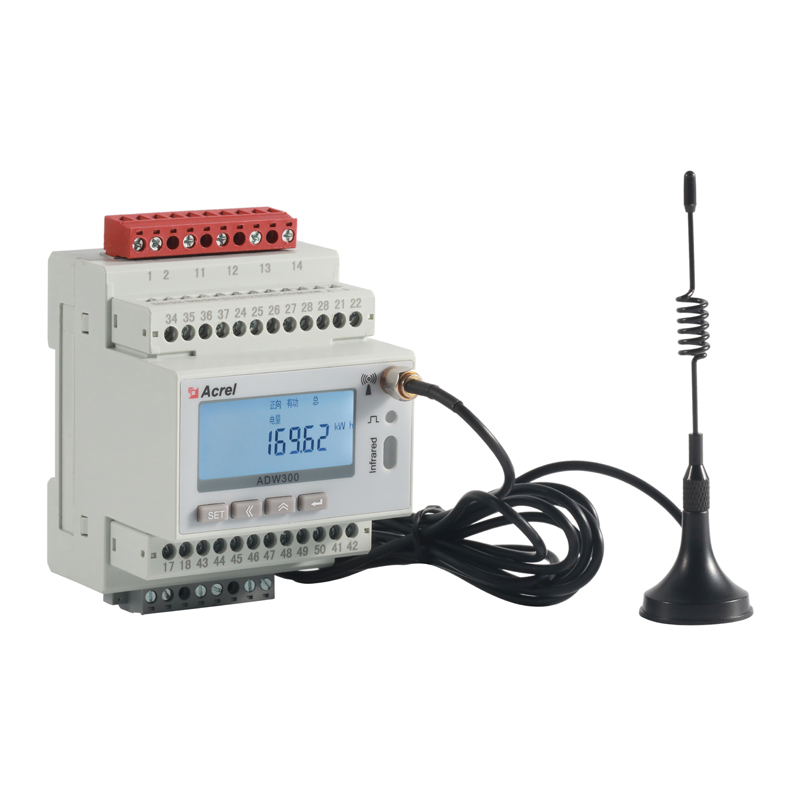
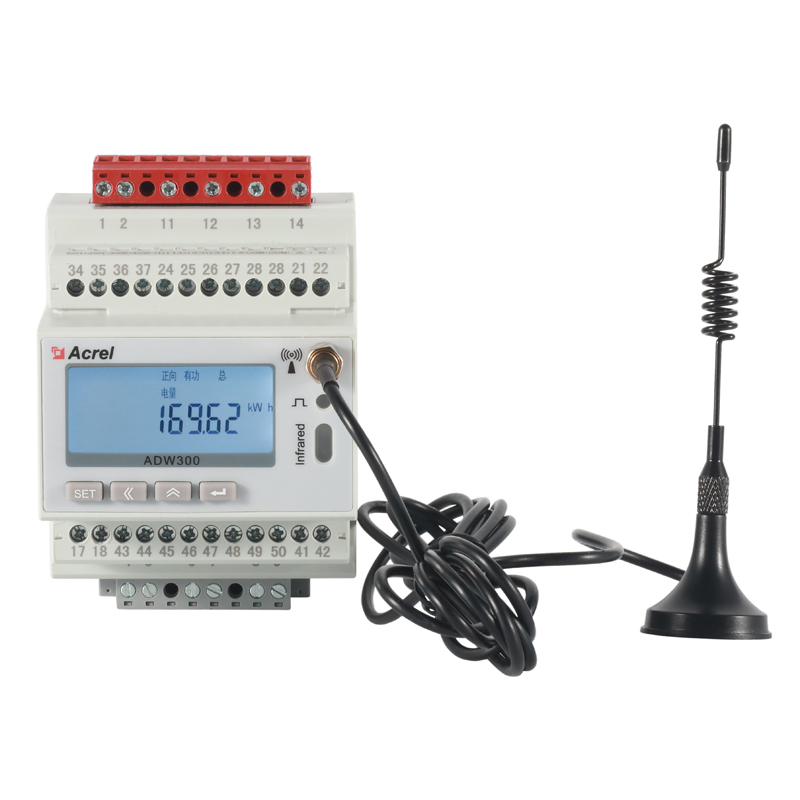
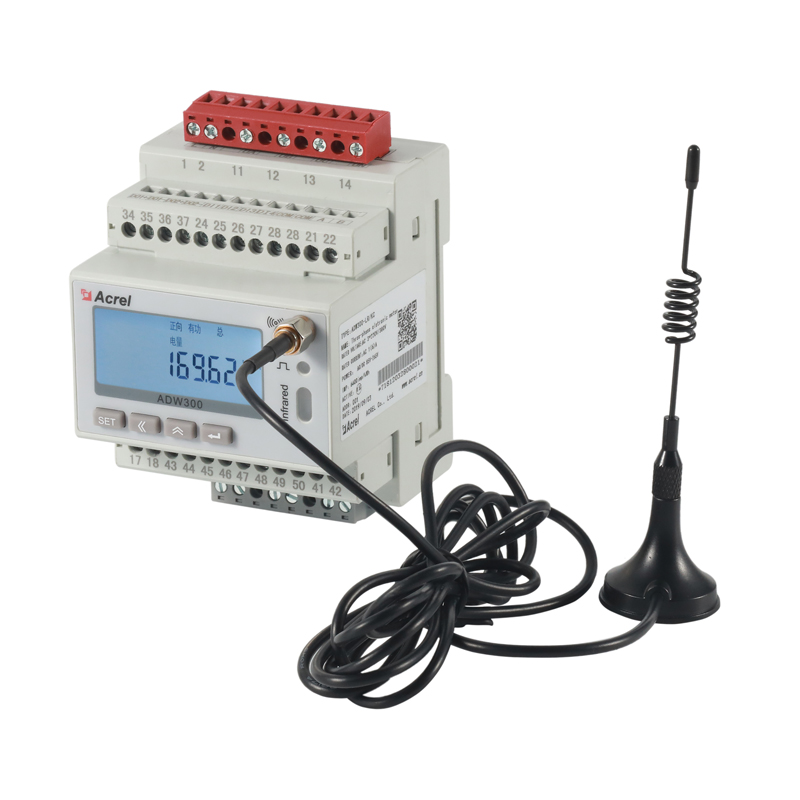
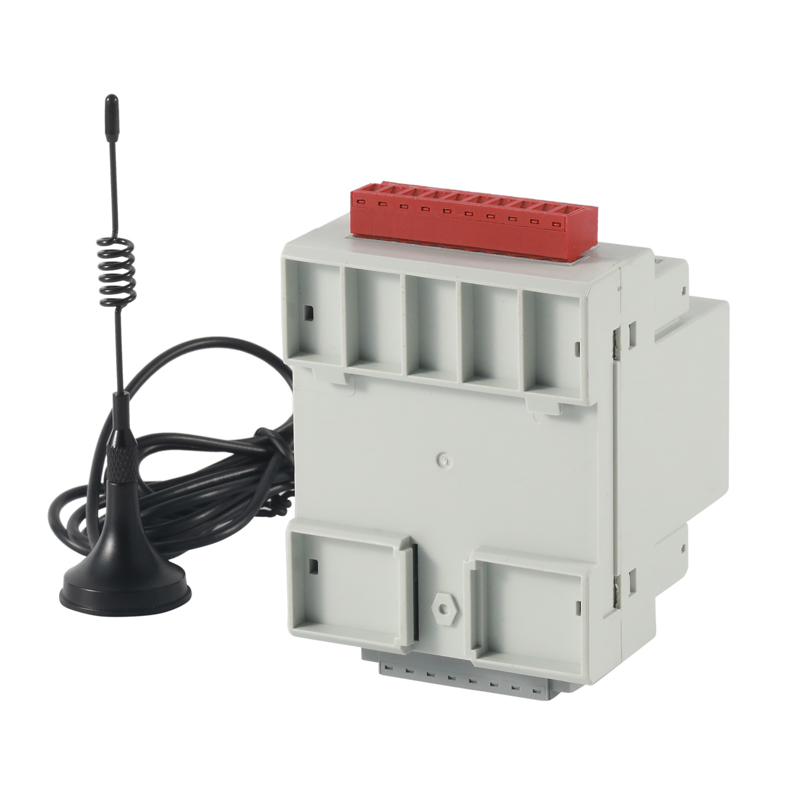
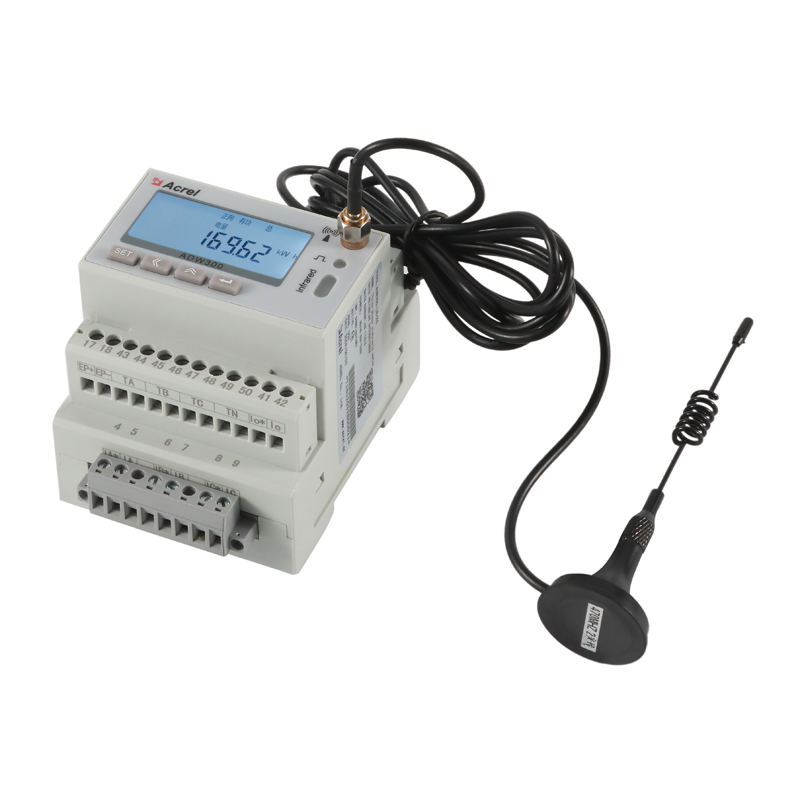
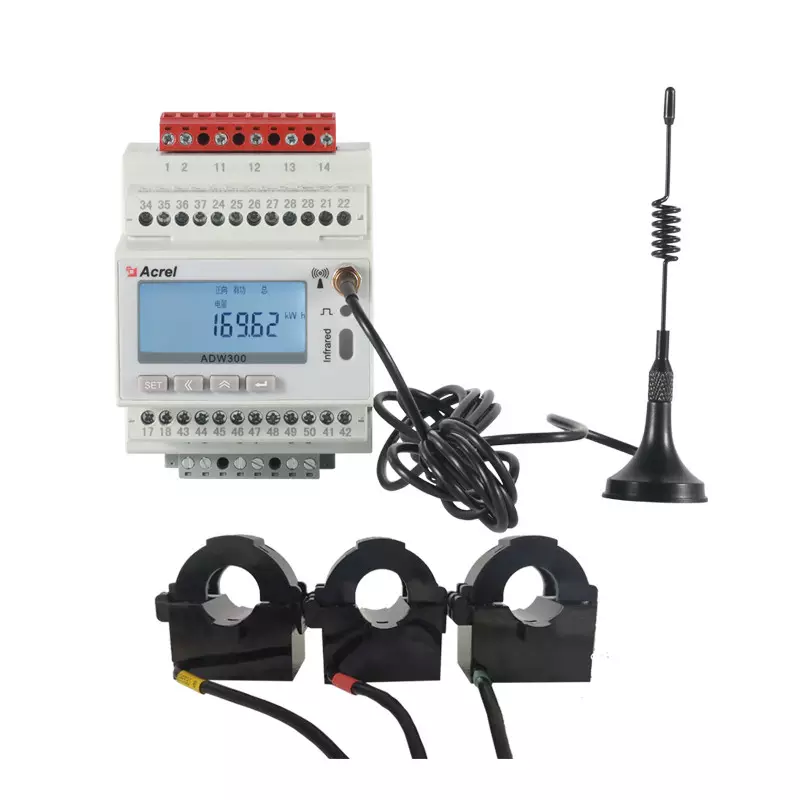
ADW300 IoT 3-phase Wireless Smart Energy Meter


Quick answers
What is the ADW300 used for?
Sub-circuit energy metering inside low-voltage distribution boards. Each tenant lot, production line, solar string or server rack gets its own three-phase reading instead of one building-wide total, so consumption can be billed, trended and alarmed separately.
What does it measure, and how accurately?
Three-phase active energy to class 0.5S under IEC 62053-22:2003 (the ADW300W variant is class 1), plus voltage, current, power, power factor, frequency and temperature to plus or minus 2 degrees C. The 0.5S class is defined for currents well below the reference current, which is the point of the S, so lightly loaded and standby circuits are still measured in range. Current is taken from external transformers or a Rogowski coil rather than an internal shunt, which keeps the case to 72 x 87.8 x 71.5 mm on DIN rail.
How does the ADW300 send data out of the board?
RS485 with MODBUS-RTU over shielded twisted pair is the base route. Wireless runs on 470 MHz (up to 1 km in open space), with 2G, NB-IoT, 4G and Wi-Fi options, and a LoRa link to an AWT100 gateway covers boards far from the server room. A front-panel infrared port at a fixed 1200 baud is used for on-site reading, and a pulse output (6400, 400, 100 or 60 imp/kWh depending on the CT option) is available when a local revenue check is still required.
Which supply and network does it need?
Rated voltage selections cover 3 x 57.7/100 V, 3 x 100 V, 3 x 220/380 V, 3 x 380 V and 3 x 380/660 V, on 3-phase 3-wire or 3-phase 4-wire networks at 50 Hz reference. The auxiliary supply is 85-265 V AC at below 2 W. Operating range is -20 to 55 degrees C at up to 95 percent humidity, non-condensing, below 2000 m altitude.
Sizing depends on your CT ratio and on where a gateway can sit. Send us the load schedule and we confirm the model, CT selection and wiring before you order.
General
ADW300 wireless metering meter is mainly used to metering three phase active energy on low voltage network. The product boasts of advantages including compact size, high precision, rich features.According to different requirements, there are many communications functions like RS485 communication, WIFI, NB, 4G, adding the new current sampling mode using external transformer. It can be flexibly installed in the distribution box to achieve sub-item electric energy metering, operation and maintenance supervision or power monitoring requirements for different regions and different loads.
Characteristic

Function
Accuracy: 0.5 class
Frequency: 50 ~ 60HZ
Pulse output: 6400imp/kWh , 400imp/kWh
Consumption: <10VA
Ordering an ADW300: what each code actually changes
Most returns are wrong current transformer orders, not faulty meters. The option code fixes the current range and the energy pulse constant together.
| Order code | Current input | Energy pulse output |
|---|---|---|
| D10 | 3 x 1.5 (6) A | 6400 imp/kWh |
| D16 | 3 x 20 (100) A | 400 imp/kWh |
| D24 | 3 x 80 (400) A | 100 imp/kWh |
| D36 | 3 x 120 (600) A | 60 imp/kWh |
A Rogowski option covers 1000 A at 200 mV or 333 mV output, for bars you cannot unbolt.
Picking the transformer, not the meter
Split-core bodies are sized by what has to pass through them. Measure first, then match the outer diameter.
| Outer diameter | Body weight | Typical home |
|---|---|---|
| 76 mm | 0.18 kg | Tenant final circuits, cable clusters |
| 120 mm | 0.42 kg | Floor and feeder breakers |
| 140 mm | 0.50 kg | Sub-mains, busbar runs |
| 190 mm | 1.32 kg | Incoming sections, large bar |
| 240 mm | 1.94 kg | Transformer LV bushings |
Window diameters are model-specific and hold a plus or minus 1 mm tolerance. Send the busbar or cable size and we confirm the exact transformer before the order is placed.
On a demand tariff, this is where the meter pays for itself
Malaysian large-supply tariffs bill demand on a 30-minute sliding window, and the time-of-use peak band runs 14:00 to 22:00. One short compressor start inside that window lifts the charge for the entire month. An incoming meter proves the spike happened. It cannot say which circuit caused it. Sub-circuit ADW300s record their own maximum and the timestamp, so the offender is named rather than guessed.
0.5S or Class 1 is a billing decision
| ADW300 | ADW300W | |
|---|---|---|
| Active energy class | 0.5S to IEC 62053-22:2003 | Class 1 |
| Tested at low load | Yes, the S suffix | Standard range only |
| Choose it when | A tenant, line or solar string gets billed or recharged | Internal trending only, no cost allocation |
The S in 0.5S means the class is verified at currents well below the reference value, which is exactly the situation on a lightly loaded tenant circuit. A Class 1 meter is not, so a vacant lot drawing standby power can fall outside its tested range and reappear later as an unexplained gap between the incoming meter and the sum of the sub-circuits.
Commissioning notes that save a return trip
- RS485 wants shielded twisted pair with one earth reference.
- Wireless runs 470 MHz, about 1 km in open space.
- The infrared service port is fixed at 1200 baud.
- Auxiliary supply 85 to 265 V AC, under 2 W.
- Above 2000 m altitude, derate the supply rating.
Full technical data
| Accuracy | 0.5S class (ADW300) / Class 1 (ADW300W) |
| Rated voltage | 3 x 57.7/100, 3 x 100, 3 x 220/380, 3 x 380, 3 x 380/660 V |
| Frequency | 50 to 60 Hz |
| Environment | -20 to +55 C, up to 95 % RH, below 2000 m |
| Data out | RS485 Modbus-RTU; Wi-Fi, 2G, NB-IoT, 4G and LoRa options |
| Pulse output | 6400, 400, 100 or 60 imp/kWh by order code |
| Mounting | DIN rail, 72 x 87.8 x 71.5 mm |
Tell us the conductor size, the tariff type and how many circuits you need to separate. We return the exact order code, transformer and communication option in one reply.
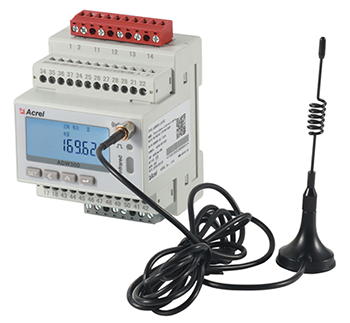
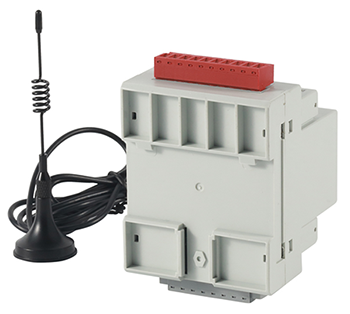
Dimension(L*W*H): 72*87.8*71.5mm
Wireless Transmission: on 470MHz and maximum distance in open space is 1km; 2G; NB
Starting current: 2%In
Dimension
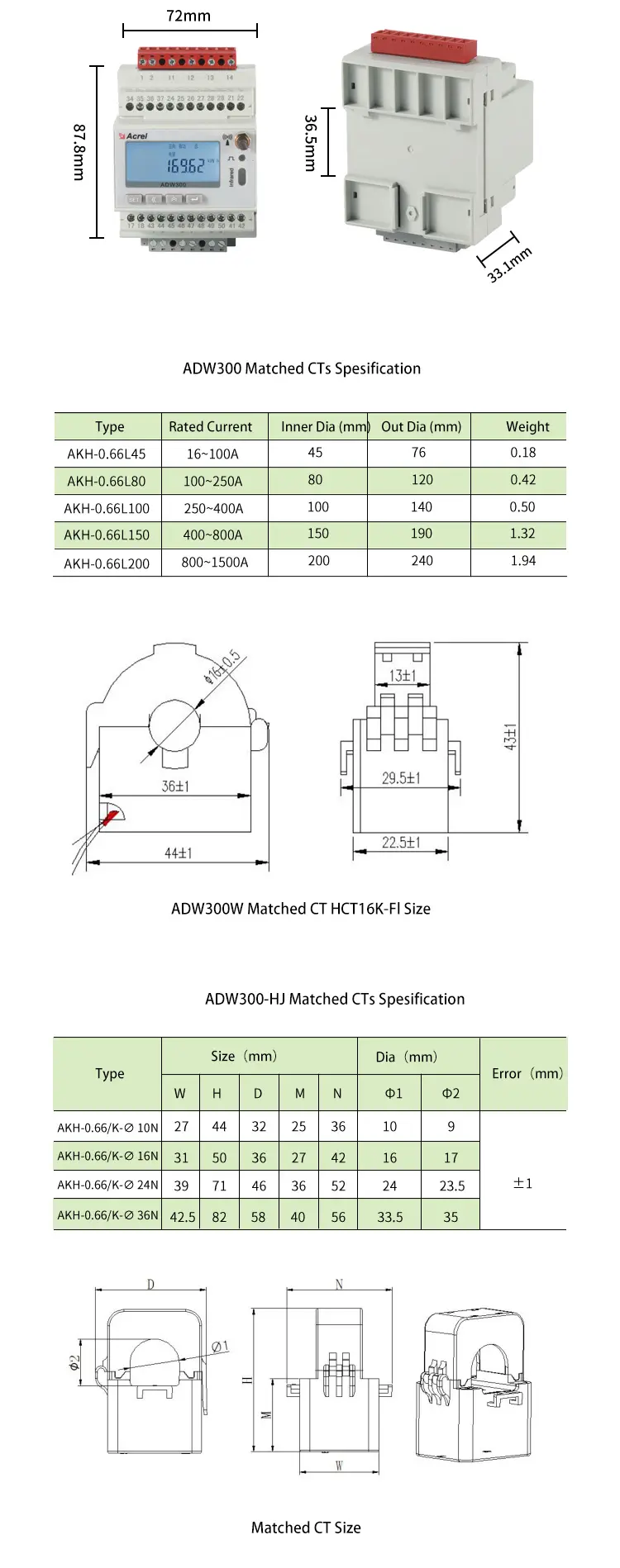
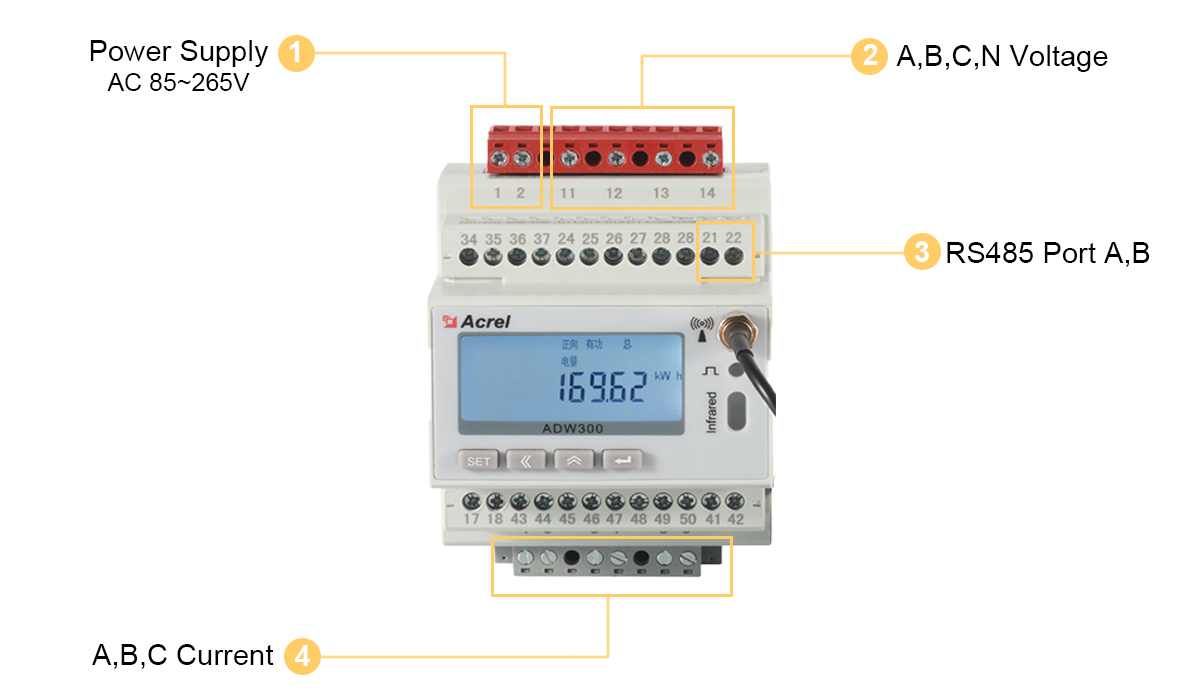
PIN Overview
ADW300 Basic Functions
ADW300 could work in 690V AC system. It can measure all electrical parameters, including current, voltage, power consumption, power factor, etc. Besides, it uses RS485 and Modbus-RTU as communication method.
ADW300 Optional Functions
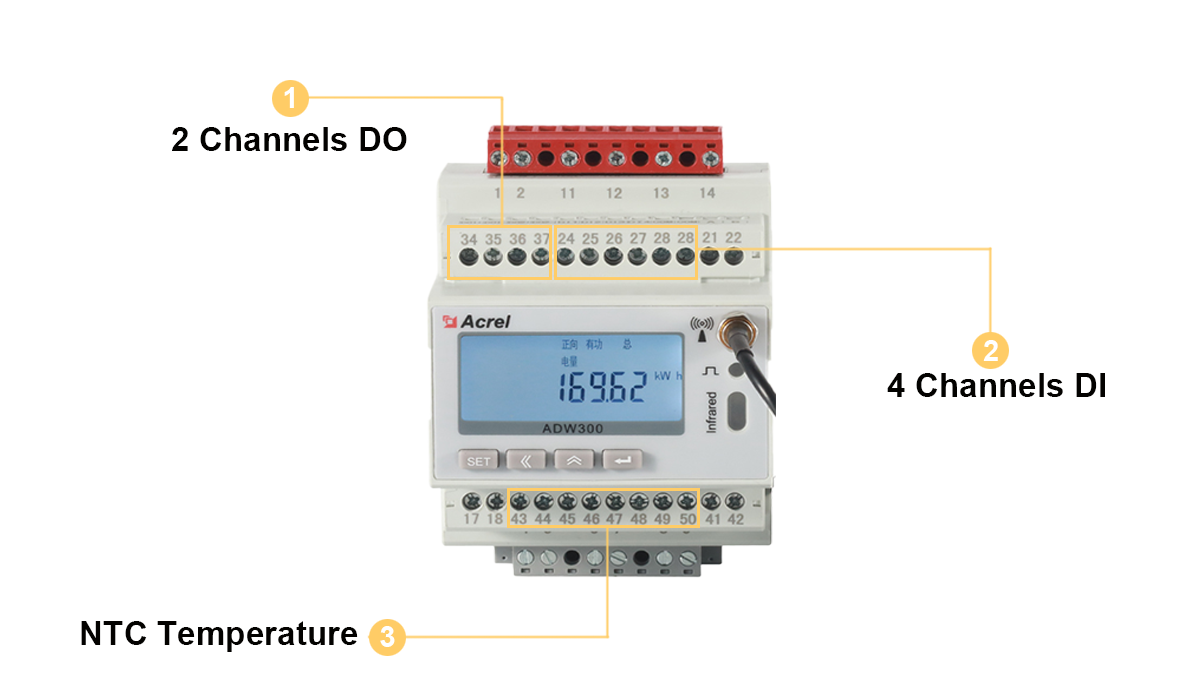
1. Switch: 4DI & 2DO.
2. Temperature measurement: A, B, C, N. 4-channel temperature measurement.
3. Leakage Current: 1-channel measuring.
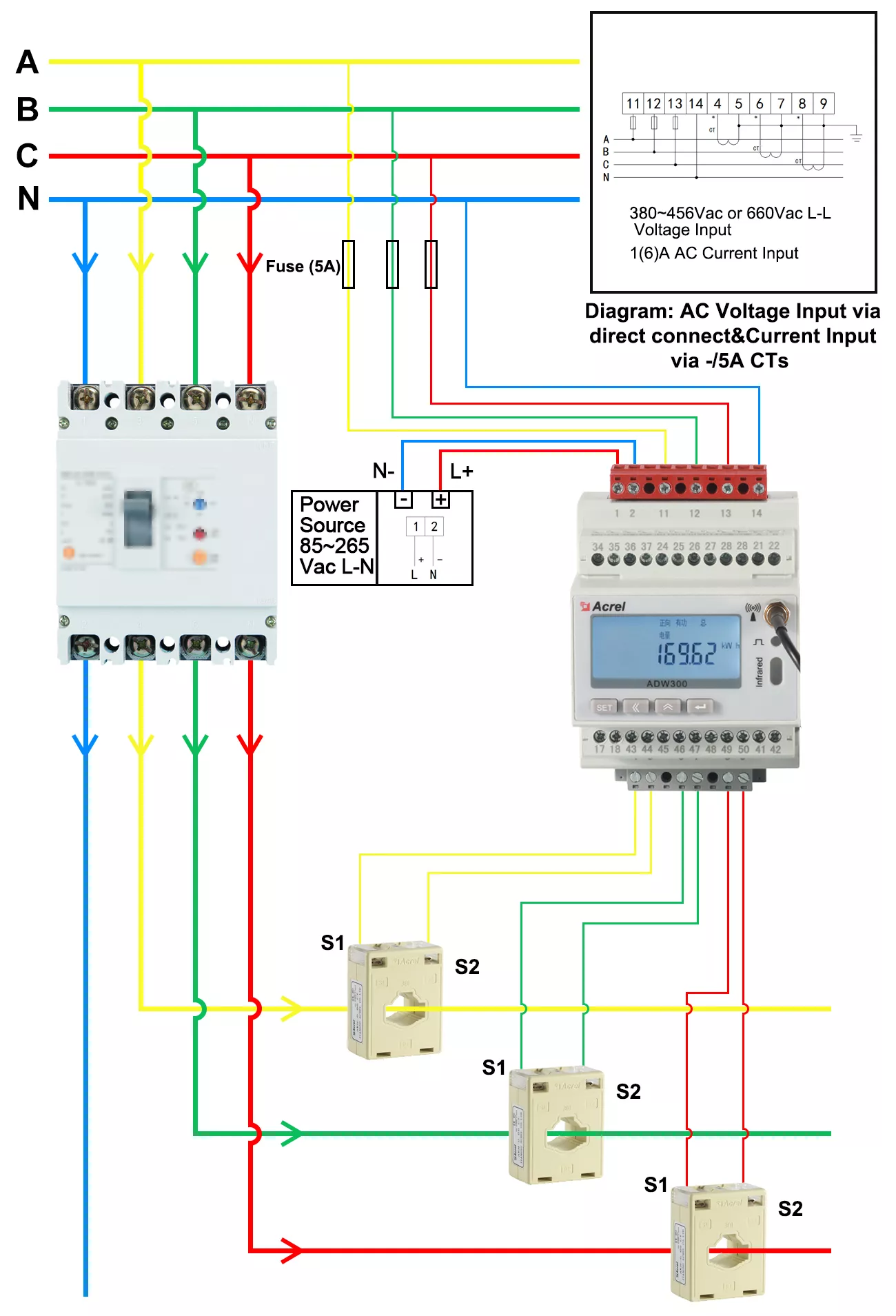
Wiring
Solution Structure
Solution Structure Direct:
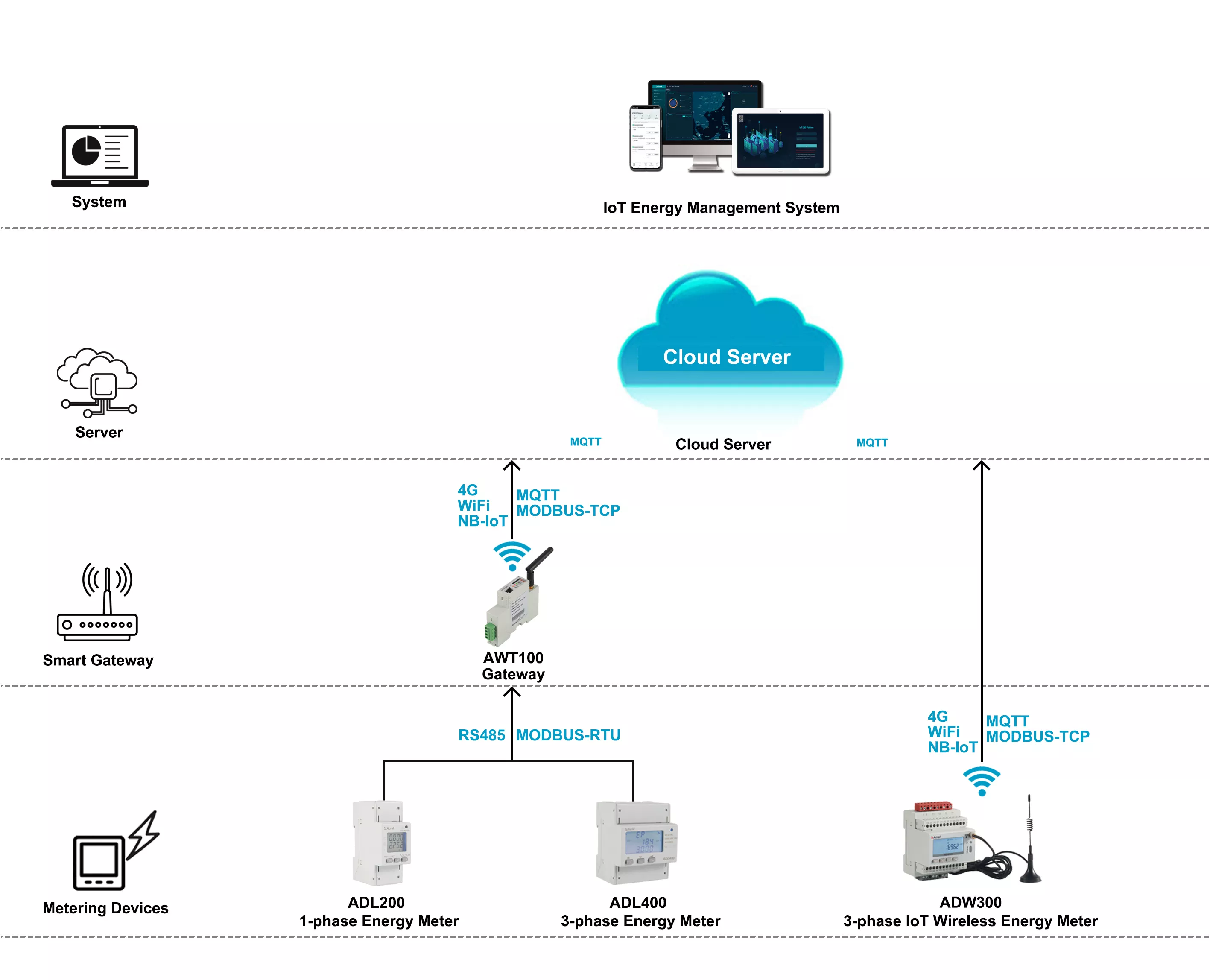
Solution Structure LoRa Based:
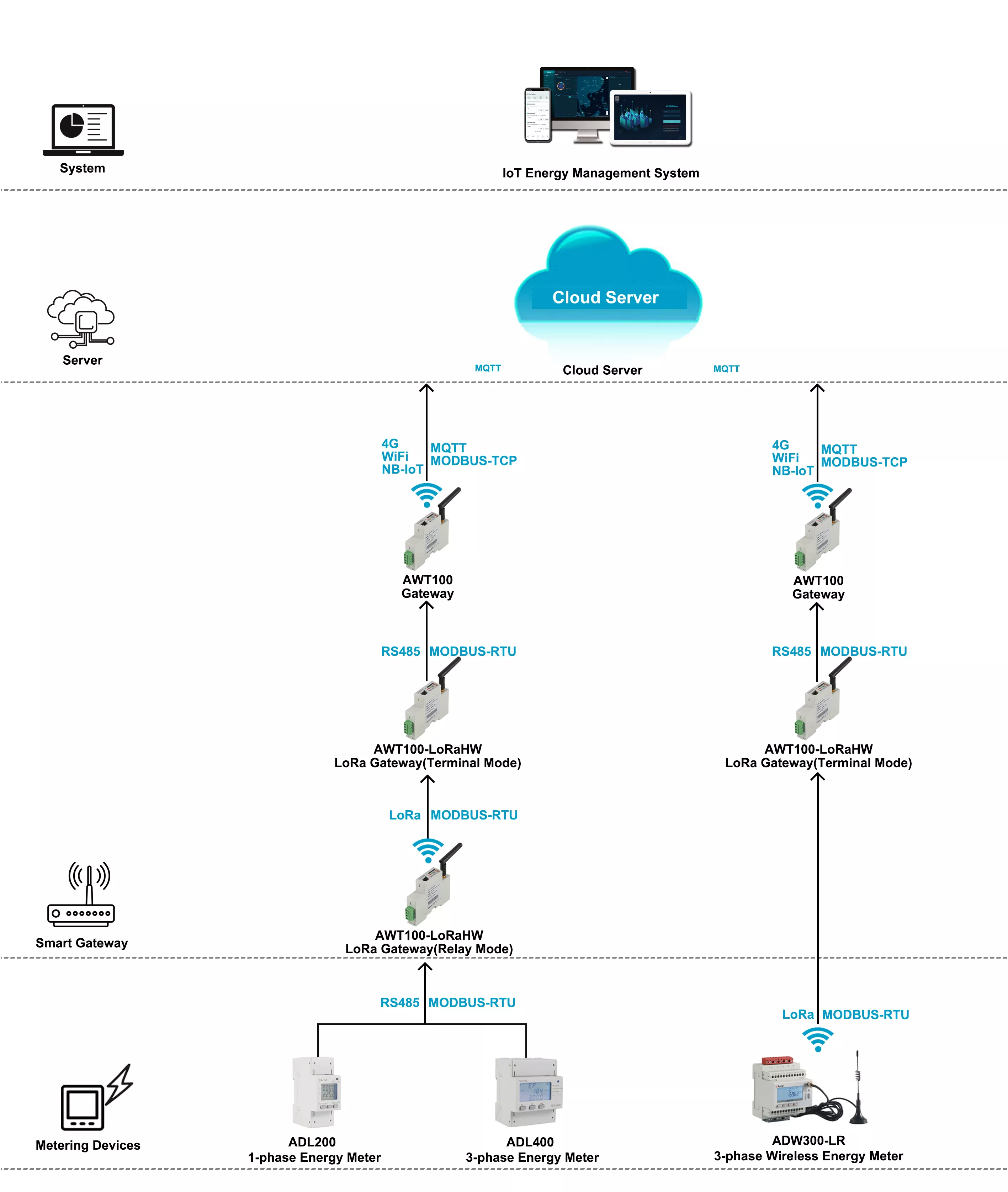
Typical Diagram

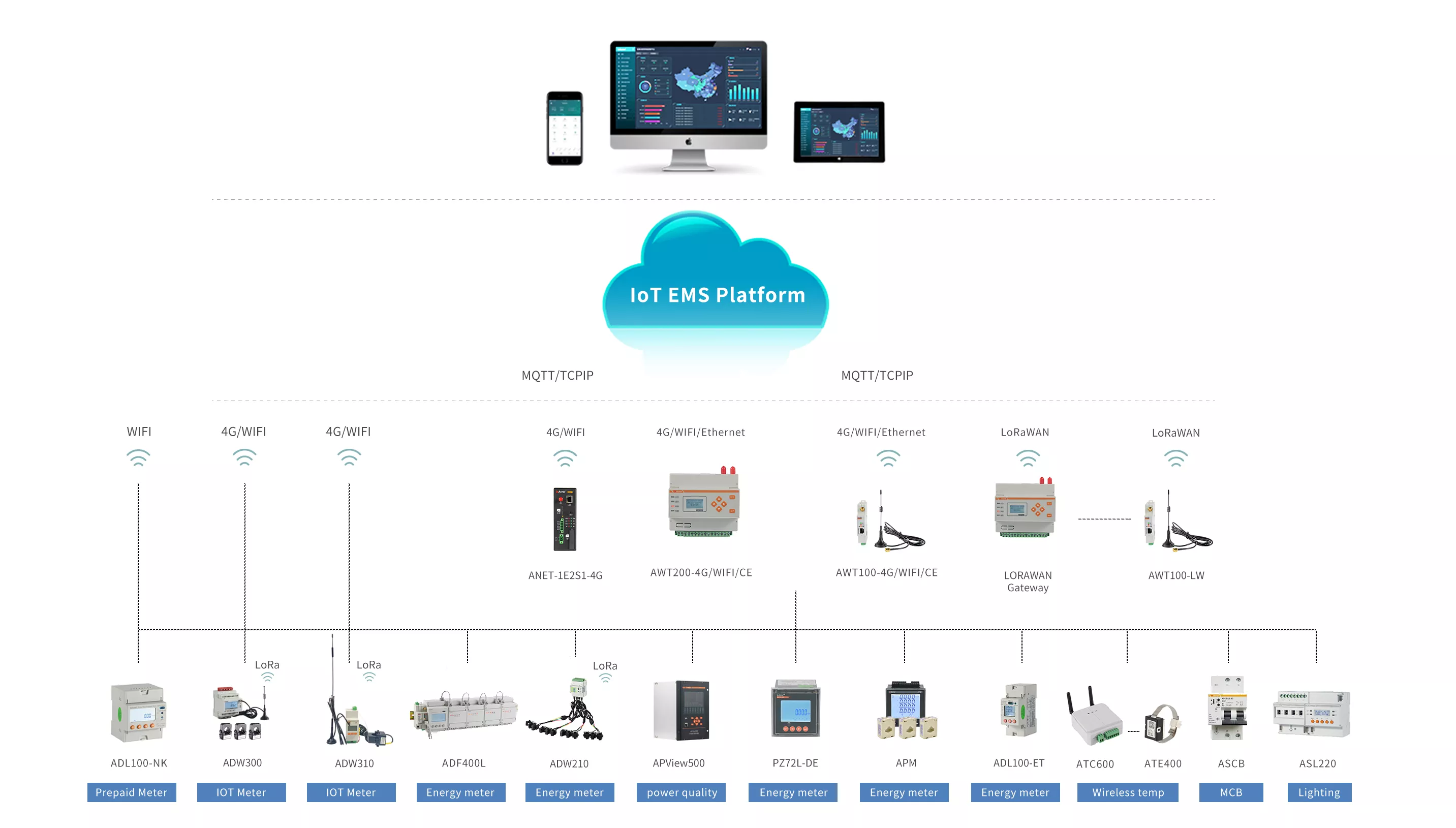
Application Scene

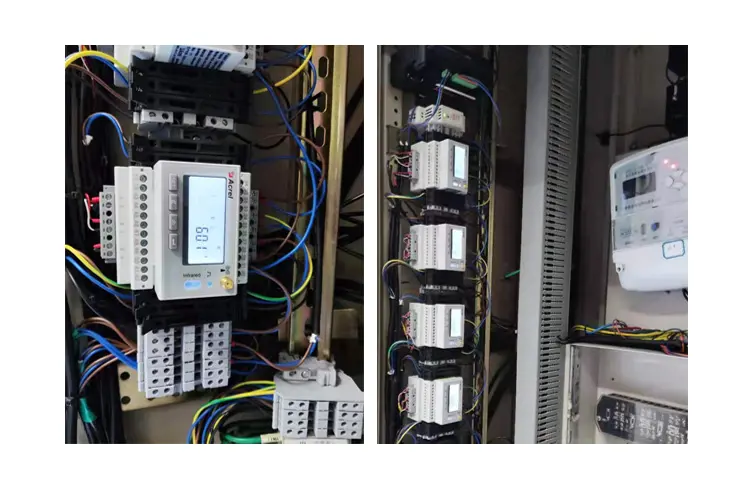
Site Picture
1.Technical parameter
1.1 Electrical performance
|
Voltage input |
Rated voltage |
3×57.7/100V, 3×220/380V, 3×380/660V, 3×100V, 3×380V, 3×660V |
|
Reference frequency |
50Hz |
|
|
Consumption |
<0.5VA (Each phase) |
|
|
Current input |
Input current |
3×1(6)A ; 3×1(6)A [ADW300W], 3×20(100)A [ADW300W] -CT: 3×1.5(6)A [D10]; 3×20(100)A [D16]; 3×80(400)A [D24]; 3×120(600)A [D36]; -Rogowski Coil: 1000A/200mV, 333mV |
|
Start current |
1‰ Ib (Class 0.5S), 4‰ Ib (Class 1) |
|
|
Consumption |
<1VA (Each phase) |
|
|
Auxiliary power |
Power Supply |
AC 85~265V |
|
Power consumption |
<2W |
|
|
Measurement performance |
Standard |
IEC 62053-22:2003, IEC 62053-21:2003 |
|
Active energy accuracy |
Class 0.5S [ADW300], Class 1 [ADW300W] |
|
|
Temperature accuracy |
±2℃ |
|
|
Pulse |
Width of pulse |
80±20ms |
|
Pulse constant |
6400imp/kWh , 400imp/kWh -CT: 6400imp/kWh [D10], 400imp/kWh [D16], 100imp/kWh [D24], 60imp/kWh [D36] |
|
|
Communication |
Wireless |
Transmission on 470MHz and maximum distance in open space is 1km; 2G; NB; 4G; WIFI |
|
Infrared communication |
The constant baud rate is 1200 |
|
|
Interface |
RS485(A, B) |
|
|
Connection mode |
Shielded twisted pair conductors |
|
|
Protocol |
MODBUS-RTU |
1.2 Work environment
|
Temperature range |
Operating temperature |
-20℃~55℃ |
|
Storage temperature |
-40℃~70℃ |
|
|
Humidity |
≤95% (No condensation) |
|
|
Altitude |
<2000m |
|
2. Functional Characteristic
2.1 Basic & Optional Function
|
Functions |
Description |
|
Display mode |
LCD |
|
Energy metering |
Active kWh (positive and negative), quadrant reactive power energy |
|
Electrical measurement |
U, I, P, Q, S, PF, F |
|
Harmonic function |
THDv, Harmonic on 2nd-31st |
|
Pulse output |
Active pulse output |
|
Three-phase unbalance degree |
Voltage unbalance, current unbalance |
|
Temperature measurement |
Temperature of A/B/C/N(Alternate configuration: T) |
|
DI/DO |
4DI,2DO(Alternate configuration: K) |
|
Residual current |
One-way residual current(Alternate configuration: L) |
|
LED display |
Pulse LED display |
|
External current transformer |
External open type current transformer (Alternate configuration: W) |
|
Electrical parameter |
Undervoltage, undercurrent, overcurrent, underload, etc |
|
Communication |
Infrared communication |
|
RS485(Alternate configuration: C) |
|
|
Wireless transmission on 470MHz(Alternate configuration: LR) |
|
|
GPRS(Alternate configuration: 2G) |
|
|
NB-IOT(Alternate configuration: NB) |
|
|
4G(Alternate configuration: 4GHW) |
|
|
WIFI(Alternate configuration: WF) |
|
|
|
LORAWAN【Alternate configuration: LW915(AU915), LW868(EU868)】 |
2.2 LORAWAN parameters
|
Type Specification |
Standard |
Channel Plan |
|
LW915 |
AU915 |
AU915~928 |
|
LW868 |
EU868 |
EU863~870 |