

How prepaid metering works on these meters
A prepaid rail meter keeps the money on the meter, not in a spreadsheet. The sequence the AcrelEMS platform and the meter run between them is:
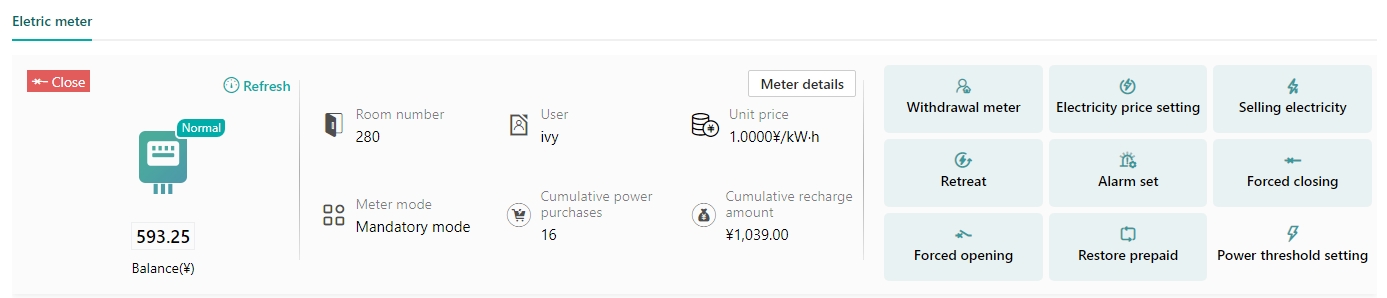
- A tenant recharge is entered on the platform and written to the meter over RS485 with encrypted purchase data, so the balance lives in the meter.
- The LCD shows the remaining energy; the meter switches on its own relay when the balance reaches zero.
- A low-balance threshold closes the relay warning first, so the tenant gets notice before the load drops.
- A recharge restores supply without anyone opening the distribution board, which is the cost that makes prepaid worth it for landlords.
Two DIN-rail models cover the usual cases: the single-phase ADL100-EY and the three-phase ADL300-EY.
Built-in relay, so the cut-off needs no extra hardware
Both meters carry a built-in high-capacity sub-holding relay that performs the load on / off control itself. Nothing has to be added in the cabinet for a cut-off, and the same relay is used for remote switching from the platform: the property manager can enable or disable a circuit from the phone or browser, and set rules by balance, by load or by time.
Because control is inside the meter, a circuit stays switched off during a communication outage — the rule is enforced at the meter, not only on the server.
Direct platform integration
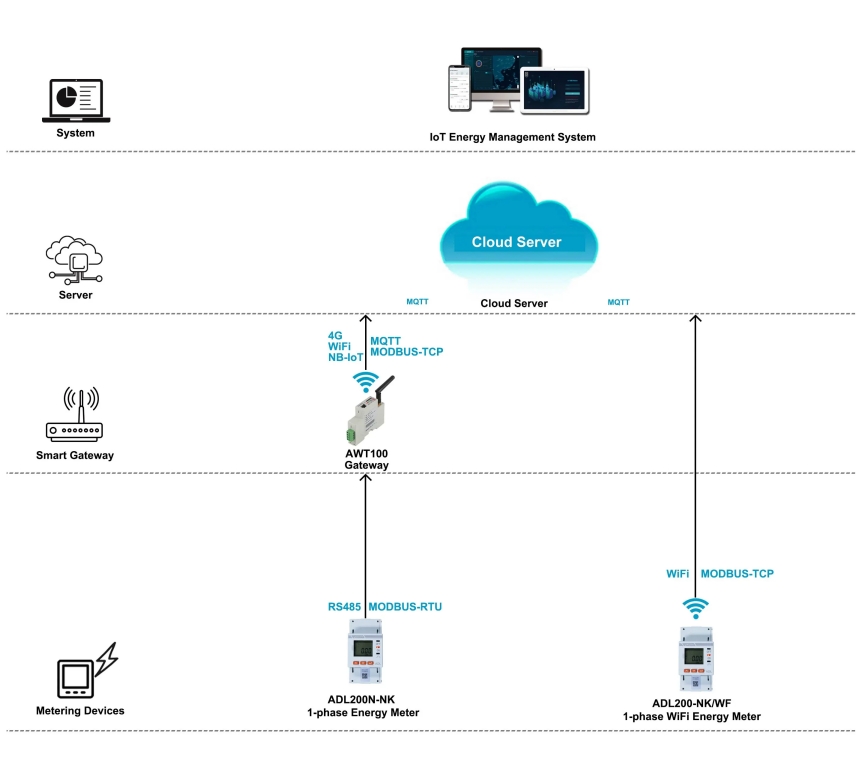
The meter side is always RS485 with Modbus-RTU, shielded twisted pair. That bus can reach a server directly, or it can be published over the AWT100 gateway, which takes 4G, Wi-Fi or LAN as its uplink and speaks Modbus-RTU downwards.
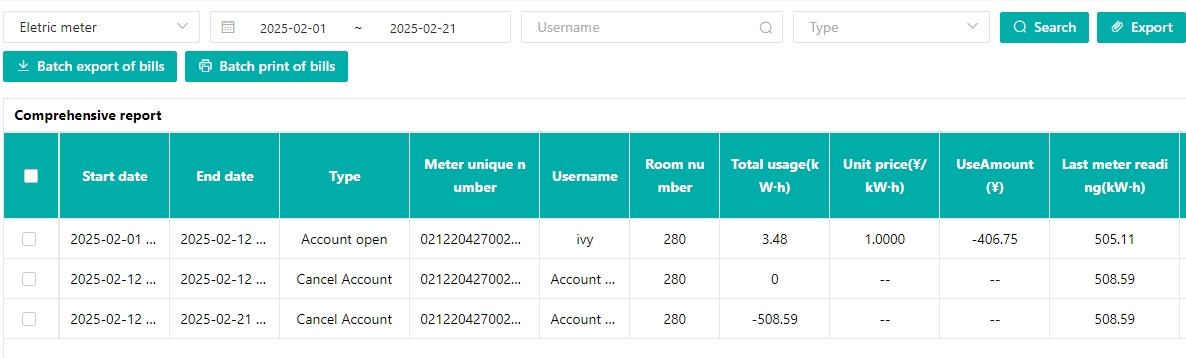
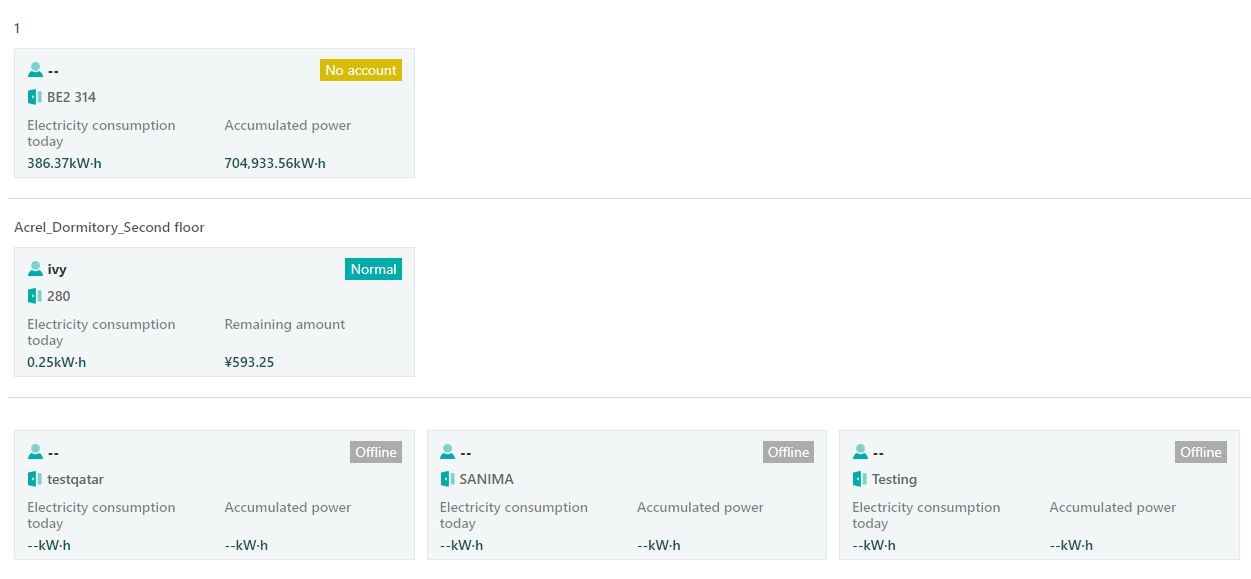
On the platform the same tenant record then covers consumption per meter, real-time values, recharge history, remote control and the billing report — one dataset for the operator and the tenant.
Multi-tenant billing, and what to compare
Split billing in apartments, offices, dormitories or shared workshops needs three things from the meter: an energy register the landlord cannot argue with, a relay it can act on, and a rate table that matches the utility tariff. The two models differ mainly in phase count, current rating and accuracy class.
| Parameter | Value |
|---|---|
| Reference voltage | ADL100-EY: 220 V | ADL300-EY: 3×220/380 V |
| Input current | ADL100-EY: 10(60) A | ADL300-EY: 1(6) A or 10(80) A |
| Accuracy class | ADL100-EY: class 1 | ADL300-EY: class 0.5S |
| Energy measured | Total active kWh, positive and negative; U, I, P, Q, S, PF, F |
| Pulse constant | 1600 imp/kWh (ADL100-EY) / 6400 or 400 imp/kWh (ADL300-EY); 80±20 ms |
| Starting current | 0.004 Ib direct-connected; 0.002 In via CT |
| Clock error | ≤0.5 s per day |
| Multi-tariff | 4 tariff rates, 14 time intervals per day (optional) |
| Prepaid & control | Encrypted RS485 recharge; built-in sub-holding relay for load on/off |
| Communication | RS485 (A+, B−), Modbus-RTU, shielded twisted pair |
| Environment | Working −25 to 55 °C; storage −40 to 70 °C; ≤95% RH no condensation; <2000 m |
| Display | 8-segment LCD |
Order the CT-connected version when a circuit runs above 80 A; the direct-connect versions are the ones that need no external transformer.
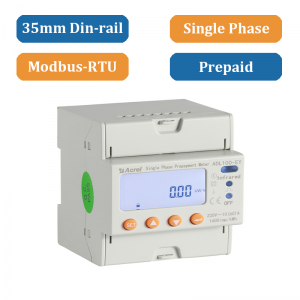
ADL100-EY
1. Single phase energy meter
2. 230V 60A
3. Build-in relay & Remote control
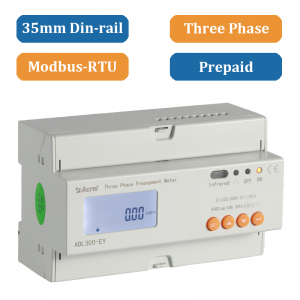
ADL300-EY
1. 3 phase energy meter
2. 3*230/400V, 3*10(80)A
3. Build-in relay & Remote control
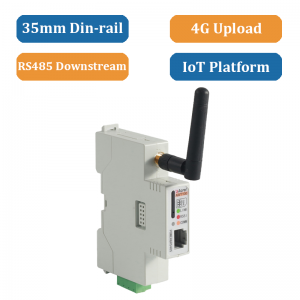
AWT100
1. Wireless gateway, 4G / Wi-Fi / LAN uplink
2. Modbus-RTU downlink to the RS485 meters
3. Publishes the meter register map to the cloud platform
Post time: Mar-05-2025


