

Since July 2025 a Malaysian electricity bill has been itemised into five charges. The switchboard behind it still reports one number. That gap is where savings disappear.
Five charges on the bill. One total at the meter.
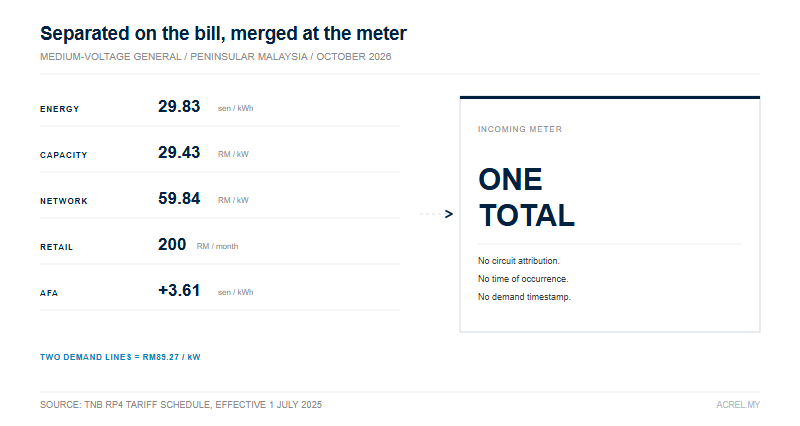
A medium-voltage factory in Peninsular Malaysia does not pay one rate. It pays four, plus a fuel adjustment revised monthly.
Energy — 29.83 sen per kWh. Capacity — RM29.43 per kW of maximum demand. Network — RM59.84 per kW. Retail — RM200 a month. AFA — 3.61 sen per kWh in October 2026.
The two demand lines together come to about RM89.27 for every kilowatt of your highest 30-minute average in the billing month. One compressor restarting at 14:05 can set that figure for four weeks.
Low-voltage premises pay 50.68 sen per kWh all in — 27.03 energy, 8.83 capacity, 14.82 network — plus RM20 a month, so the bill rises in a straight line with usage.
The bill answers what we paid. It never answers what did it.
A cash register cannot diagnose a plant
The incoming meter is a cash register, not a diagnostic instrument. It sees every load added together and reports the sum. When the sum rises, nothing says which part moved.
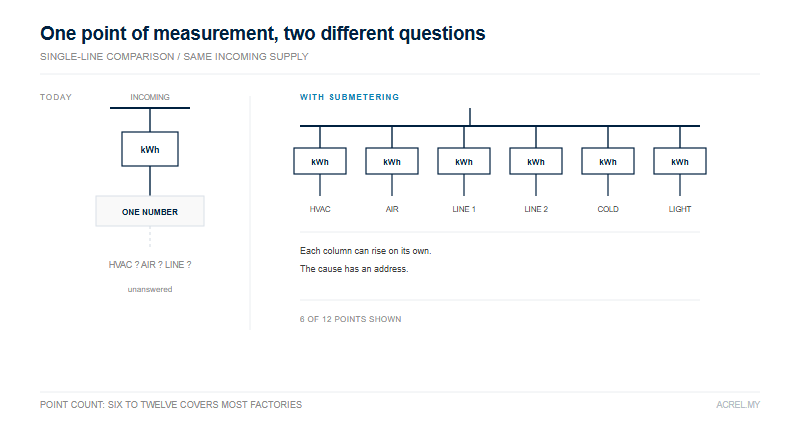
One point of measurement is being asked to answer a question that needs six.
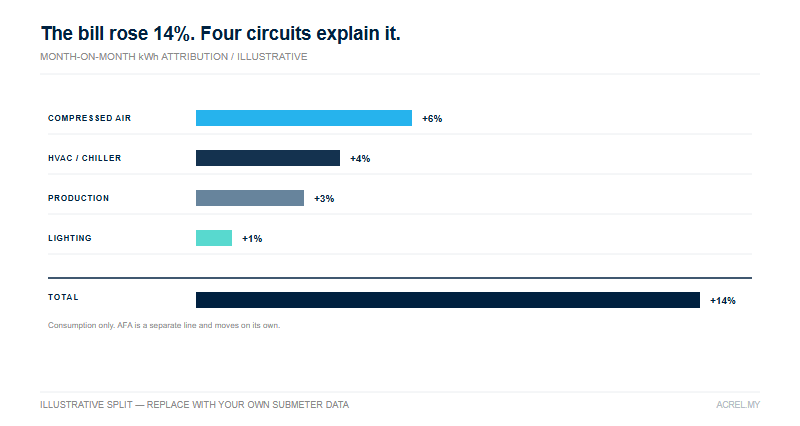
A factory’s consumption rises 14%. Maintenance checks the chiller, finds nothing, calls it seasonal. Months later a compressed-air leak is found at a flange — running eight hours a day for most of a year, invisible on the incoming meter because it never moved the total enough to look abnormal.
Submetering does not find the leak. It makes the leak visible as a column that climbs while the others stay flat.
Meter where responsibility changes
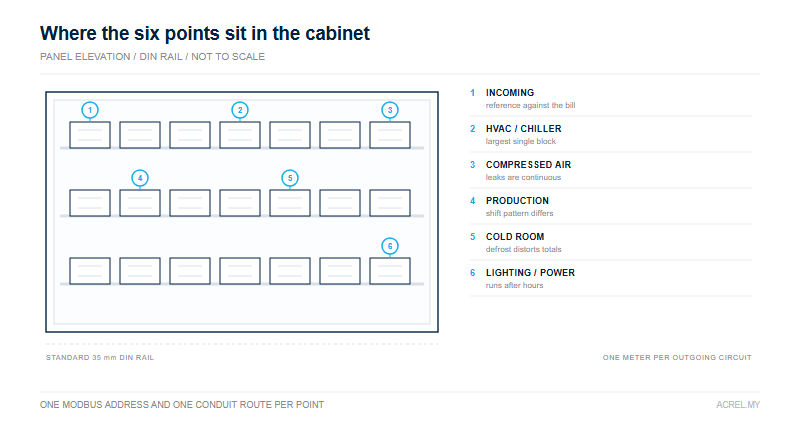
The rule is not "meter everything": meter wherever responsibility changes, or where a load can be acted on independently.
Two constraints decide the count: every point needs a Modbus address and a route back to the gateway, so empty panel space and spare conduit are real costs; and a meter on a circuit nobody will act on produces data, not savings. Start with six to twelve points.
Commercial buildings use the same points under different names.
What the register has to hold
The requirements are modest but specific: three-phase measurement, a demand register with a timestamp, time-of-use registers that match the tariff bands, and a readable port.
The
DTSD1352-C
covers that set. It measures voltage, current, active, reactive and apparent power, power factor and frequency, with voltage and current accuracy of ±0.2% and power accuracy of ±0.5%. Active energy is Class 0.5S to IEC 62053-22, reactive energy Class 2, and harmonic content is available to the 31st order plus total harmonic distortion.
The demand register is what matters for a TNB bill. The meter records four kinds of maximum demand — forward active, reverse active, inductive reactive, capacitive reactive — with the time each occurred. Its demand cycle defaults to 15 minutes with a one-minute sliding window. TNB bills on a 30-minute average, so the cycle has to be set to match before the two numbers can be compared; this is a commissioning step, not a factory default.
4 kinds + time stamp
15 min default
Class 0.5S
4 zones / 8 lists / 8 rates
to 31st + THD
Time-of-use registers support four time zones, eight interval lists and eight tariff rates — enough to separate the 14:00–22:00 weekday peak from off-peak. It keeps 48 months of monthly frozen data and 90 days of daily, so a year-on-year check does not depend on someone exporting a report.
Communication is RS485 Modbus-RTU at 1200–19200 bps, addressable 1 to 247. There is one optocoupler input, one relay output (AC 220V / DC 30V), and support for three external NTC sensors.
Voltage ranges include 3×240/415V — Malaysia’s low-voltage three-phase supply — alongside 3×220/380V, 3×380V, 3×100V and 3×57.7/100V. Current input is 3×10(80)A direct, or 3×1(6)A and 3×10(100)A through CTs. Mounting is DIN rail. CE marking covers EMC and LVD, with an IEC 62052 / 62053 declaration on file.
Where points are dense — a row of outgoing feeders in one cabinet — the
DTSD1352-4S
puts several circuits into one DIN-rail unit.
Read the data against the right line
AFA moves monthly, so a rising bill is not automatically a rising load. Comparing kWh by circuit separates what you consumed from what the adjustment added.
The charge is set by the highest 30-minute average, not monthly energy. A circuit running briefly at high load can carry a disproportionate share of an RM89.27 per kW charge while looking small in a monthly kWh report — which is why the demand register needs a timestamp.
Below 0.85 the tariff adds 1.5% per 0.01 of shortfall, so a site at 0.80 pays a 7.5% surcharge. Submetering shows which circuit drags the site figure down — usually an idling motor, not the whole plant.
Add the last three bills and we will mark the metering points, telling you which circuits are worth a meter — no charge, no obligation.
DTSD1352-C DIN-rail three-phase energy meter
Post time: Oct-19-2026


