

Where Do You Measure a PV + Storage Plant? A Guide to the Point of Common Coupling
A PV and storage project can be technically excellent and still fail to prove its value, because the meters were put in the wrong place. The point of common coupling is where the numbers mean something to the utility, the finance team and the control system at once.
One point decides everything
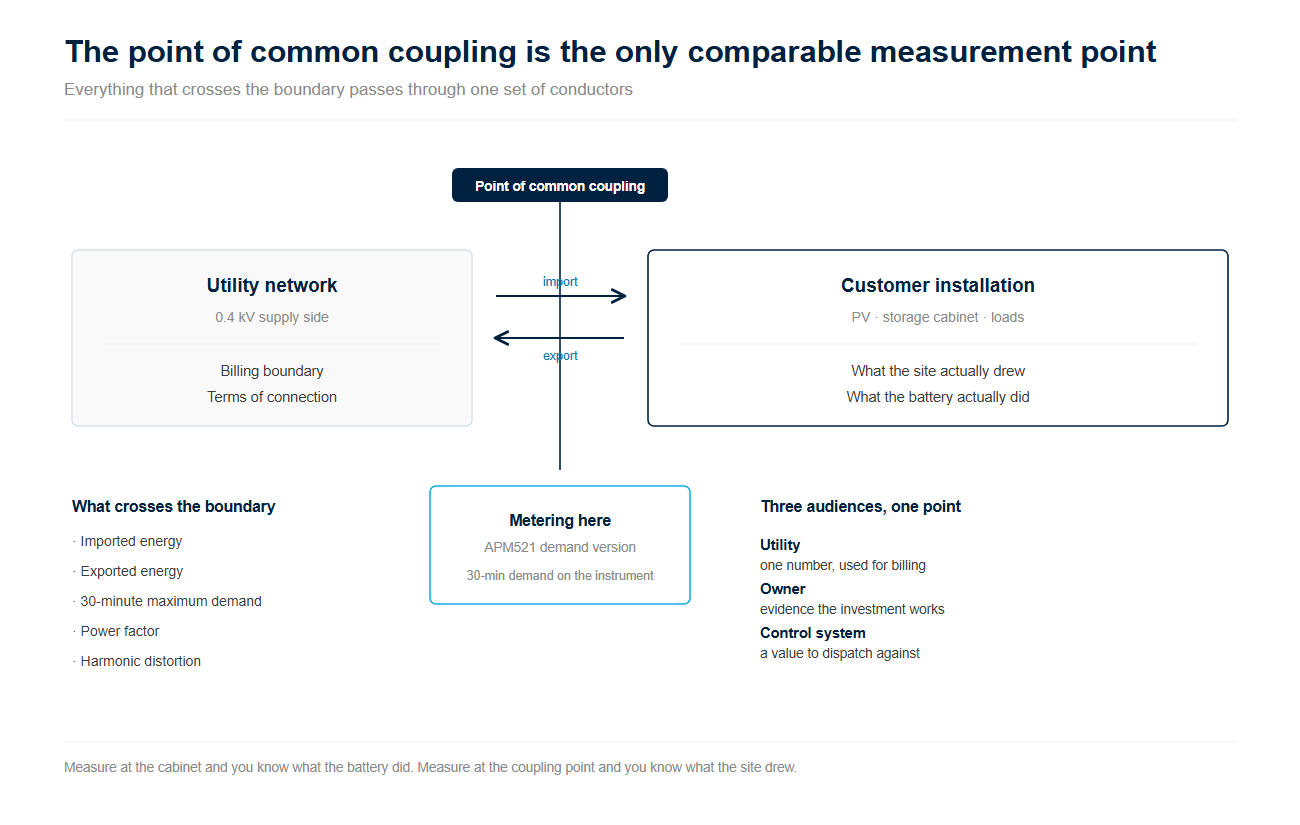
The point of common coupling is the boundary between the customer's installation and the utility's network. Everything that crosses it — imported energy, exported energy, the 30-minute maximum demand, the power factor, the harmonic distortion seen by the network — passes through a single set of conductors, making it the only place where a measurement can be compared directly with a utility bill. Measure at the cabinet and you know what the battery did; measure at the coupling point and you know what the site drew.
|
Utility
One number, used for billing
|
Owner
Evidence the investment works
|
Control system
A value to dispatch the battery against
|
Three different audiences, one measurement point. Import is energy bought — the register behind the invoice. Export is energy pushed back. The meter must resolve both, at the same boundary the utility uses — otherwise the two sets of readings never reconcile. In practice that means the coupling point, and nowhere else.
Six questions the coupling point has to answer
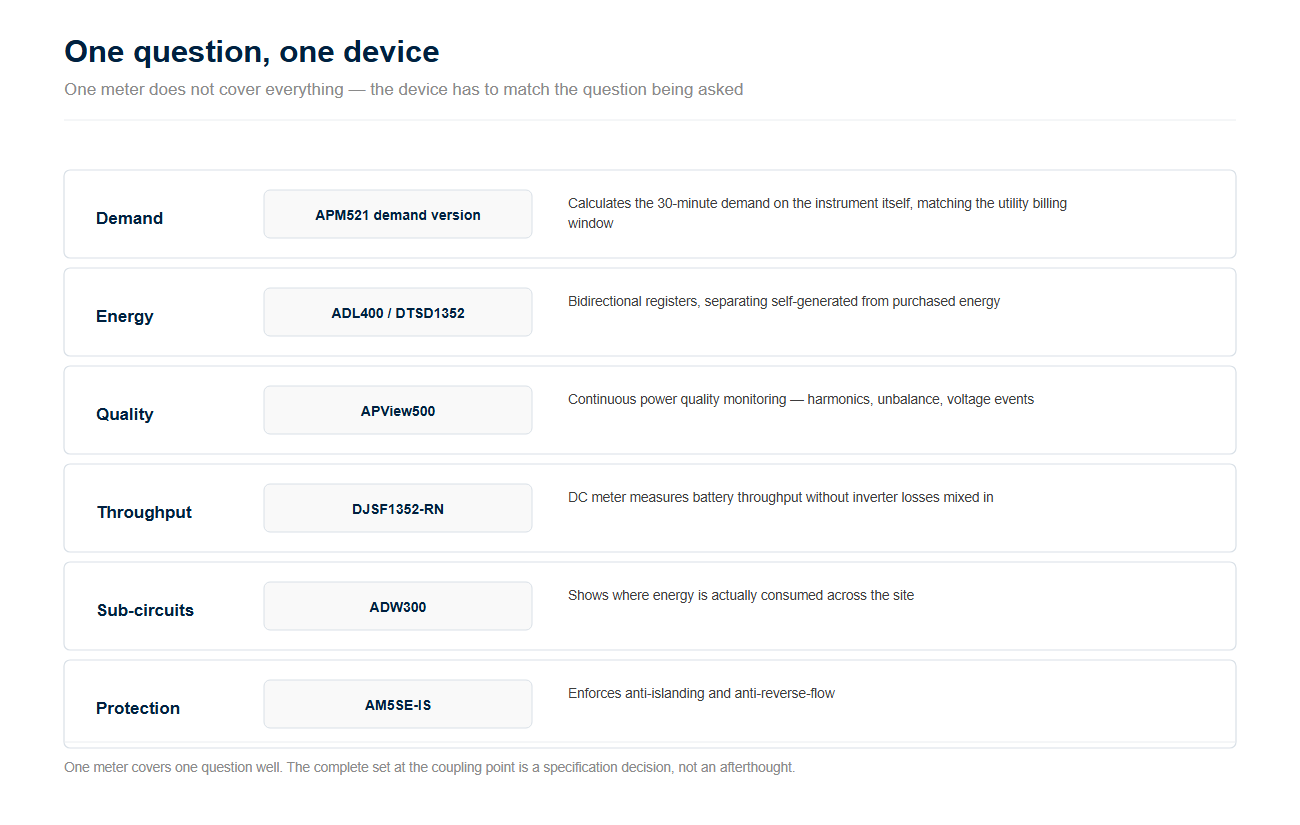
One meter does not cover everything, and the device has to match the question being asked.
The demand meter, and both sides of the inverter
The demand meter is the one most often specified incorrectly. Many installations use a general-purpose meter and calculate demand in software afterwards, producing a number that may not match the utility's. The APM521 is a panel-mounted multifunction meter; its Malaysia demand version performs the 30-minute calculation on the instrument itself. A strategy reacting to a differently calculated demand will either over-control, wasting battery cycles, or under-control, leaving demand on the bill. The difference between the two is a software setting, and it is worth confirming before the order is placed.
|
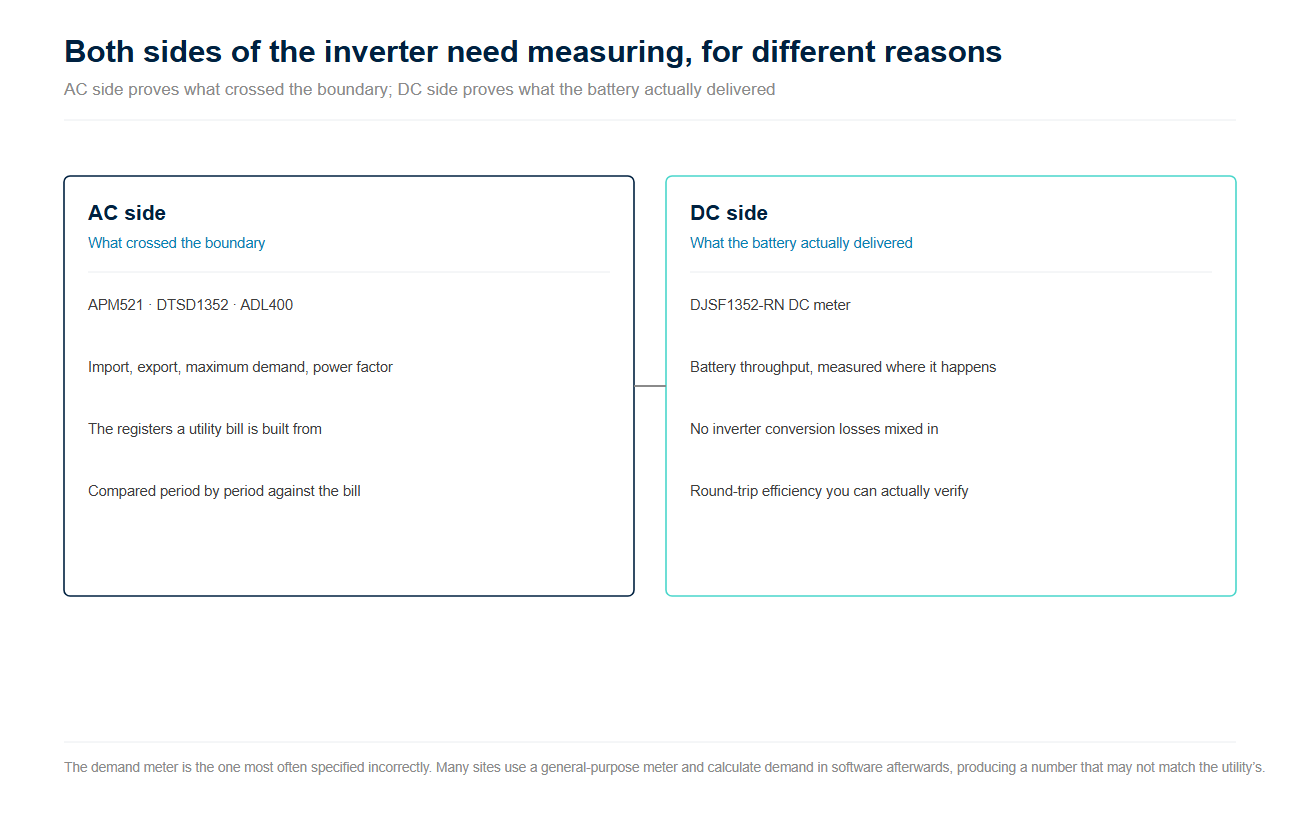
AC side
What crossed the boundary
APM521, DTSD1352 or ADL400
Import, export, maximum demand and power factor
The registers the invoice is built from
|
DC side
What the battery actually did
DJSF1352-RN DC meter
Battery throughput and round-trip efficiency
Answers: is the storage delivering the energy specified?
|
Protection, and turning the data into an answer
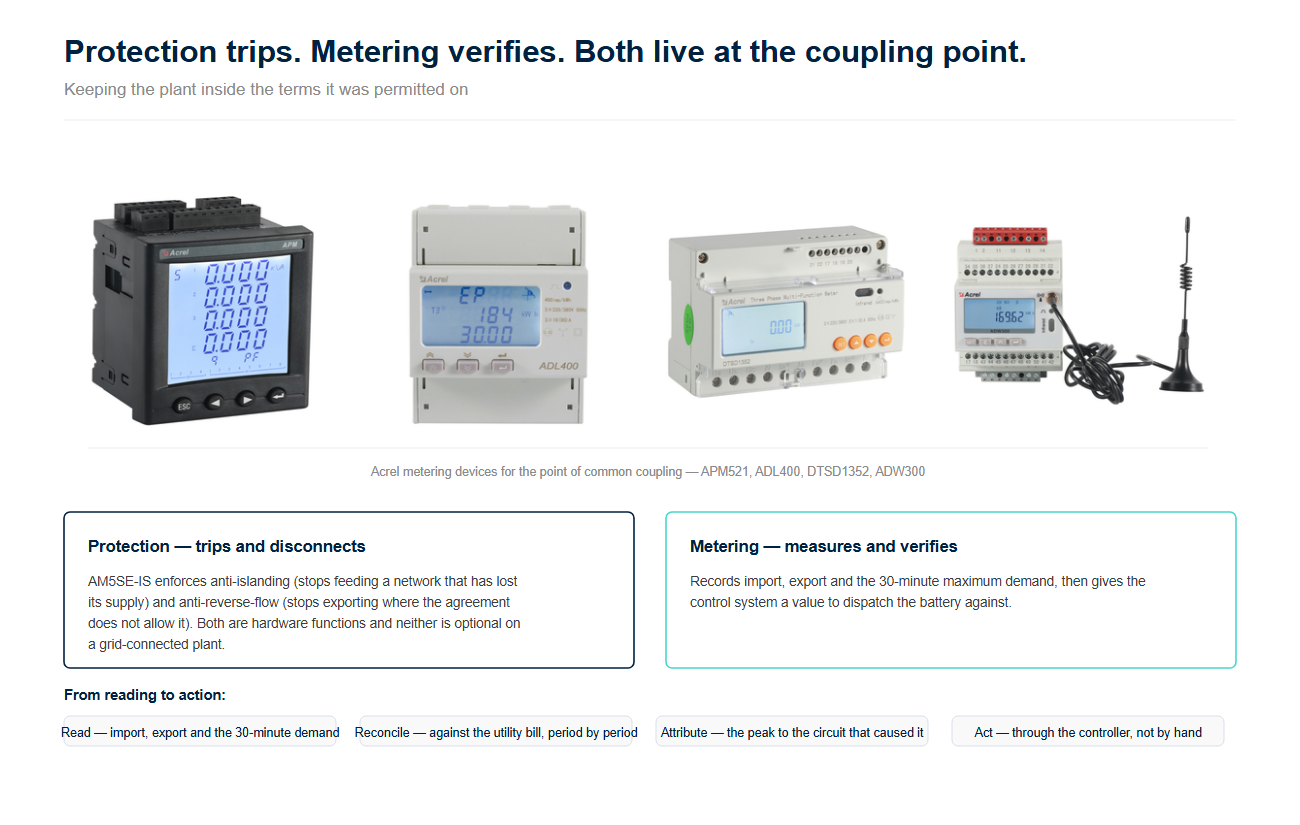
Metering and protection serve the same purpose at the coupling point: keeping the plant within the terms it was permitted on. Protection trips and disconnects — anti-islanding stops feeding a network that has lost its supply; anti-reverse-flow stops exporting where the agreement does not allow it. Both are hardware functions in the AM5SE-IS device, and neither is optional on a grid-connected plant. Metering measures and verifies — it records import, export and the 30-minute maximum demand and gives the control system a value to dispatch against.
NOT THE REVENUE METER Site meters here are for control and verification. They do not replace the utility revenue meter, and the two will not always agree to the last digit.
This article is technical information, not a commercial offer. Product descriptions are taken from Acrel published literature. Certification is held per model; confirm the applicable certificate for the model you specify. Site meters here are for control and verification and do not replace the utility revenue meter.
Post time: Oct-16-2026


