

·
Demand Management · Energy Storage
TNB’s
New Demand Charge Is Set in 30 Minutes —
Can Storage Cut It?
Since
the TNB RP4 tariff took effect on 1 July 2025, the maximum
demand on a Malaysian factory bill is no longer a single line item. It has been split into a capacity
charge and a network charge, and the number that drives both of them is the highest
30-minute average power you drew in the month. This article explains how
that number is set, why monitoring alone cannot lower it, and how a battery energy storage cabinet turns maximum
demand from something you measure into something
you control.
Why
a 30-minute window decides your whole
month
Maximum demand is not your average consumption and it is not your total kilowatt-hours.
Under the RP4 tariff it is the highest 30-minute
average power recorded anywhere in the billing month. The utility measures it on a sliding
30-minute window, which means any half hour in which several loads start together
can set the reference point for every day that follows.
The
consequence is uncomfortable: a compressor, a chiller bank and an extrusion line starting
within the same ten minutes can push the monthly peak up by 60 to
100 kW, and that single half hour is then charged for the rest of the month. Recovering the situation by hand means
interrupting production, which most plants
cannot do.
Tariff basis: TNB RP4 Revised Tariff Schedule, effective 1 July 2025, valid to
31 December 2027. Your own
account terms prevail. Verify the current schedule with TNB before making investment decisions.
Monitoring
tells you what happened. Storage changes
what happens.
A demand monitoring system is genuinely useful. It shows you the profile,
warns you before a new peak is set, and gives you the evidence
to argue about load scheduling. What it cannot do is absorb the spike. Between the moment the
meter records a rising trend and the moment a human can react, the 30-minute window has
usually already closed.
A battery
energy storage cabinet closes that loop inside the half hour. A controller compares the incoming power at the point
of common coupling against a demand threshold
and discharges the battery to hold the import below that threshold. Because the battery responds in milliseconds and the billing window
is 30 minutes long,
the correction is invisible to production.
| Comparison | Monitoring only |
Monitoring + storage |
|---|---|---|
| Lowers maximum demand |
No — records it | Yes — holds the import below a set threshold |
| Effect on production |
Requires manual load shedding | None — the battery absorbs the difference |
| Additional revenue |
None | Peak / off-peak arbitrage, PV self-consumption |
| Transformer relief |
Visibility only | Defers or avoids a transformer upgrade |
| Typical first step |
Meter at the incoming supply | Meter plus storage cabinet and controller |
Three control strategies
that actually get used
Demand management is not one algorithm. In practice Malaysian installations use one of three, or
a combination, depending on how predictable the load
is.
discharge
during the peak window
Between 14:00 and 22:00 the battery discharges at a fixed power,
cutting the incoming supply by a known
amount. Outside the peak window it recharges freely, limited by transformer capacity. Simple, predictable, and well
suited to plants with a flat load curve.
control
A demand target is set and the controller compares it with the live power at the point of
common coupling. Whenever the import
rises above the target, the battery discharges just enough to hold the line. The threshold itself can be fixed by the
operator, updated automatically as a higher peak appears during
the month, or refreshed from a forecast that combines weather and the production plan.
03
or
charge-discharge during peak
Discharging only during the peak window protects battery life but limits
how much peak the system
can cover. Allowing the battery to recharge in the gaps between peaks keeps more headroom available, at the cost of additional cycles.
The choice is a commercial decision, not a technical
one, and it should be made with the site owner.
What goes in the equipment
room
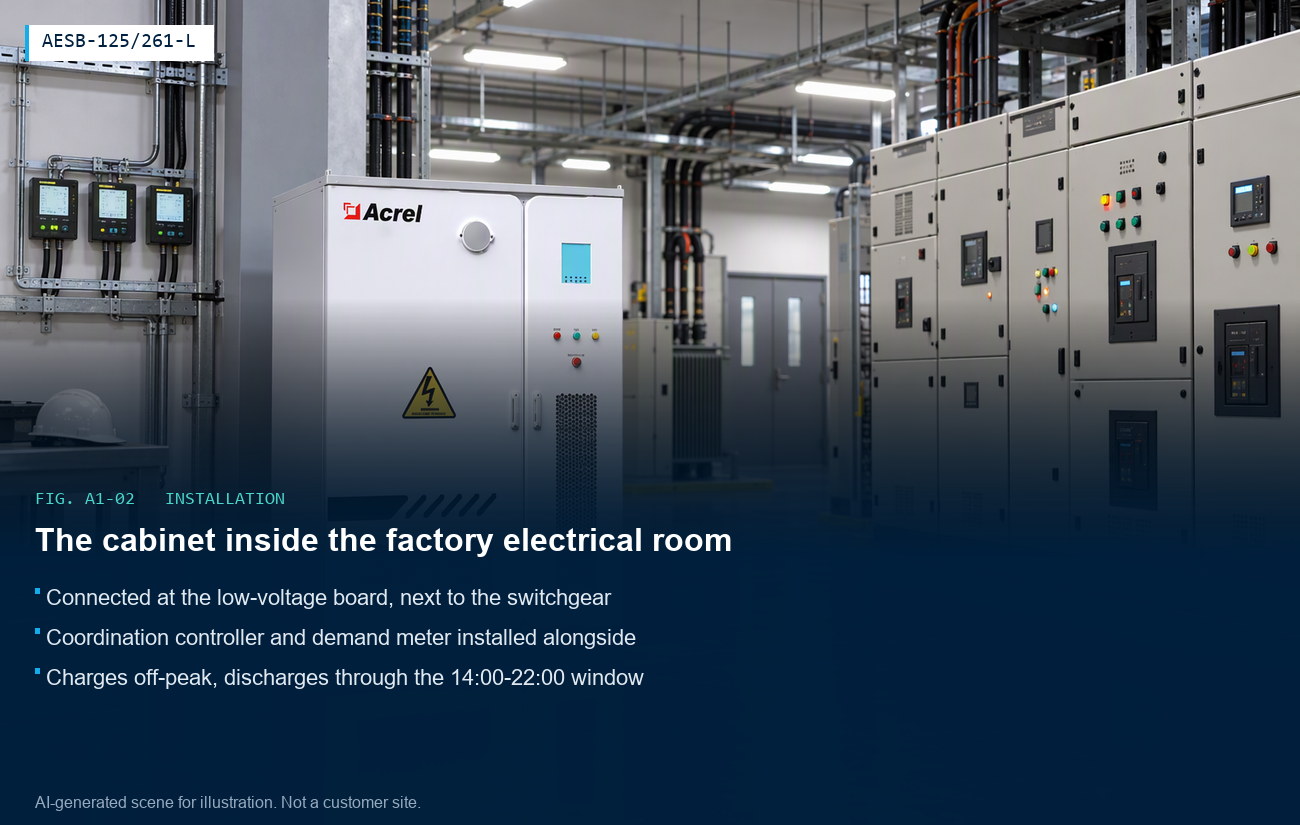
A demand management installation is four things: a storage cabinet, a controller that decides, a meter that measures,
and a platform that records. The table
below lists the hardware used in Acrel demand management projects in Malaysia and how each part is used.
| Role | Model | What it does here |
|---|---|---|
| Storage cabinet |
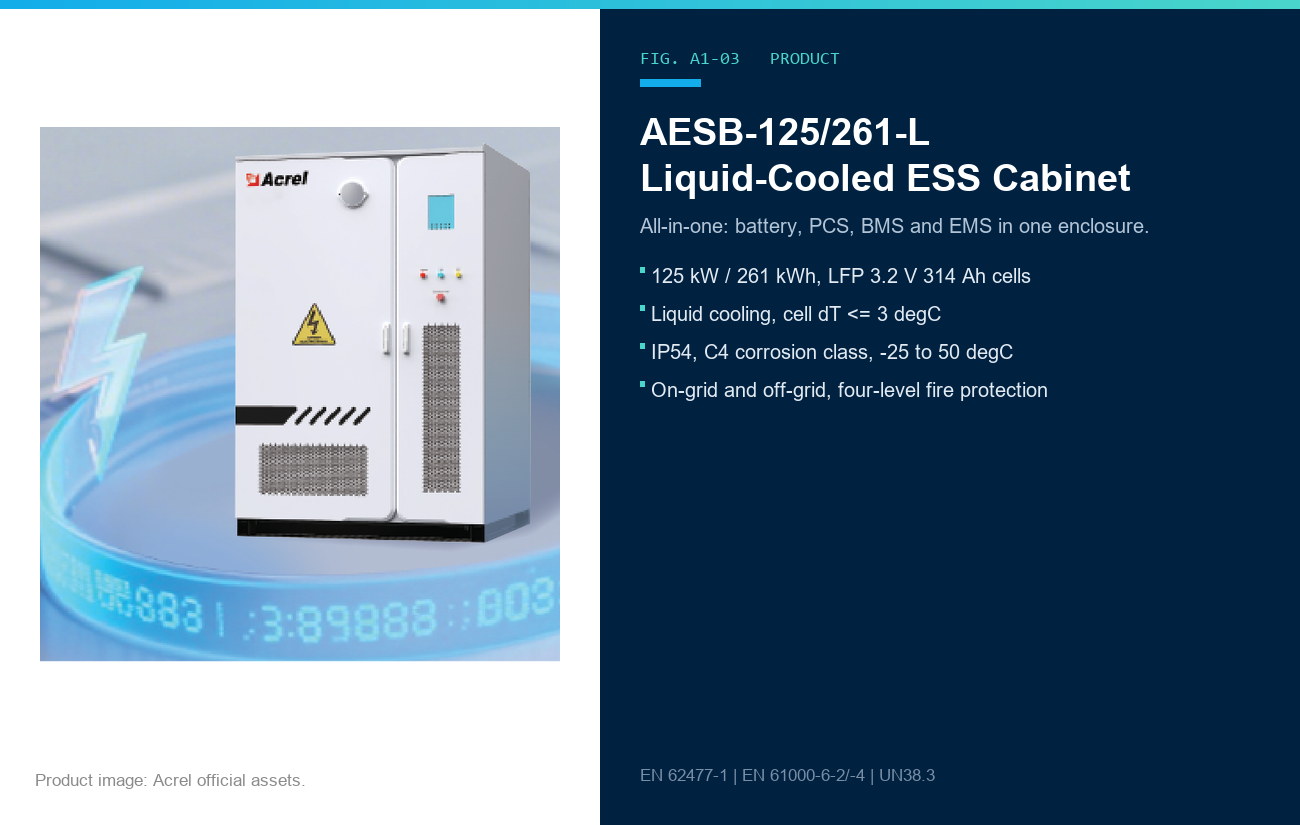
AESB-125/261-L | 125 kW / 261 kWh, liquid cooled, all-in-one cabinet with battery, PCS, BMS and EMS |
| Coordination controller |
ACCU series | Runs the demand strategy locally and issues charge / discharge commands |
| Energy management |
Acrel-2000MG | Site-level monitoring and control of PV, storage, loads and protection devices |
| Demand metering |
APM521 (Malaysia demand version) |
Calculates and iterates the 30-minute demand value at the incoming supply |
| Distribution metering |
DTSD1352,ADL400,ADW300 | Feeder and sub-circuit measurement, including wireless points where cabling is impractical |
| Platform | AcrelEMS 3.0 |
Daily and monthly demand analysis, control results, reporting |
The AESB-125/261-L cabinet carries EN 62477-1, EN 61000-6-2 / -4 and UN38.3. It
is a liquid-cooled cabinet with a cell-to-cell temperature
difference of 3 °C or less, IP54 enclosure with C4 corrosion class, and a four-level fire protection
design covering detection, aerosol suppression, explosion venting and water
fire fighting. For Malaysia specifically, confirm any additional local approval
requirements with the utility and with Acrel before specifying.
What the saving looks
like on a real profile
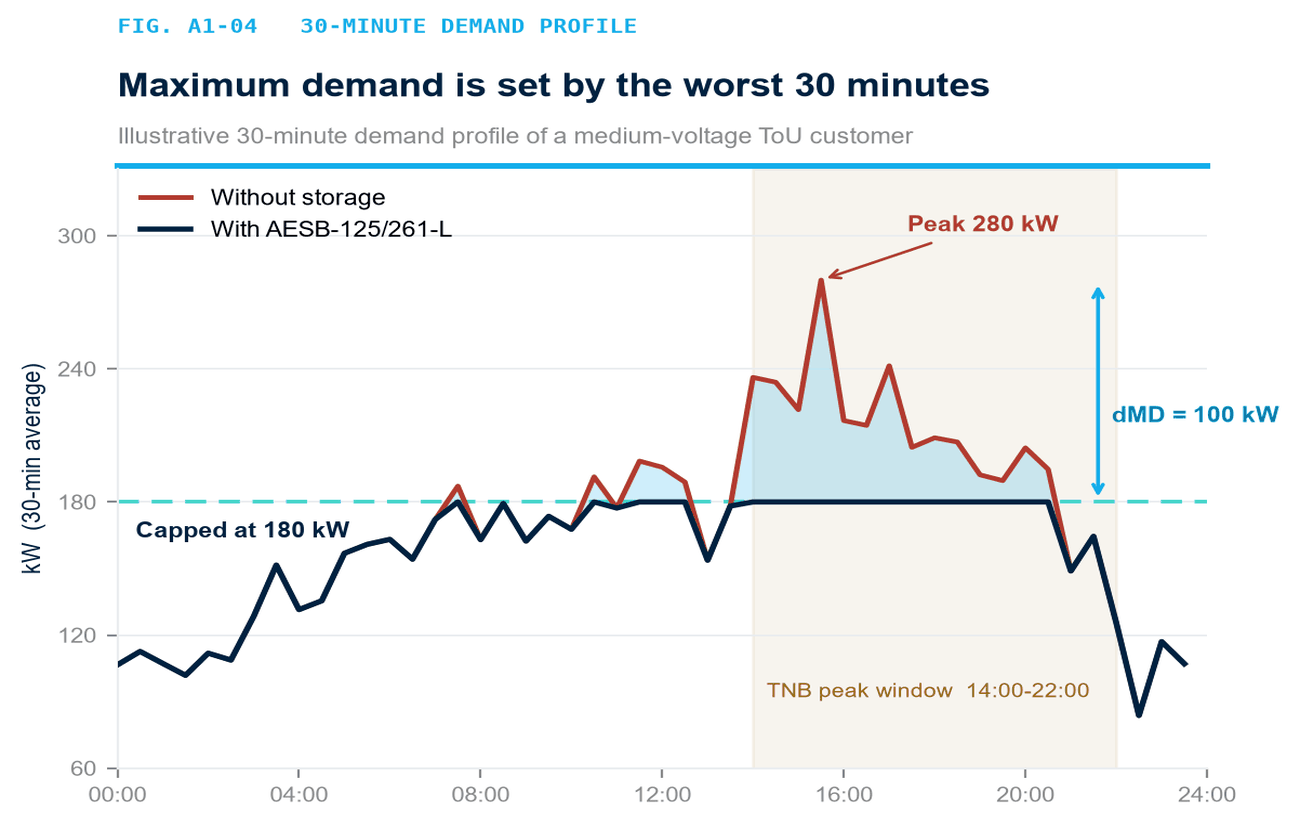
Take a medium-voltage ToU customer with a maximum demand of roughly 280 kW before any control is
applied. A 125 kW / 261 kWh cabinet running a threshold
strategy holds the import at about 180 kW. The reduction in maximum demand is 100 kW.
At
RM97.06 per kW per month, 100 kW of avoided demand is approximately
RM9,706 per month, or RM116,472 a year before operating cost. Deduct
an indicative RM8,000 a year for maintenance and the system’s own consumption, and the net figure
is around RM108,472. Against an indicative capital cost
of RM420,000 for the system and its installation, the simple payback is approximately 3.9 years. Discounting
the cash flows at 8 per cent
extends that to roughly 4.9 years.
These figures are an illustrative example based on current TNB tariff values and a specific
installed
capacity. Your result depends on the site load curve, the historical maximum demand record, the installed capacity you choose, the operating strategy, and
any future tariff
revision. They are not a quotation.
How
the result is proved
A demand management project is only as good as its evidence. The metering at the point of common coupling
records the actual 30-minute demand for every window
of the month, and the platform stores both the recorded demand and the amount the control system removed.
That comparison is what you show the finance team, and it is also what tells
you whether the threshold should be tightened.
A
practical note on measurement boundaries: the meter installed on site is a control and verification
instrument. It does not replace the utility’s own revenue
meter, and the two will not read identically because the measurement points and the utility’s averaging method may differ slightly.
Always reconcile against
the TNB bill, not against your own meter alone.
Frequently asked questions
The starting point is the difference between your current maximum demand and the target you want to hold.
That difference, in kW, is
the power the battery has to supply during the peak window. The energy rating follows from how long the peak lasts on your own
load curve. A load survey and at least three months of
half-hourly data are needed before a number can be quoted.
run out during a long peak?
This is the sizing question, and it is answered with the site’s own historical
peak duration. A threshold strategy with automatic recharge
during the gaps between peaks keeps more headroom available than a simple fixed-power discharge,
and it is the usual choice where the peak window is long.
solar?
Yes, and it is often the strongest configuration. During the day the PV reduces the import directly. In
the late afternoon,
when PV output falls away but production is still running, the battery covers the rise instead of the grid. The controller coordinates
both so that the site never exceeds the threshold.
to be installed outdoors?
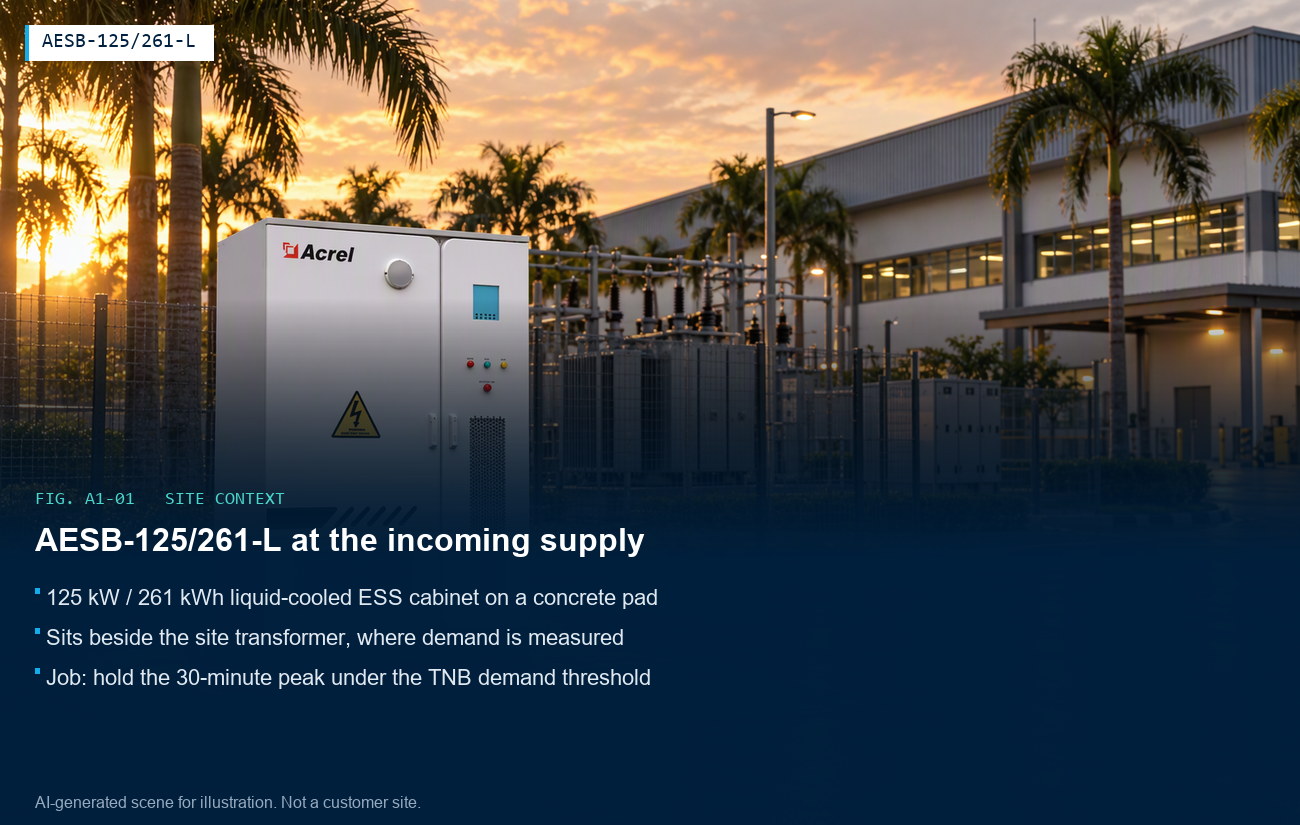
The AESB-125/261-L is an outdoor cabinet with IP54 protection and C4 corrosion class, so it can be
installed
on a concrete pad near the switchroom. It occupies approximately 2 square metres. Indoor installation is also possible where space and ventilation allow.
during a grid outage?
The cabinet supports both on-grid and off-grid operation. With an appropriate
changeover arrangement it can continue supplying
critical loads when the grid is lost. Whether that is worth the additional switchgear depends on how critical
the load is and should be decided during the design stage.
The published brochure lists EN 62477-1, EN 61000-6-2 / -4 and UN38.3 for the AESB-125/261-L. Requirements
specific to Malaysia,
including any local utility or standards approval, should be confirmed with Acrel before the specification is frozen.
installation take?
The cabinet arrives as a single integrated unit, which removes most of the on-site
assembly. Site works are the pad, the cabling
between the cabinet and the point of common coupling, the controller and metering installation, and commissioning.
The programme depends on the site, the extent of the metering, and
whether the connection requires a shutdown.
figure guaranteed?
No. The payback
depends on your own load curve, your historical maximum demand,
the installed capacity and the tariff that applies. Any figure quoted before a site survey is an indication for planning,
not a commitment.
reading
step
demand data.
With your half-hourly maximum demand
record, your tariff category and your installed
transformer capacity, we can size a storage cabinet and a control threshold against your own profile, and
return a technical confirmation with capacity, threshold and an indicative
payback range.
This article is technical information, not a commercial
offer. Tariff values
refer to the TNB RP4 Revised Tariff Schedule effective 1 July 2025 and should be verified against your own account terms. Energy and
cost figures shown are illustrative examples. Product
specifications are taken from Acrel published literature; confirm the current specification and certification
status for your project with Acrel before purchase. Local approval requirements
in Malaysia should be confirmed with the relevant authority.
Post time: Oct-12-2026


