

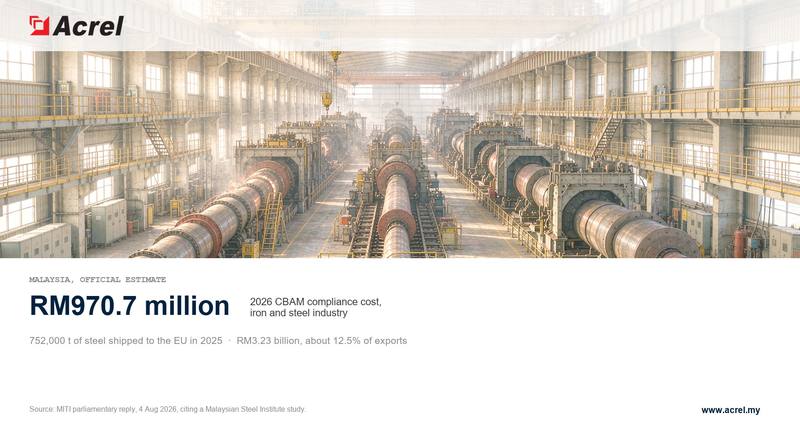
Malaysia now has an official number for CBAM. In a parliamentary reply published on 4 August 2026, the Ministry of Investment, Trade and Industry put the 2026 compliance cost for the country’s iron and steel industry at RM970.7 million, citing a Malaysian Steel Institute study. The year before, Malaysia shipped about 752,000 tonnes of steel to the European Union, worth RM3.23 billion — roughly an eighth of everything the sector exported.
Here is the part that catches most plant managers out. That bill is not calculated on your electricity. For iron and steel, aluminium, hydrogen and electricity, CBAM declares direct emissions only. The power your furnace draws does not enter the certificate calculation at all.
It will still be asked for.
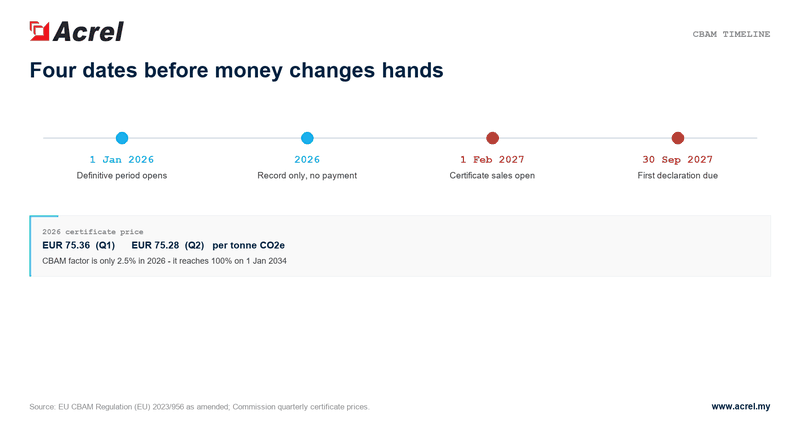
Four dates, and none of them is sailing day
The definitive period opened on 1 January 2026. Since then, EU importers of CBAM goods have been recording embedded emissions quarter by quarter. No money changes hands in 2026: certificate sales do not start until 1 February 2027, on the Common Central Platform. The first annual declaration, covering calendar 2026 imports, is due by 30 September 2027.
The certificate price tracks the EU ETS auction average. The Commission published €75.36 per tonne of CO2e for the first quarter of 2026 and €75.28 for the second; from 2027 the price moves to a weekly average. There is also a platform fee of €0.05 per certificate bought.
What keeps the 2026 bill small is not the price. It is the CBAM factor. Free allocation under the EU ETS still covers 97.5 per cent of the domestic equivalent this year, so only 2.5 per cent of the embedded emissions is actually charged. That factor rises to 48.5 per cent by 2030, and reaches 100 per cent on 1 January 2034. Any exporter reading the 2026 number as the size of the problem is reading the first step of a curve.
A useful way to read that last figure. At published 2026 prices, 752,000 tonnes of blast-furnace steel would carry a certificate bill in the low millions of euro — so the RM970.7 million estimate is mostly monitoring, reporting, verification and the decarbonisation spending behind them. The data work is the expensive part, not the paperwork.
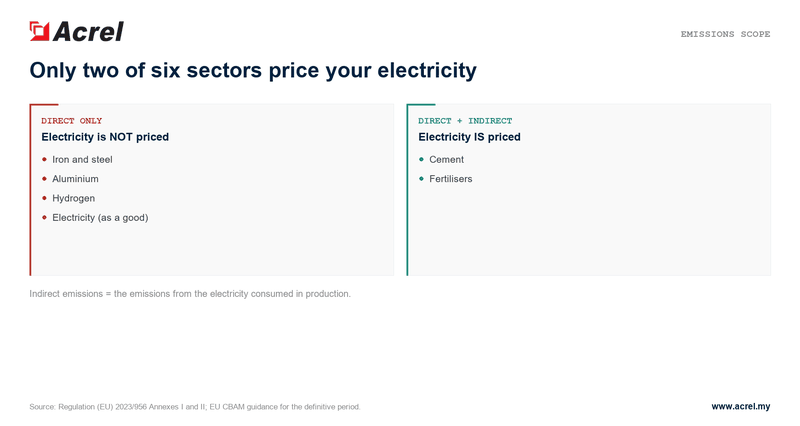
CBAM splits emissions in two, and the split decides whose electricity matters
Direct emissions come from the production process itself: fuel burned inside the installation, process emissions, purchased heat and cooling, and the embedded emissions of any CBAM precursor that went into the product. Indirect emissions are the emissions from the electricity consumed in production.
Only two of the six covered sectors pay for both.
Two consequences are worth writing down before anyone specifies equipment. The first is that a Malaysian steel plant’s own power consumption is not in its CBAM certificate obligation. The same is true for aluminium, which sits in Annex II of the regulation — so Press Metal’s hydropower advantage in Sarawak, however large in reality, currently produces no benefit inside the aluminium CBAM calculation.
The second is that the production route decides how much of this touches you at all. Steel Industry Roadmap 2035 gives representative intensities of about 2.33 tCO2 per tonne for the blast furnace and basic oxygen furnace route and about 0.68 for the electric arc furnace. Malaysia produced steel entirely through electric arc furnaces until 2014; by 2022, blast furnaces accounted for roughly 72 per cent of output. Since September 2025 the roadmap has barred new BF/BOF plants, so the installed mix is now the one the sector will live with.
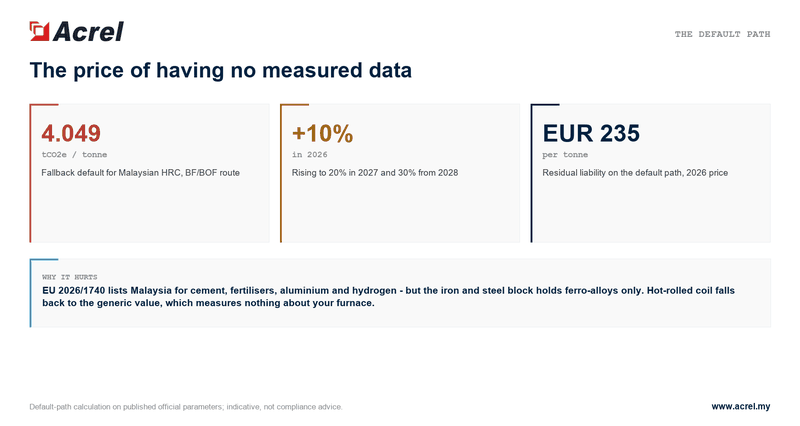
The expensive mistake is not mis-reporting. It is not reporting
A declarant may declare either verified actual emissions or default values. Defaults carry a mark-up: 10 per cent in 2026, 20 per cent in 2027, 30 per cent from 2028.
For Malaysia the default path is unusually punitive, and the reason is narrow enough to be missed. Implementing Regulation (EU) 2026/1740 lists Malaysia in its country-specific default tables for cement, fertilisers, aluminium and hydrogen — but the iron and steel block contains ferro-alloys only. Malaysian hot-rolled coil declared on defaults therefore falls back to the "other countries and territories" value of 4.049 tCO2e per tonne on a BF/BOF benchmark route, before the 10 per cent mark-up.
Run those official parameters through a default-path calculation and the residual liability lands at roughly 3.1 tCO2e per tonne of coil in 2026 — about €235 a tonne at the first-quarter certificate price. That number measures nothing about how clean your furnace is. It is the price of having no measured data to hand over.
Getting off the default path takes one thing: installation-level data a verifier will accept, with the raw records behind it and a reporting period that can be reconstructed. That is a metering question before it is a reporting question.
Three parties will ask, and none of them is the certificate
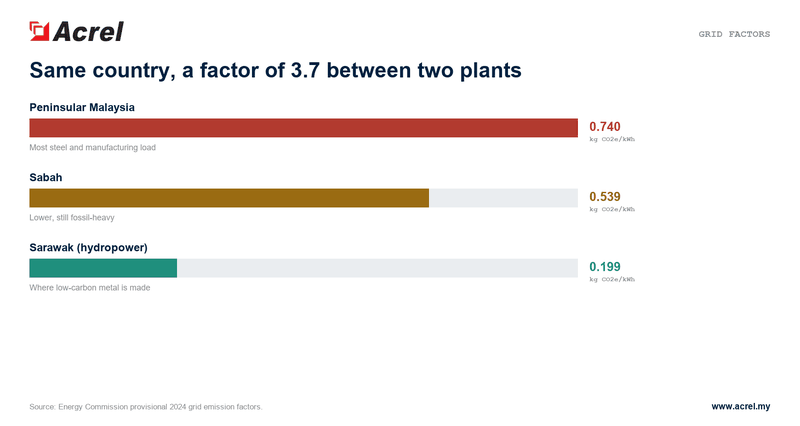
Which factor your buyer applies to your product depends on what you can prove about where your power came from, and when. That proof is a metered, time-stamped record — not a statement.
Where the meters go
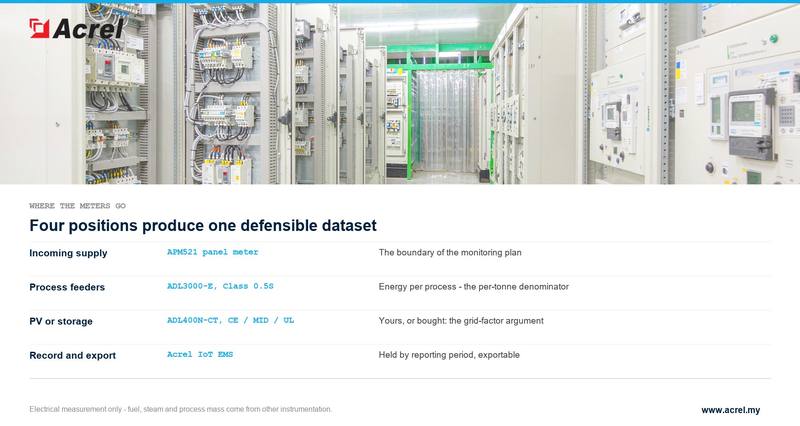
Every filing above needs the same shape of number: energy per process, over a defined period, traceable to a reading. Four metering positions produce it.
The ADL3000-E is a DIN-rail three-phase meter for low-voltage distribution: active energy Class 0.5S, reactive Class 2, voltage and current harmonics from the 2nd to the 31st, four tariff rates, frozen data, and RS485 Modbus-RTU into the EMS or SCADA you already run. It is the part that turns a plant total into a per-line number.
The ADL400N-CT covers the position that decides the grid-factor argument. It measures forward and reverse active and reactive energy through split-core coils — 80 A, 120 A, 200 A or 300 A — on a 35 mm rail, with CE, MID, UL and RoHS behind it. Where a plant has its own generation, that bidirectional record is what separates self-generated kilowatt-hours from purchased ones.
One boundary worth stating plainly. We do electrical measurement. Fuel, steam and process-mass data — the inputs that carry most of a blast furnace’s direct emissions — come from instrumentation we do not make, and a CBAM monitoring plan needs those too. What sub-metering supplies is the electricity half, and the platform to hold it next to whatever else your verifier asks for.
What to do before February 2027
Questions we are asked
Post time: Sep-30-2026


