

An EECA Audit Notice Arrived. What to Do in the Next 90 Days
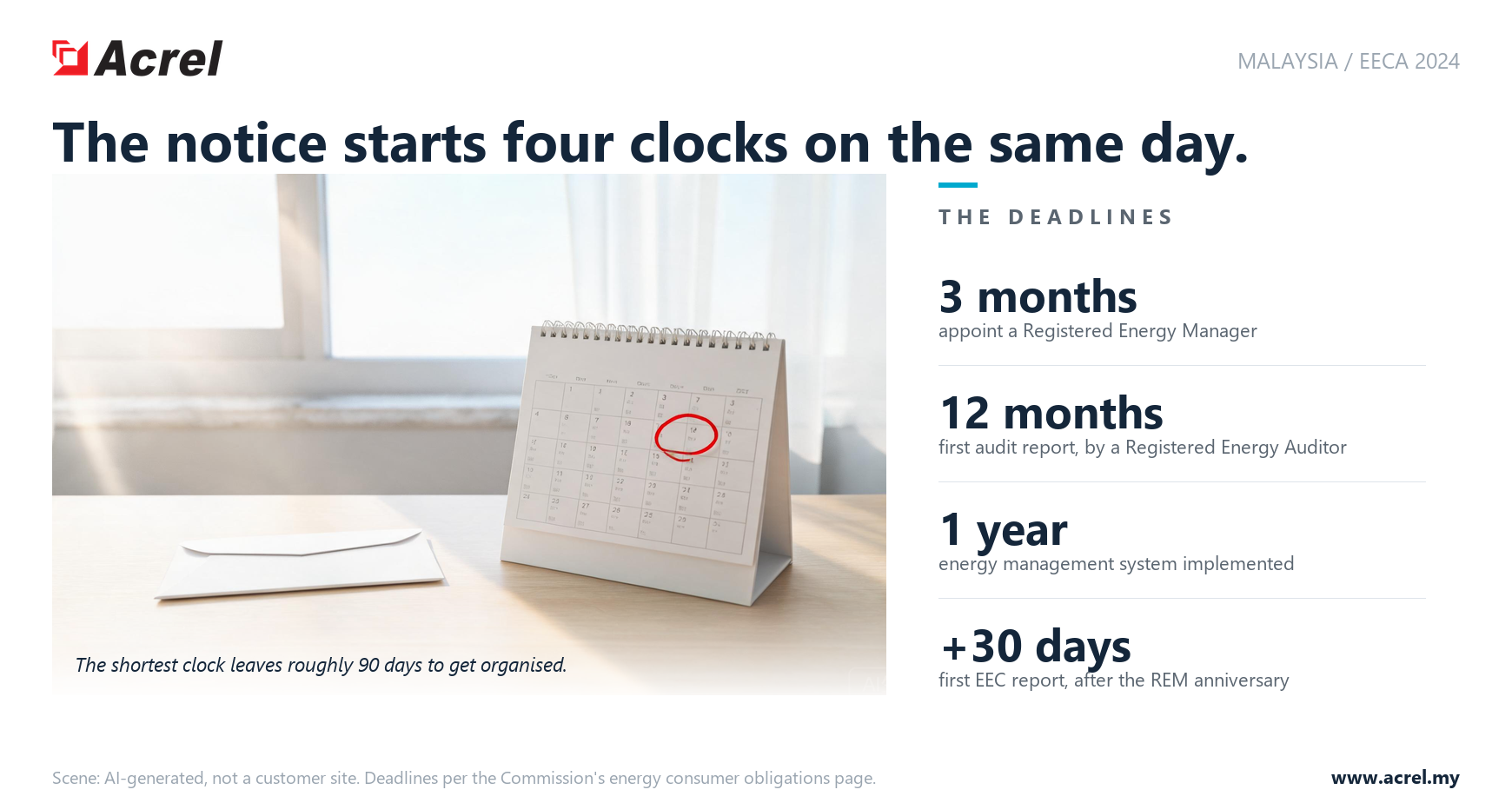
A registered energy manager within three months. A first audit report within twelve. The Energy Commission’s notice starts several clocks on the same day, and the shortest one leaves a factory roughly 90 days to get organised. Here is what those 90 days should contain.
The clock in the notice
The four deadlines inside an EECA notice
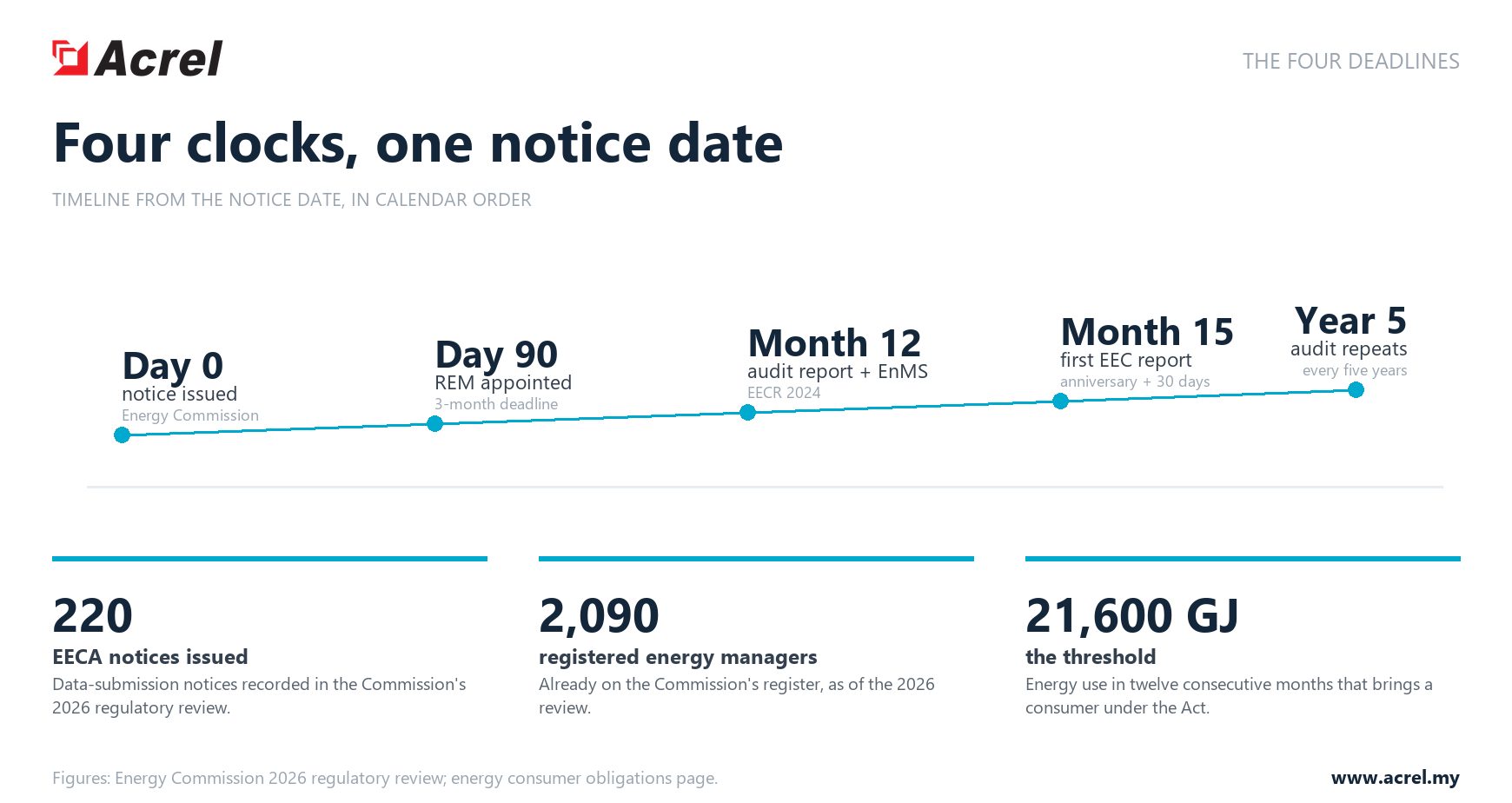
Under the Energy Efficiency and Conservation Act 2024 (Act 861) and the Energy Efficiency and Conservation Regulations 2024 [P.U.(A) 466/2024], in force since 1 January 2025, an energy consumer whose usage reaches 21,600 GJ in any twelve consecutive months – around 6,000,000 kWh of electricity – has four standing obligations once the Energy Commission issues a notice. The Act applies in Peninsular Malaysia and Labuan; EMEER 2008 was repealed the same day.
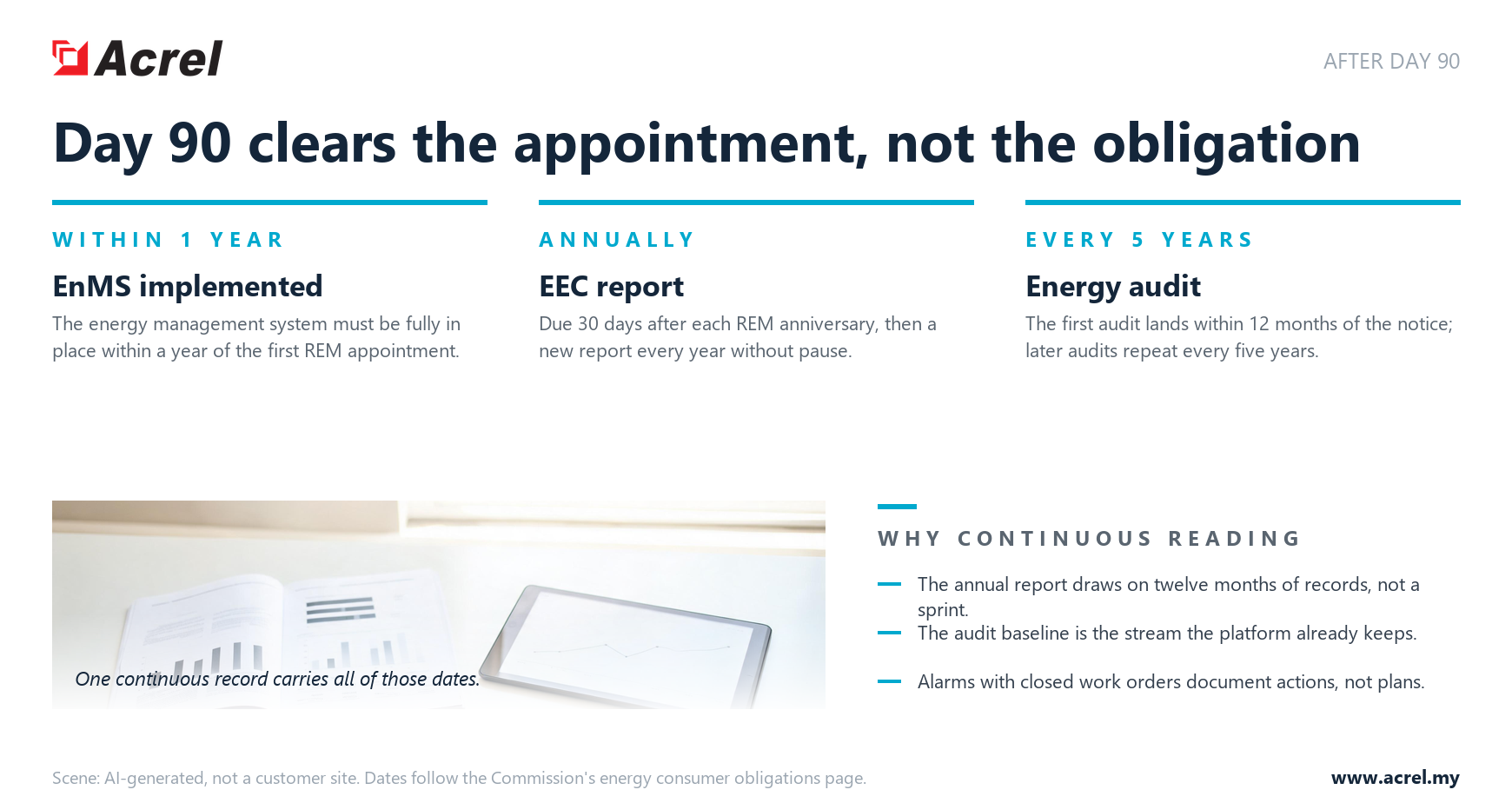
First, appoint a Registered Energy Manager (REM) within three months of the notice, under Regulations 4 to 6 of the EECR 2024. Second, develop and implement an energy management system (EnMS) within one year of the first REM appointment, following the Commission’s EnMS guideline. Third, submit the first Energy Efficiency and Conservation report within 30 days after the first anniversary of the REM appointment, and a new report every year after that. Fourth, appoint a Registered Energy Auditor (REA) and submit the first audit report within 12 months of the notice; later audits repeat every five years.
This is no longer theoretical. The Commission issued its Guide on Registration of Energy Manager on 15 September 2026, after the energy auditor registration guide on 4 August, and its 2026 regulatory review records 220 energy data submission notices already issued and 2,090 registered energy managers. Dates above follow the Commission’s energy consumer obligations page ↗.
Days 1 to 30
Confirm the scope and appoint the REM
The first month is paperwork, and it is where sites lose the most time.
Verify the notice first: confirm it is an energy consumer notice under EECA 2024 and log the issue date, from which every later deadline runs. Scope questions go to enc@st.gov.my, the Commission’s energy consumer mailbox.
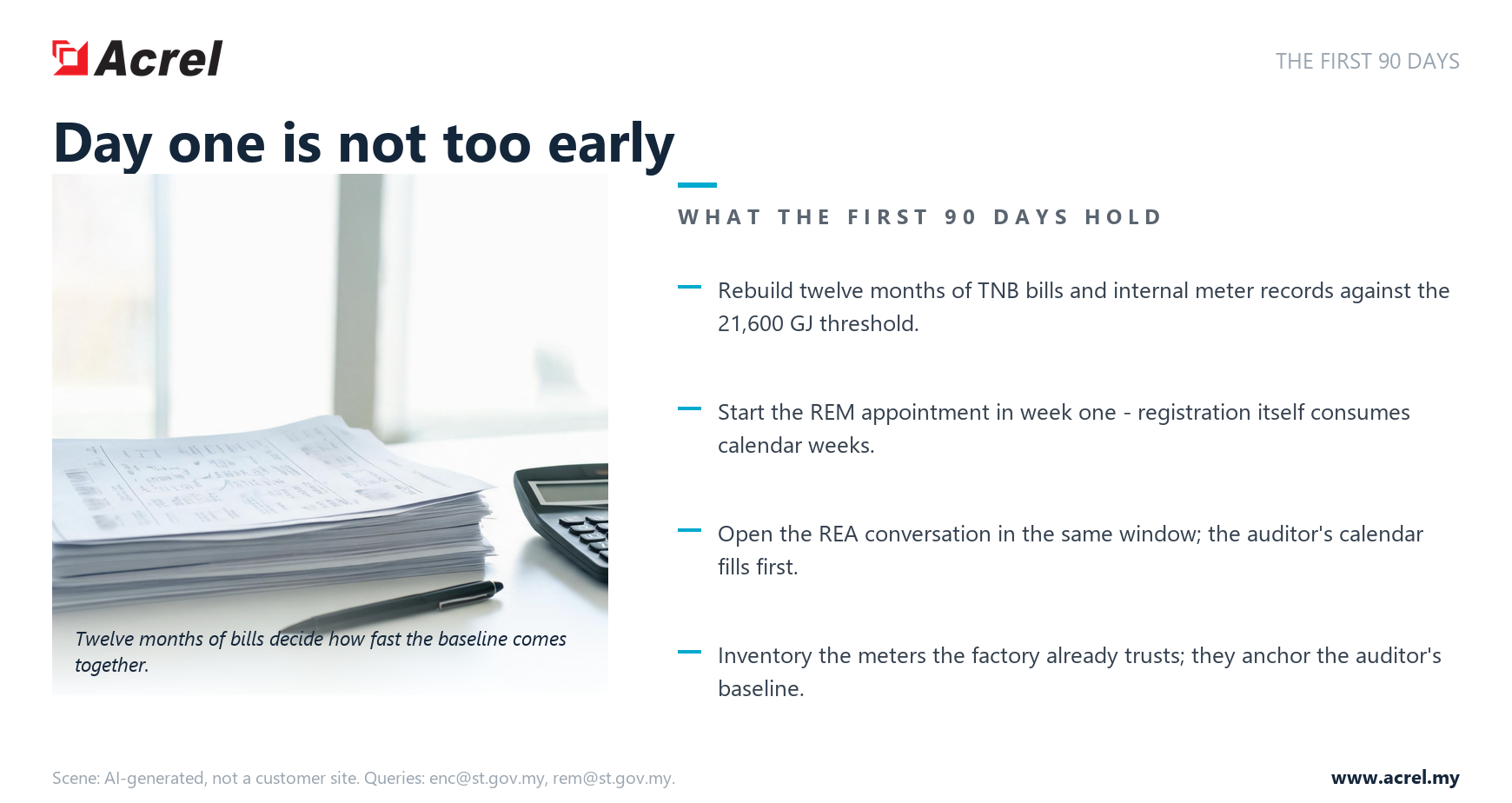
Then reconstruct twelve months of use from TNB bills and any internal meter records, to confirm the site against 21,600 GJ and sketch the auditor’s baseline.
Start the REM appointment in the same week. The manager must be registered with the Commission and hold a valid practising certificate; the September 2026 guide ↗ sets out the route, and rem@st.gov.my handles registration queries. Registration itself consumes calendar weeks, so day one is not too early. Open the REA conversation in the same window: the 12-month deadline is the auditor’s, but their calendar fills first.
enc@st.gov.my
Energy consumer notices
rem@st.gov.my
REM registration
rea@st.gov.my
REA registration
Days 31 to 60
Put the measurement layer in place
Audit and annual report both need records a monthly bill cannot produce: branch consumption, time-stamped demand and a continuous baseline. Commission the measurement layer in month two, so records exist before the EnMS paperwork starts.
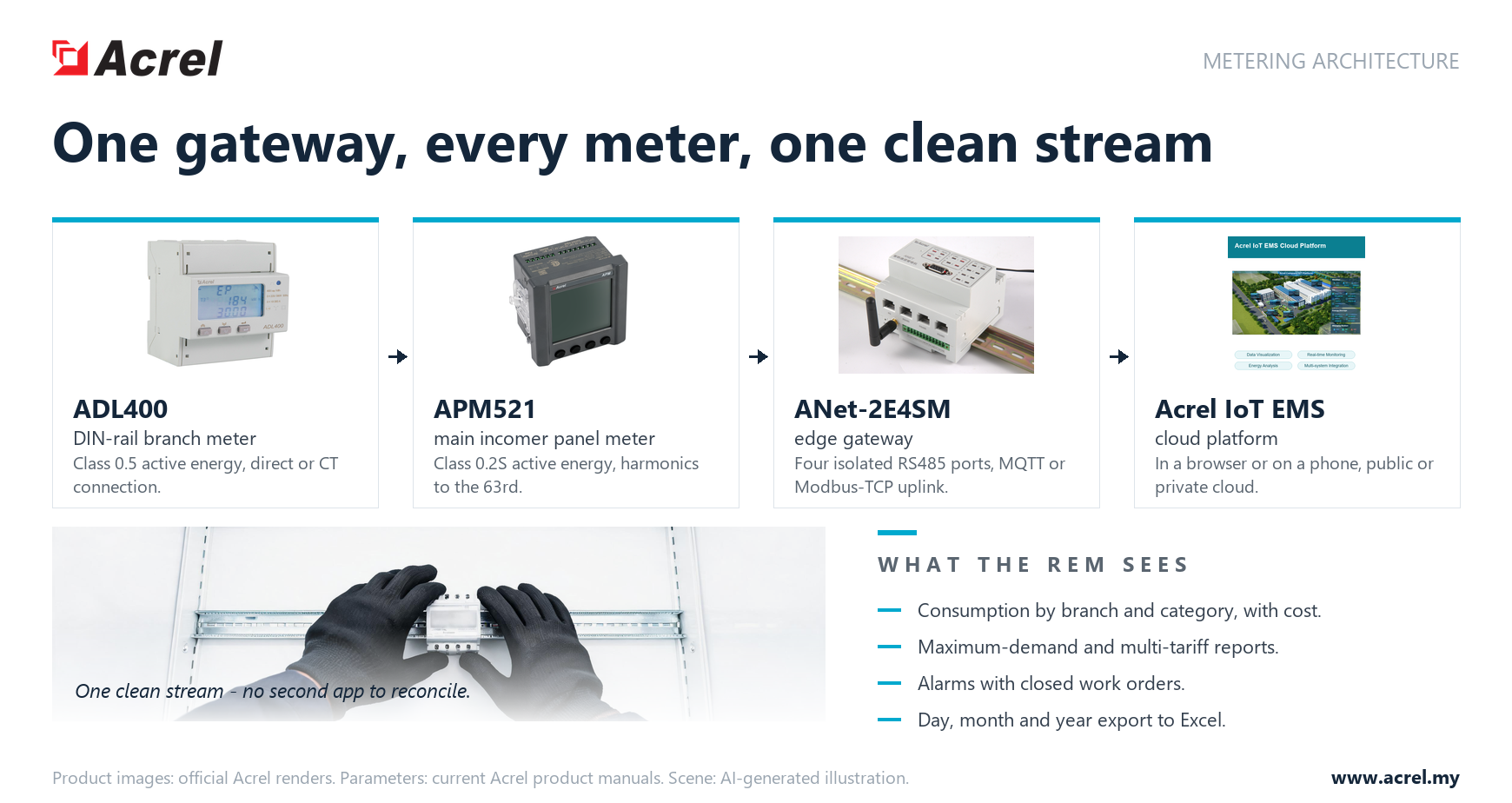
At the main incomer, the APM521 ↗ panel meter measures active energy to Class 0.2S and the full electrical parameters to within 0.2%, with 2nd to 63rd harmonics, up to 128 event and alarm records, RS485 Modbus-RTU and optional Ethernet Modbus-TCP, designed to IEC 61010-1.
On branch feeders, ADL400 ↗ DIN-rail meters deliver Class 0.5 active energy, direct connection up to 80 A or CT connection, harmonics to the 31st order, 48 months of frozen history and RS485 Modbus-RTU, CE-compliant.
At the edge, the ANet-2E4SM ↗ smart gateway polls the meter rows through four isolated RS485 ports and two Ethernet ports, covering about 36,000 data points, with Modbus, IEC 104, OPC UA and BACnet southbound, MQTT or Modbus-TCP uplink, edge summation, local storage when the network drops and an optional global 4G module.
Up on the Acrel IoT EMS ↗ platform, the REM gets consumption by branch and category, cost and maximum-demand reports, multi-tariff statistics, alarms with work-order closure, and day, month and year export to Excel, in a browser or on a phone, on public or private cloud. The gateway polls meters the factory already trusts, buffers locally and pushes one clean stream – no second app to reconcile.
Days 61 to 90
Wire the records into the EnMS
The EnMS guideline asks for significant energy uses, a baseline, objectives and documented corrective actions, and the platform records map onto each of them.
Branch and category consumption with cost reports becomes the significant-energy-use register and the consumption-by-period table in the annual EEC report. The exported time series becomes the auditor’s twelve-month baseline. Alarms with closed work orders document corrective actions, not just plans. Maximum-demand and capacity reports support the same conversation as the demand line on the TNB bill ↗.
By day 90 the REM should hold four things: a named register of metering points, the platform collecting at fixed intervals, one annual-format report exported as a dry run, and an REA briefed on the data layout. Submission through the Commission’s EMIS channel stays the REM’s job: the software produces the records, it does not file them.
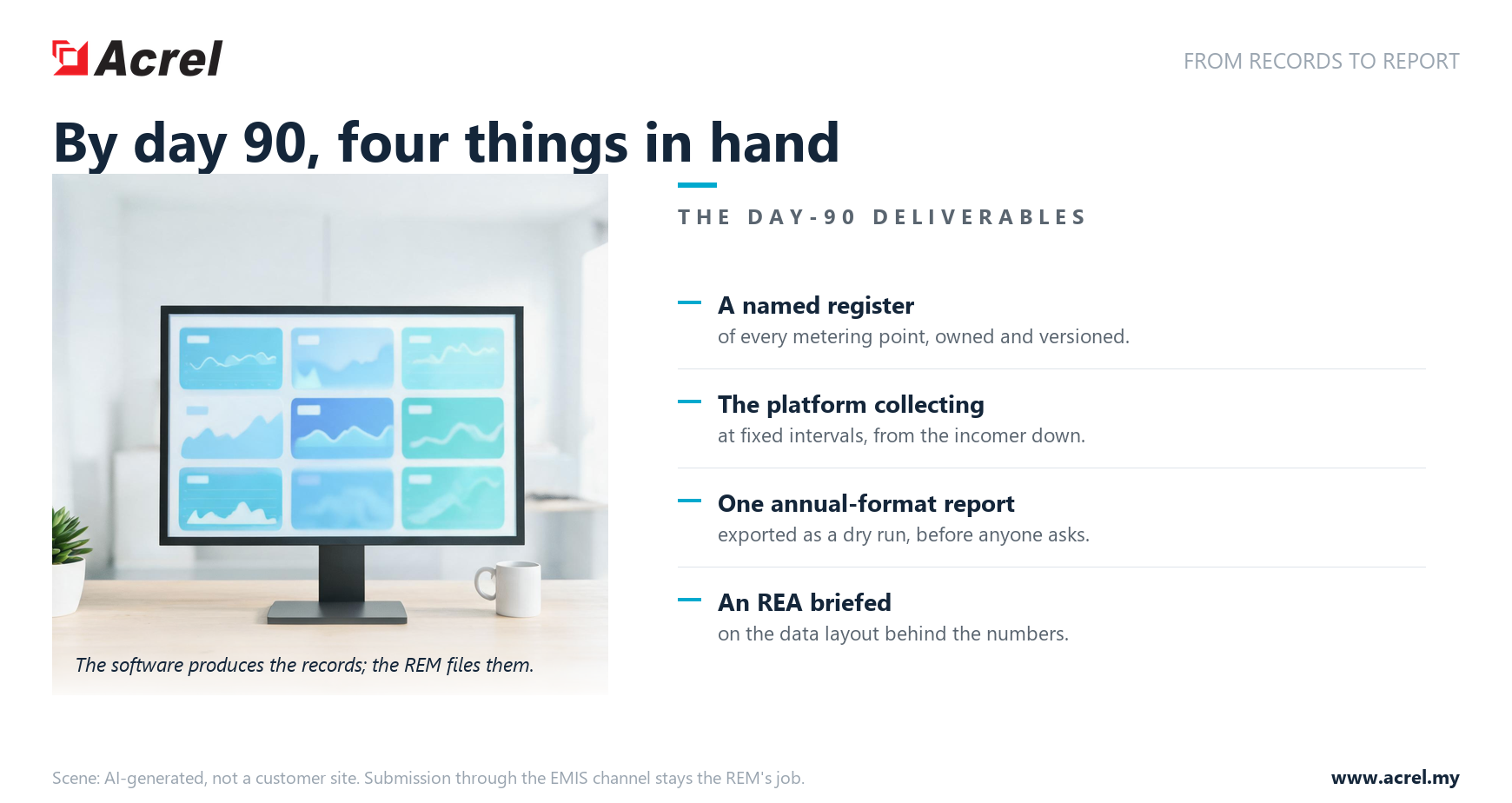
The REM submits to the Energy Management Information System; the platform only supplies the export.
emisadmin@st.gov.my
EMIS queries
After day 90
Keep the record running to the five-year audit
The 90-day sprint only clears the appointment. The EnMS must be fully implemented within the year, the first EEC report is due 30 days after the REM anniversary, and the first audit report lands within 12 months of the notice. After that, audits return every five years while the annual reporting never pauses.
A metering layer installed once and read continuously carries all of those dates. Why a snapshot is not enough between those visits is covered in our note on continuous monitoring between energy audits ↗.
Send us three numbers
Send the notice date, the incoming supply rating and the number of branch circuits you want metered. We come back with a meter list, the gateway layout and the IoT EMS configuration for the EEC cycle.
Post time: Oct-09-2026


