

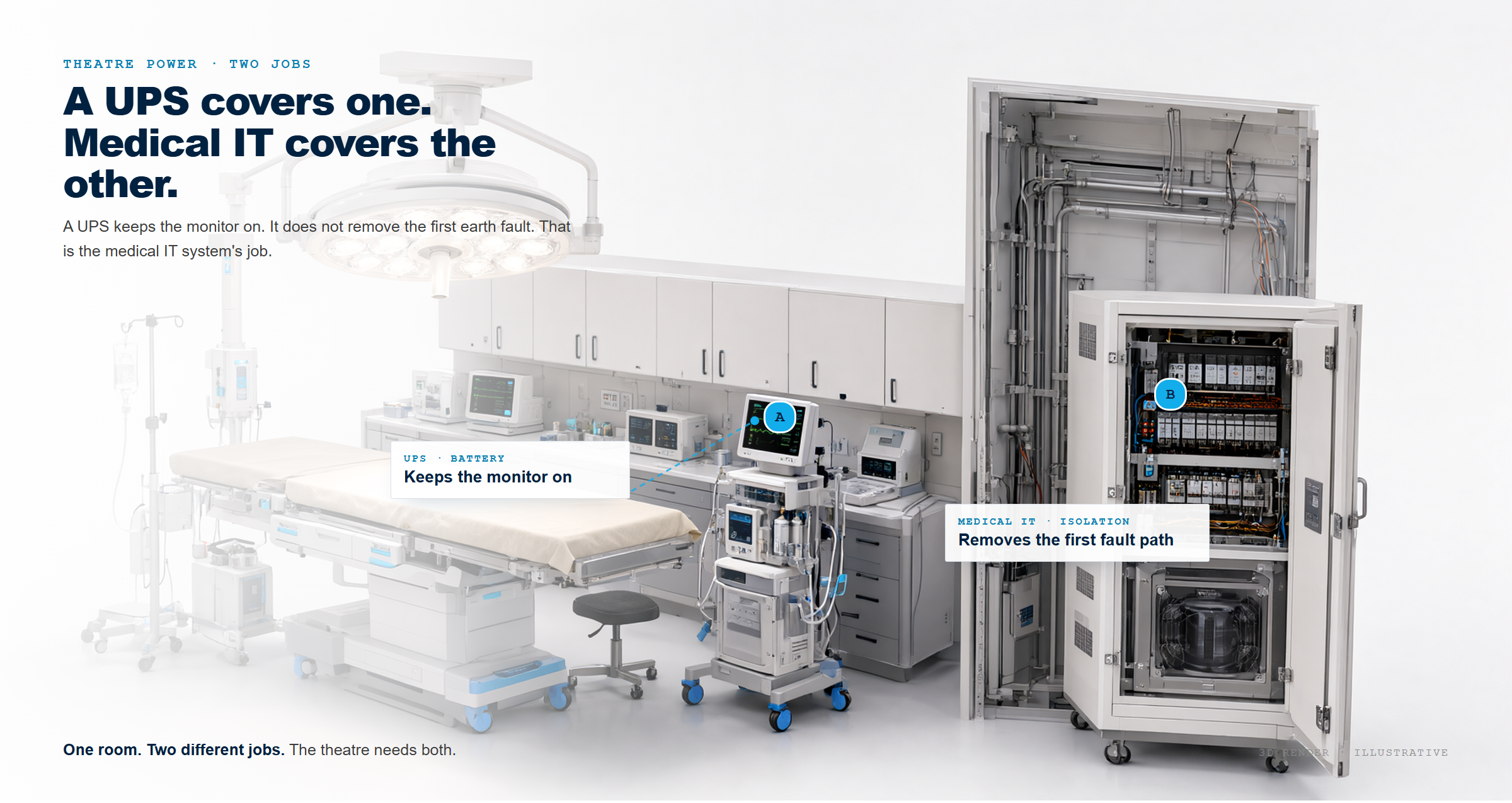
A UPS covers a power cut. It does not clear a first earth fault. In an operating theatre, those are two different jobs.
Two failures, one room
Hospitals plan for outages: generator, UPS, transfer switch. An operating theatre has a second failure mode. A damaged cable or a wet socket can put a small current through the patient. On a TN system the first earth fault trips the breaker, and the theatre goes dark mid-procedure.
The first fault becomes an alarm
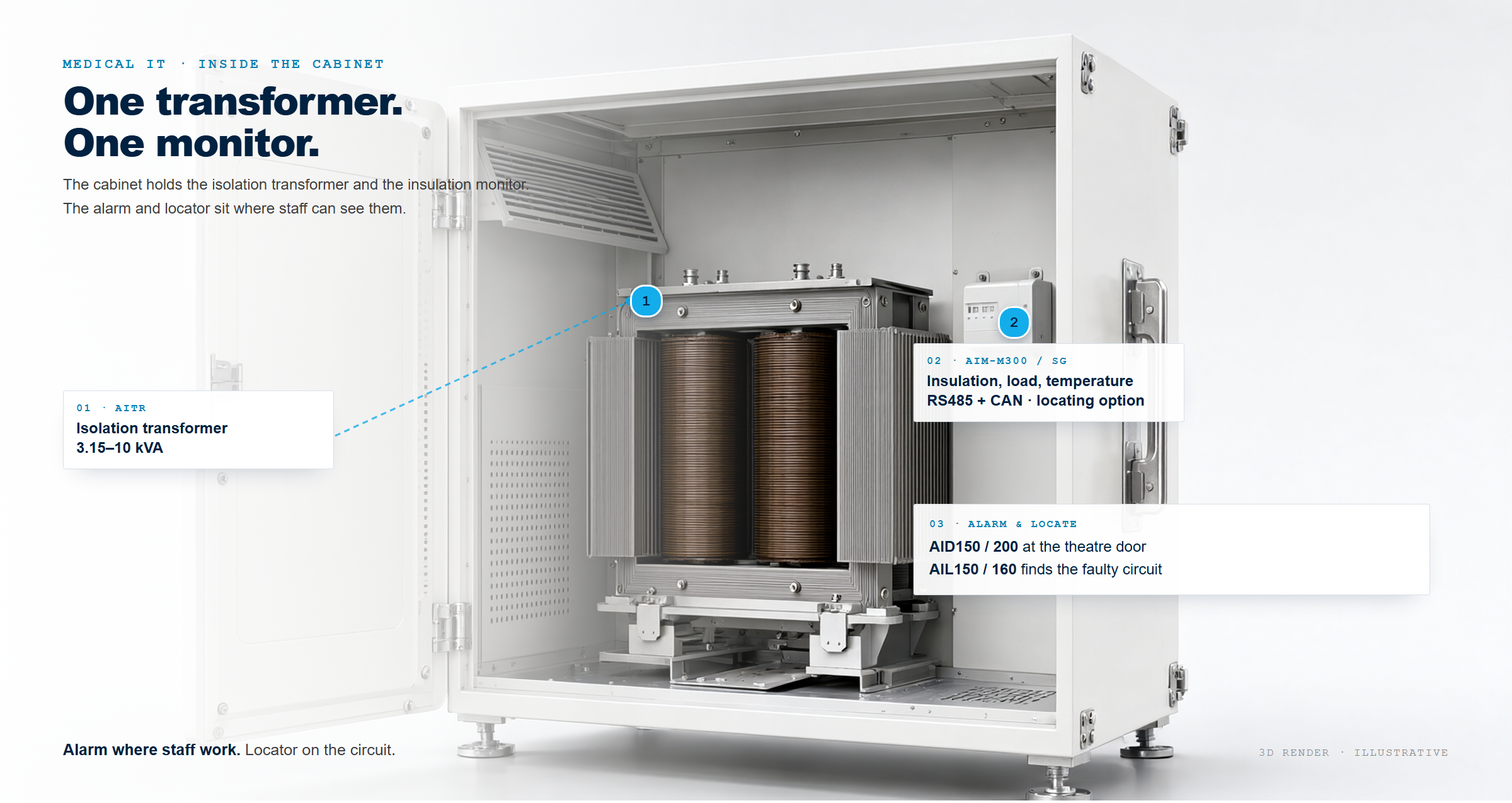
An AITR isolating transformer feeds the theatre as an IT system. The secondary is not tied to earth, so the first fault has no low-impedance path back to the source. The fault current is limited by the system’s leakage capacitance, so the breaker does not trip. The procedure continues.
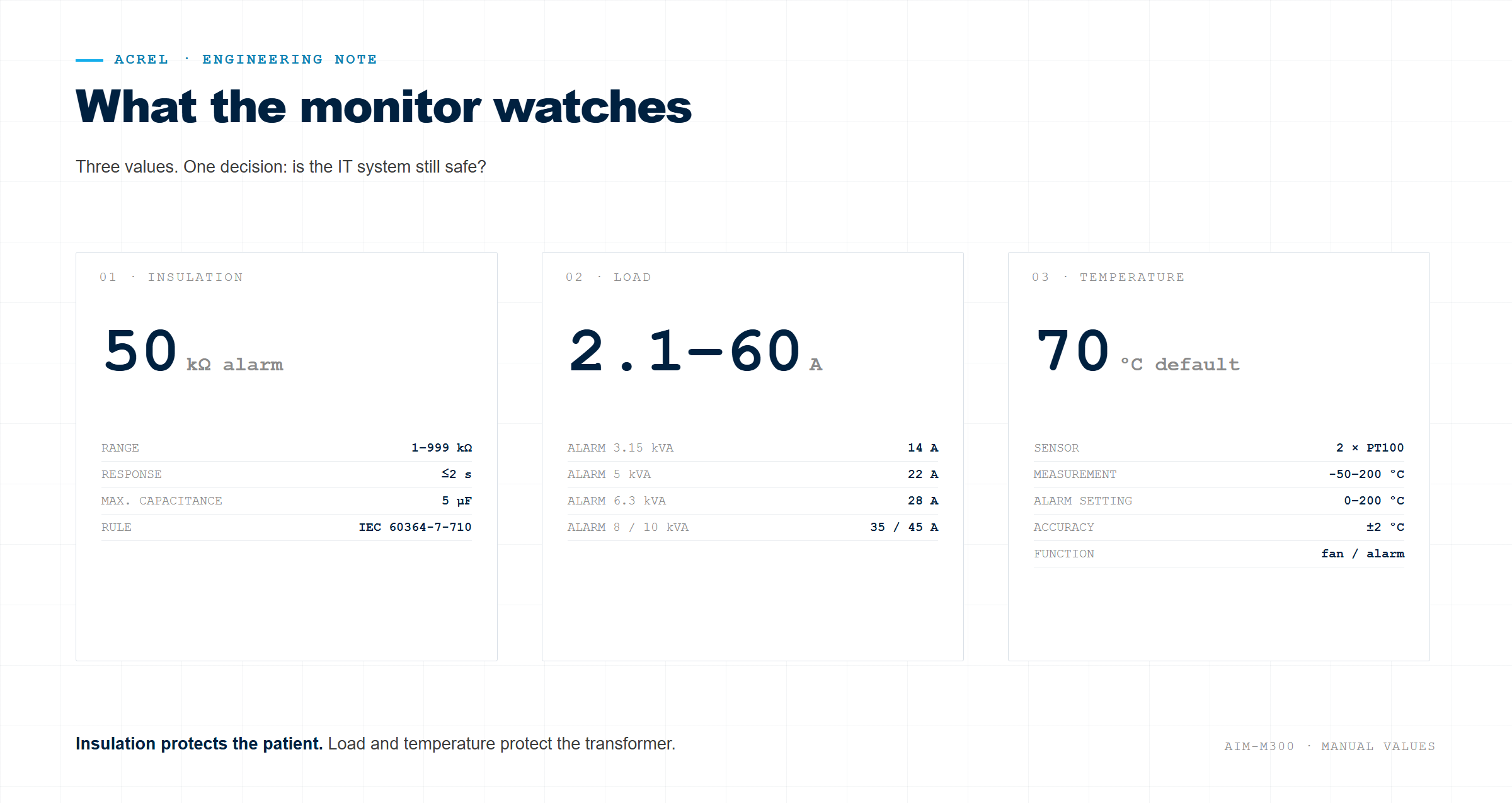
The monitor alarms at 50 kΩ, the lower limit allowed by IEC 60364-7-710. A second fault behaves like a short circuit; the breaker clears it. The alarm is the window between one fault and a lost theatre.
Insulation, load, temperature
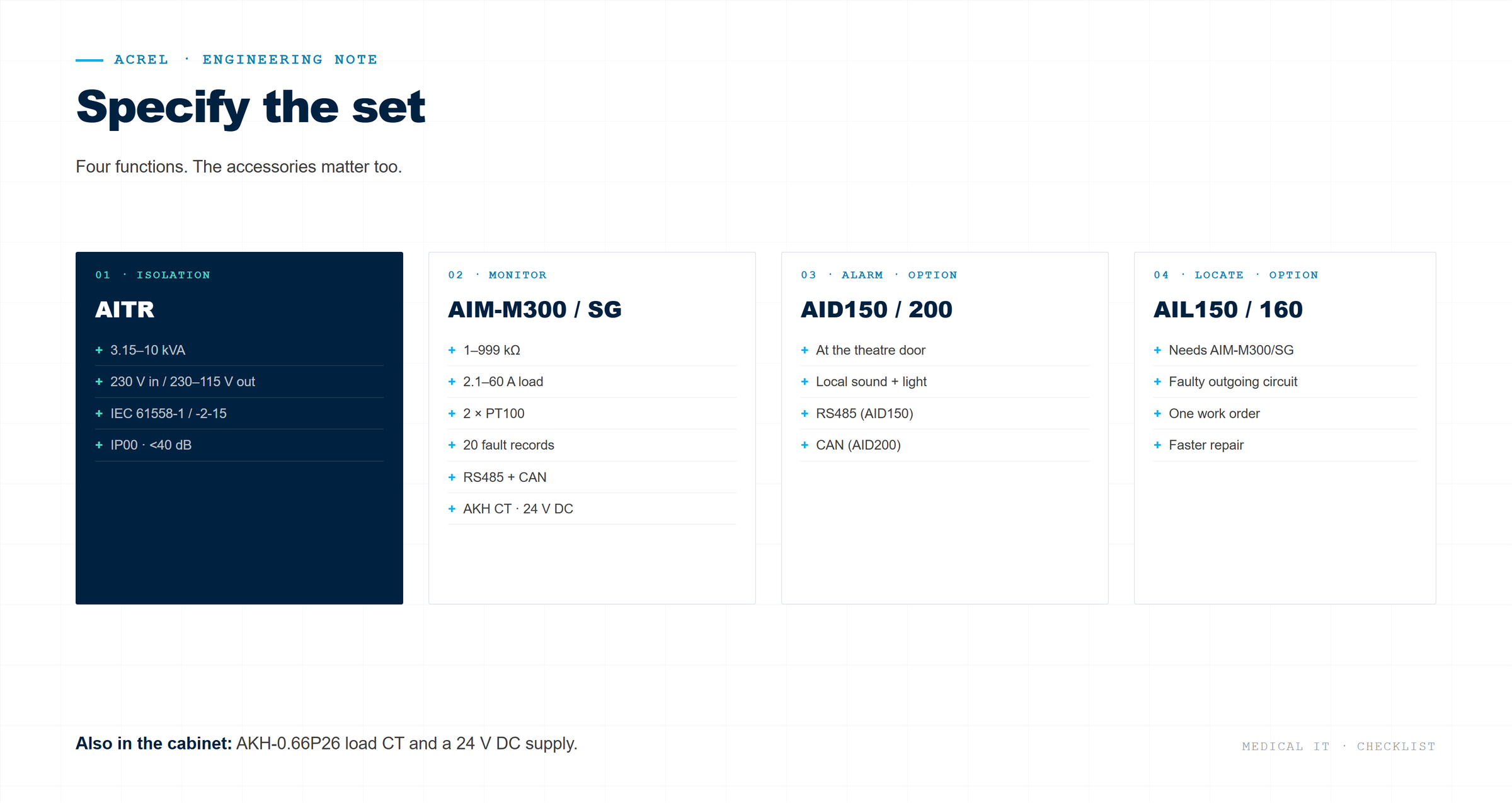
AIM-M300 watches the three values that decide whether the IT system is still safe. The load current comes from the AKH-0.66P26 CT; the monitor itself needs a 24 V DC supply.
They are not independent. A fan failure raises temperature; an overload raises current; moisture lowers insulation. The first two protect the transformer. The third protects the patient.
A lamp is not a location
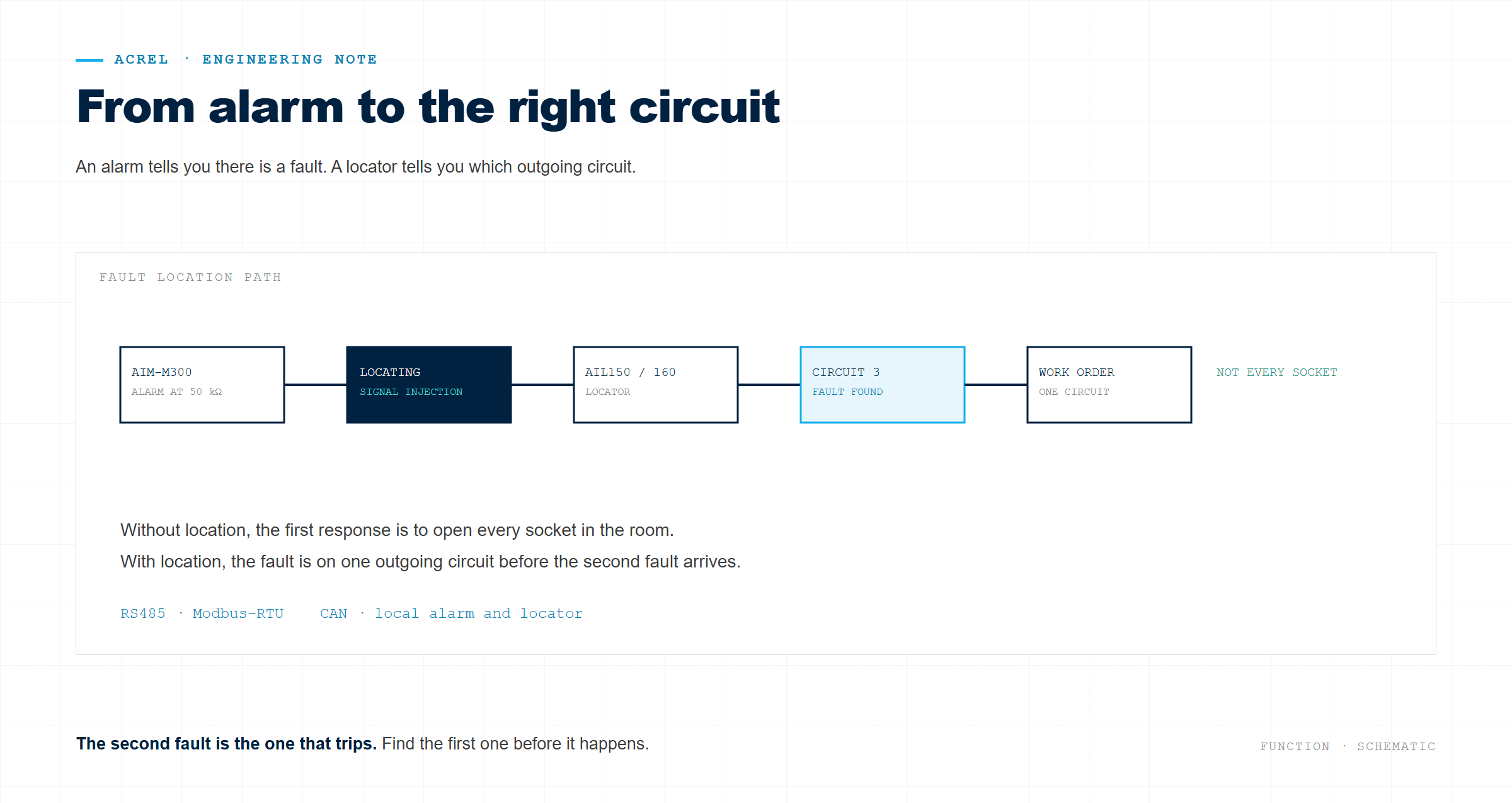
An alarm without location sends someone to open every socket. With the locating option (AIM-M300/SG), the monitor injects a signal and the AIL150 / AIL160 fault locator finds the faulty outgoing circuit. The AID150 (RS485) or AID200 (CAN) repeats the alarm at the theatre door. The alarm and the locator are outputs of the monitor, not a chain. RS485 carries Modbus-RTU to the building system; CAN links AID200 and AIL. Twenty fault records keep the event and its time.
Put the repeater where staff work — the theatre door or nurse station, not only the electrical room.
Size the transformer to the theatre
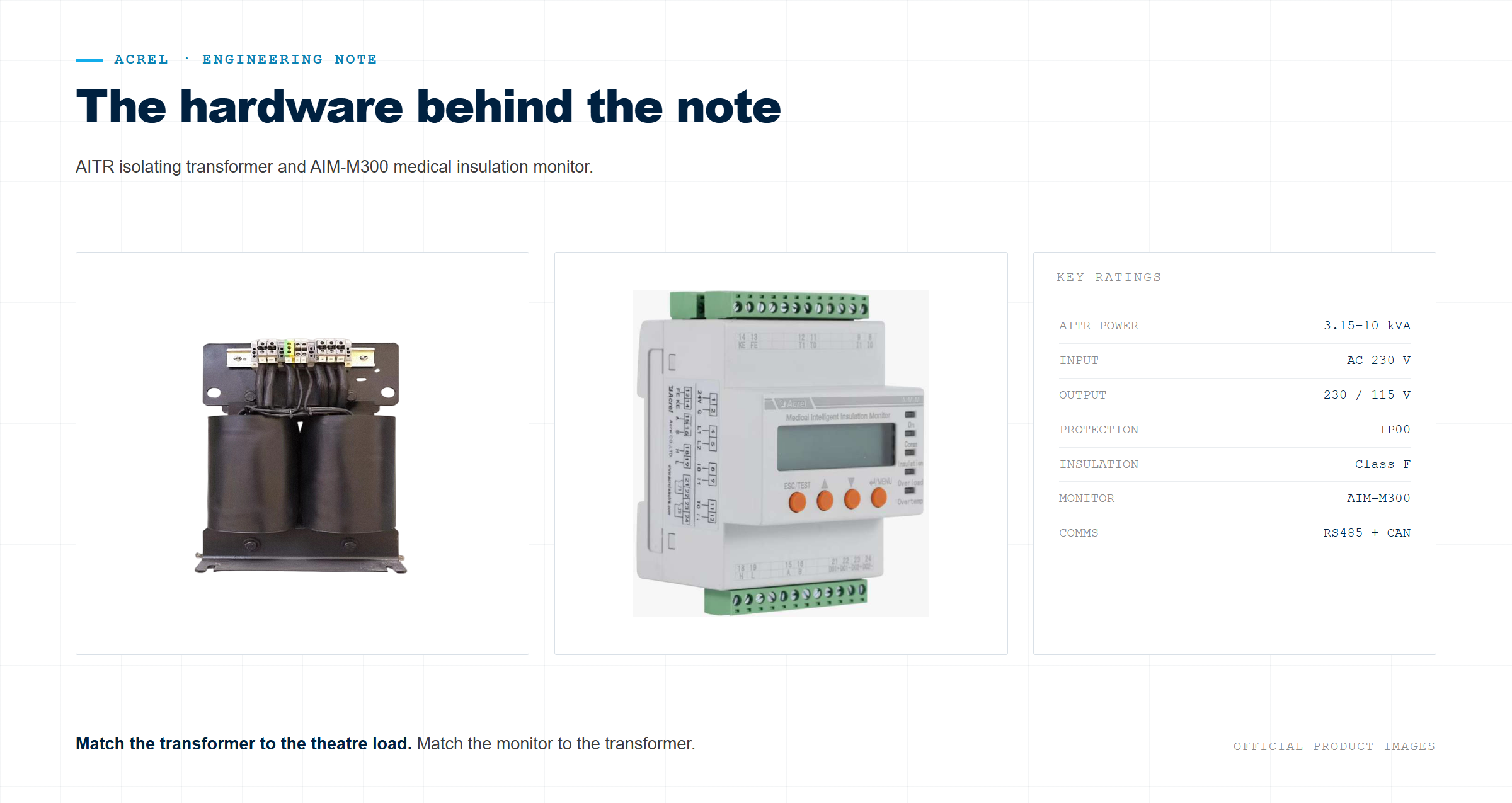
AITR covers 3.15–10 kVA, 230 V input, 230 / 115 V output, to IEC 61558-1, IEC 61558-2-15 and IEC 60364-7-710. It is IP00, class F, below 40 dB, with inrush below 12In. Match the transformer to the theatre load, not to the UPS.
Then specify the monitor, remote alarm and locator, plus the AKH-0.66P26 load CT and a 24 V DC supply for the monitor. Choose AIM-M300/SG if the locator is required. Local approval remains the consultant’s scope.
We will size the isolating transformer and the monitoring set, and mark where the remote alarm and locator belong.
Post time: Oct-22-2026


