

ob_start_detected
head_banner_news

Why Continuous Energy Monitoring Matters Between Five-Year Energy Audits


Energy management · Malaysia

Malaysia gives large energy consumers a five-year audit cycle. The obligations around that audit — a registered energy manager, an energy management system, an annual report — run every month in between. That gap is where verified savings disappear.
08-section

01 · Compliance calendar

Two clocks, one facility

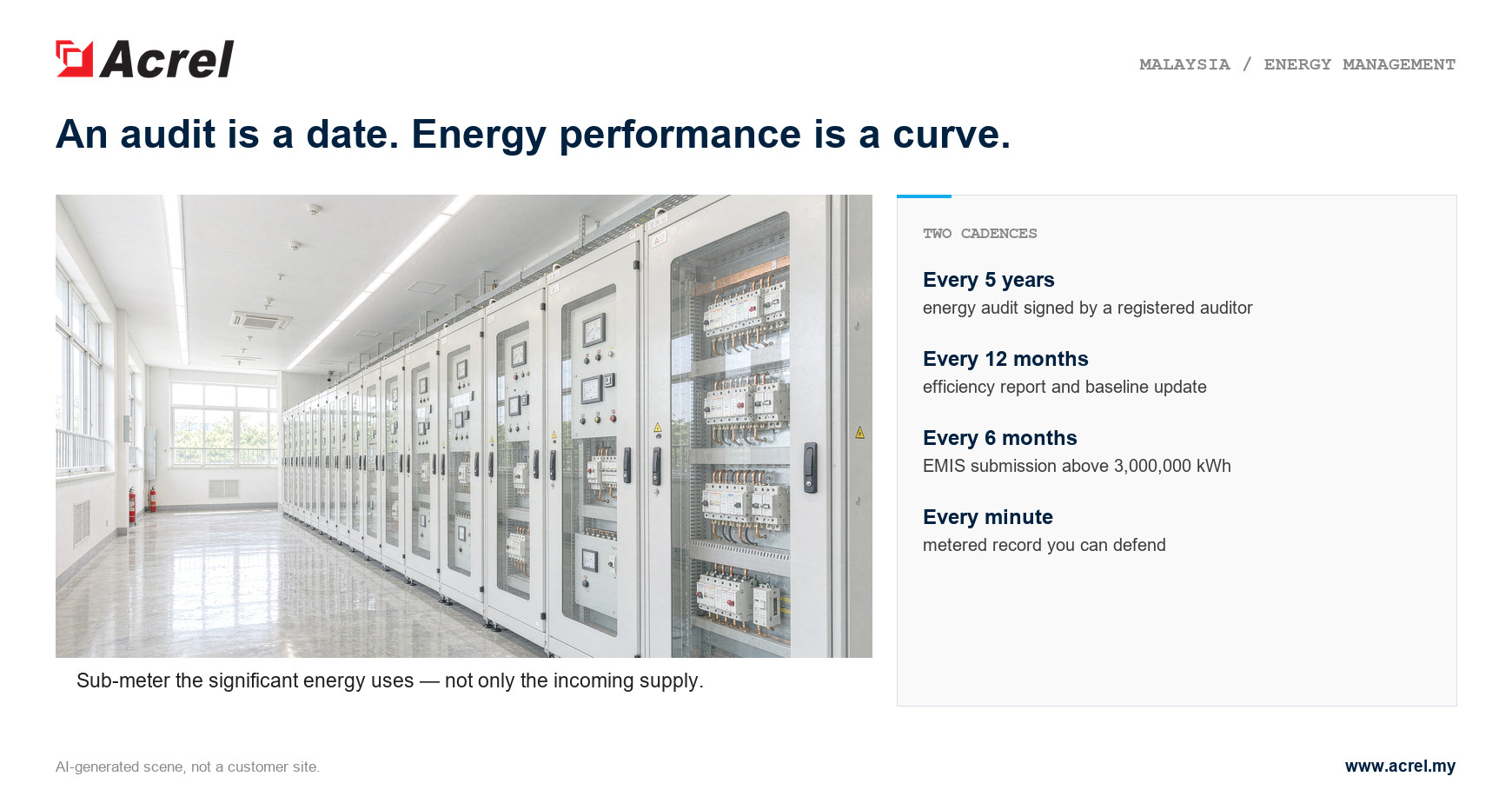
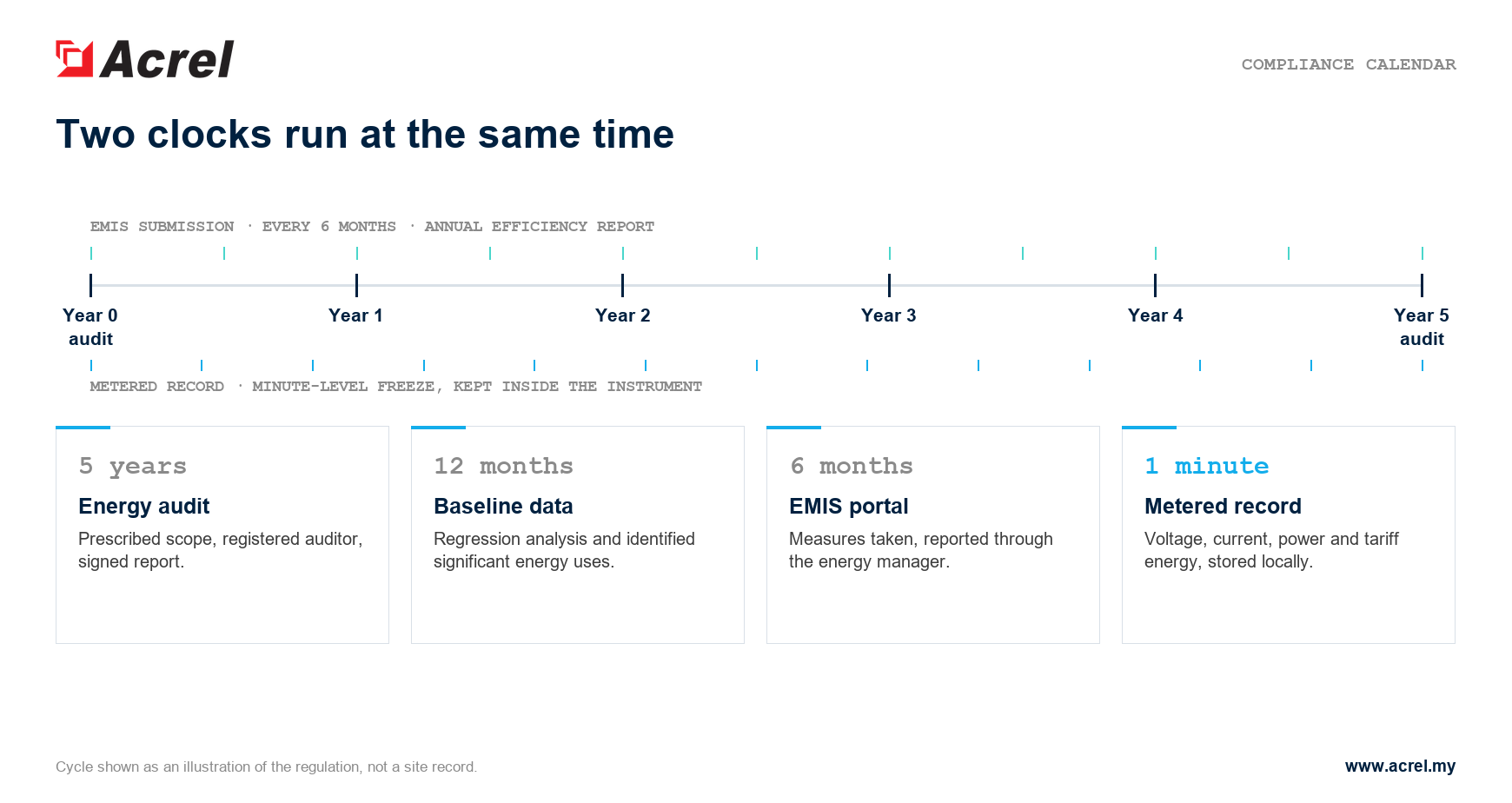
A five-year audit is the slowest item on the energy calendar. Under the Energy Efficiency and Conservation Act 2024, a facility consuming 21,600 GJ or more a year — around 6,000,000 kWh of electricity — appoints a registered energy manager, runs an energy management system, files an annual report, and completes a full audit within 12 months of the Energy Commission’s notice.

The older Efficient Management of Electrical Energy Regulations 2008 still applies above 3,000,000 kWh over any six consecutive months: the registered energy manager reports to the Commission’s EMIS portal twice a year.

So the calendar has two speeds, and the audit is the slow one.
Obligation
Cycle
Record it produces
Registered energy manager
continuous
Operating decisions and the monthly review behind them
Energy management system
continuous
Significant energy uses and the verified savings
Efficiency report (EECR)
annual
Consumption by period and the measures taken
Energy audit
every 5 years
Baseline, regression analysis, recommendations
EMIS submission
every 6 months
Measures taken and the consumption trend
08-cycle
02 · Baseline

The report is a snapshot, not a system

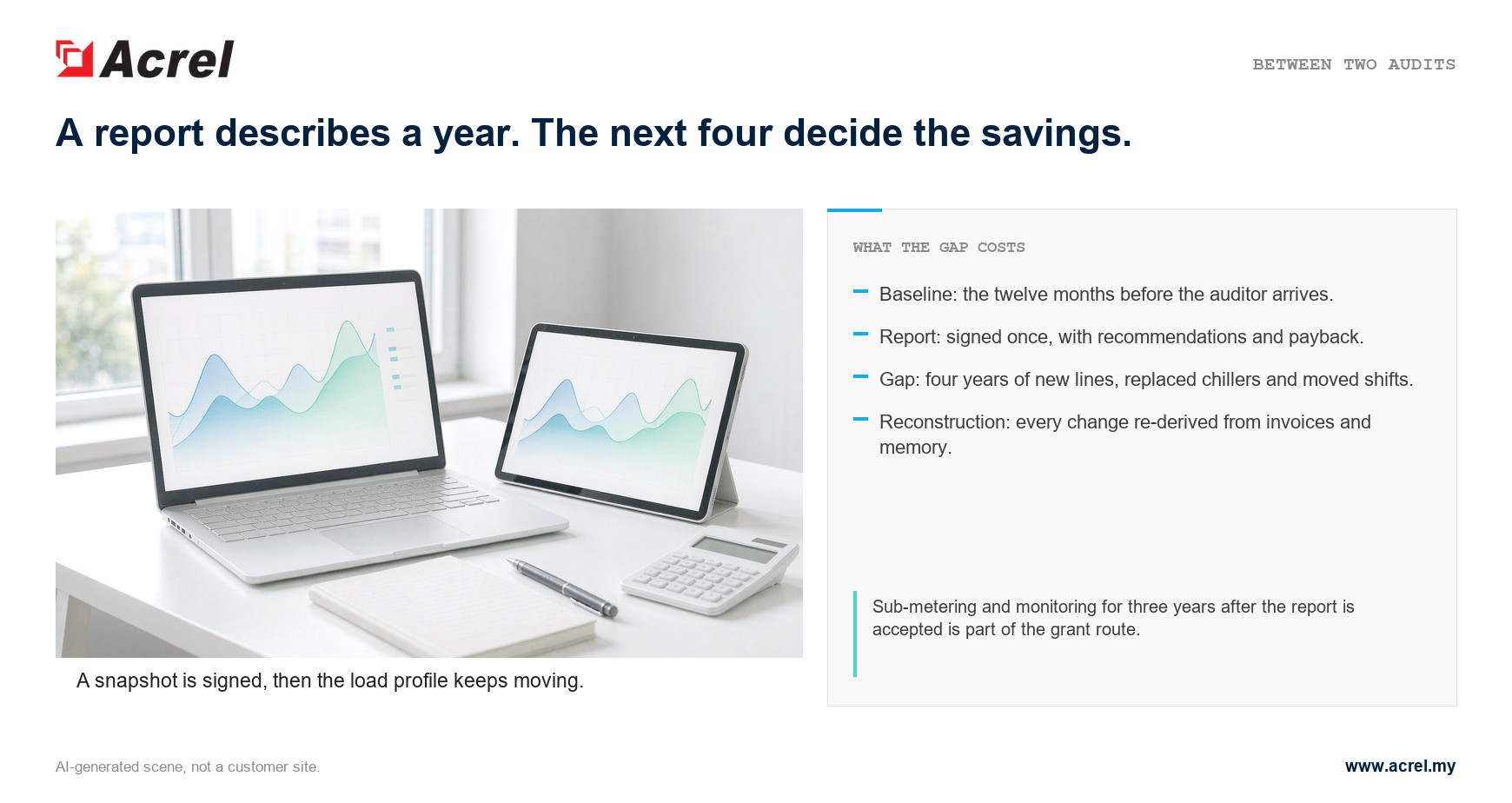
Prescribed audit scope expects roughly twelve months of baseline data, regression analysis and an identified list of significant energy uses. A signed report describes the facility as it was. The profile changes the month a line is added or a shift pattern moves, and a monthly utility bill cannot explain it.

SEDA’s grant route points the same way from the funding side: it supports the audit, then asks for sub-metering and monitoring for three years after the report is accepted.

The audit report is a dated document. The savings it recommends are a continuous claim — and a continuous claim needs a continuous record.
08-silence
03 · Measurement

What “continuous” has to mean at the meter

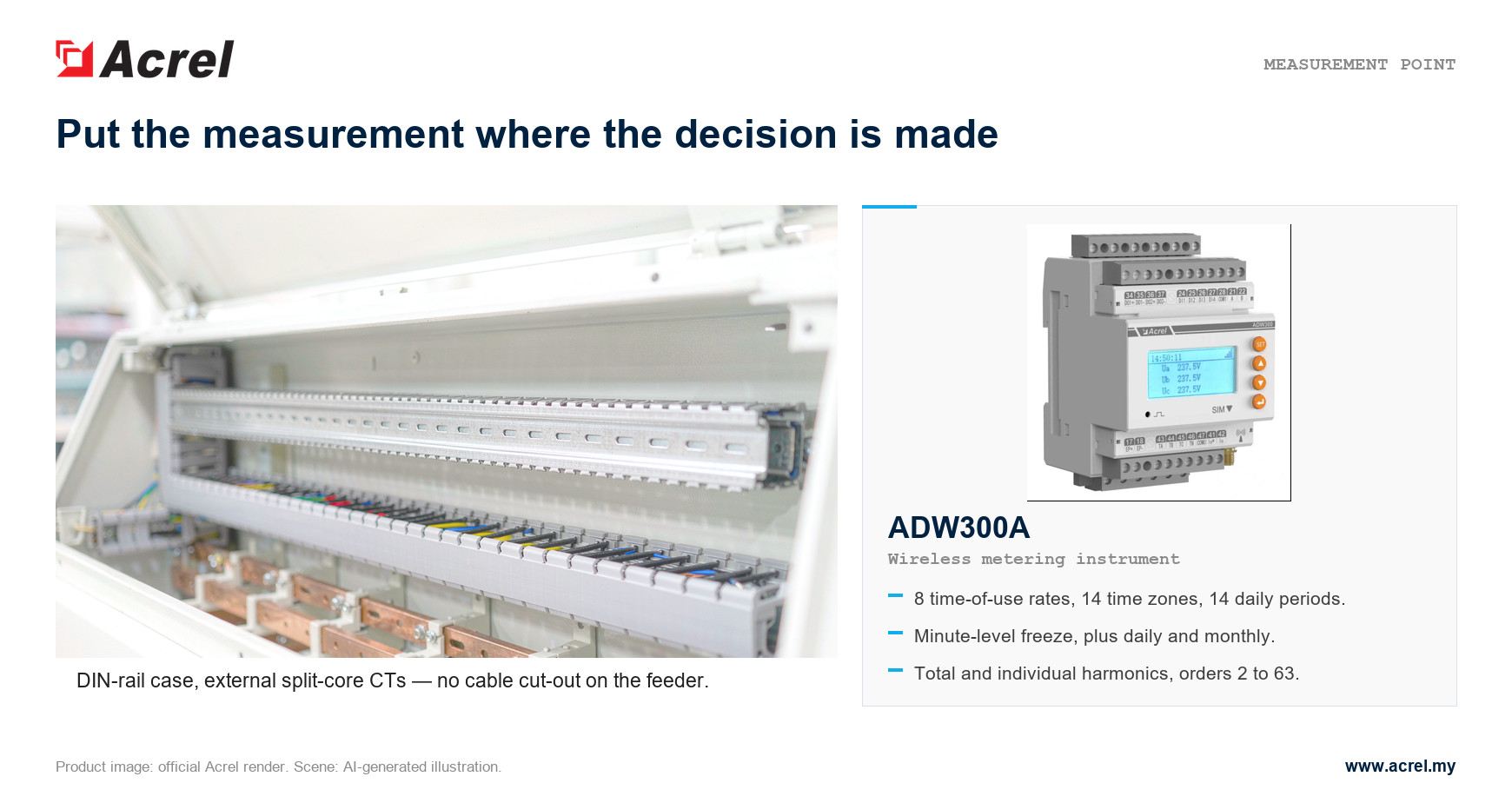
A single incoming meter read once a month answers how much. It cannot answer which load, at what hour, or against which tariff period. The ADW300A wireless metering instrument is built for that position: three-phase measurement in a DIN-rail case, external split-core CTs, and the records an energy manager has to defend later.
Accuracy
Class C · Grade B
ADW300A · ADW300A-CT
Tariff
8 rates · 14 periods
14 time zones per day
Freeze
Minute · Day · Month
history kept for every rate
Harmonics
Orders 2 to 63
total and per order
What the record has to cover
Time-of-use energy at 8 rates, 14 time zones and 14 daily periods
Minute-level, daily and monthly freeze
Beyond energy
Extreme values for three months, with the time each event occurred
Voltage and current imbalance, phase sequence diagnosis, harmonics to order 63
08-meter
04 · Data path

From meter to report without a re-wiring project

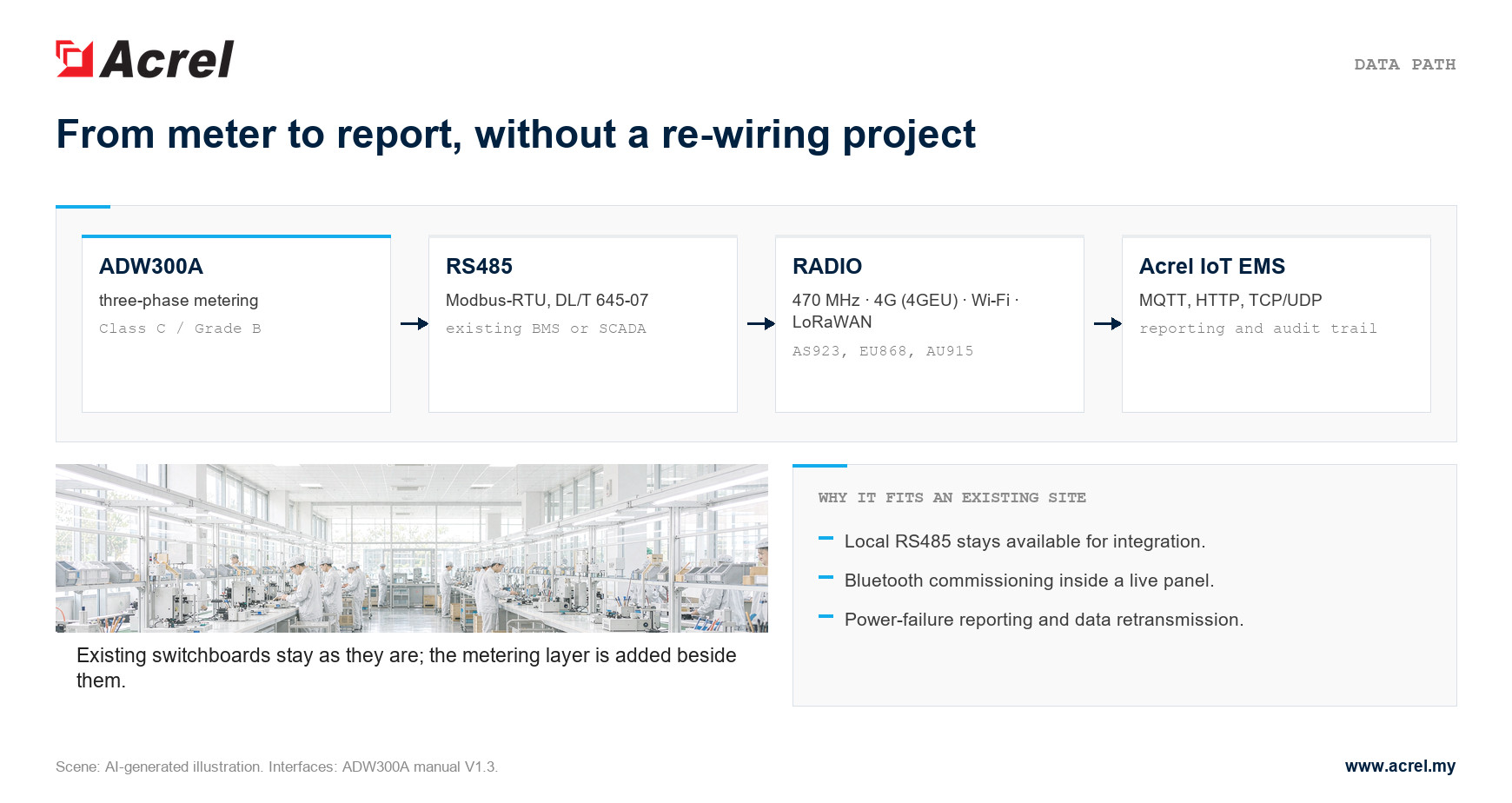
Wireless metering only helps if it fits the site that already exists. ADW300A keeps RS485 for Modbus-RTU and DL/T 645-07 beside the radio, and the radio variant is chosen for the market: 4G for Southeast Asia (4GEU), Wi-Fi, or LoRaWAN on AS923, EU868 or AU915. Data can be pushed to a third-party platform over MQTT, HTTP or TCP/UDP, so the metering layer sits next to an existing BMS instead of replacing it.
Path
What runs on it
What it is for
RS485
Modbus-RTU, DL/T 645-07
Local SCADA and BMS integration
470 MHz radio
LoRa, up to 1 km in open areas
Meters inside one building or yard
4G
cellular, 4GEU band
Sites without a data network
Wi-Fi and LoRaWAN
AS923, EU868, AU915
Campus and private networks
08-path
05 · Selection

Matching the meter to the load

Selection is mostly about the current path. The CT aperture fixes the range: D10 covers 100 A of basic current with a 6 A maximum, D16 reaches 400 A, and D24 reaches 600 A. Split-core CTs are the reason the instrument can be fitted to an existing feeder without cutting the cable out of service.
Voltage input
3×220/380 V, 3×230/400 V, 3×277/480 V and other rated values
Current input
ADW300A 0.01–0.05(6) A · ADW300A-CT D10 to D36, up to 600 A
Auxiliary supply
AC 85–265 V, AC 110–415 V, DC 9–30 V · under 2 W total
Operating conditions
−40 to +70 °C, humidity up to 95 %, altitude under 2000 m
08-rollout
06 · Rollout

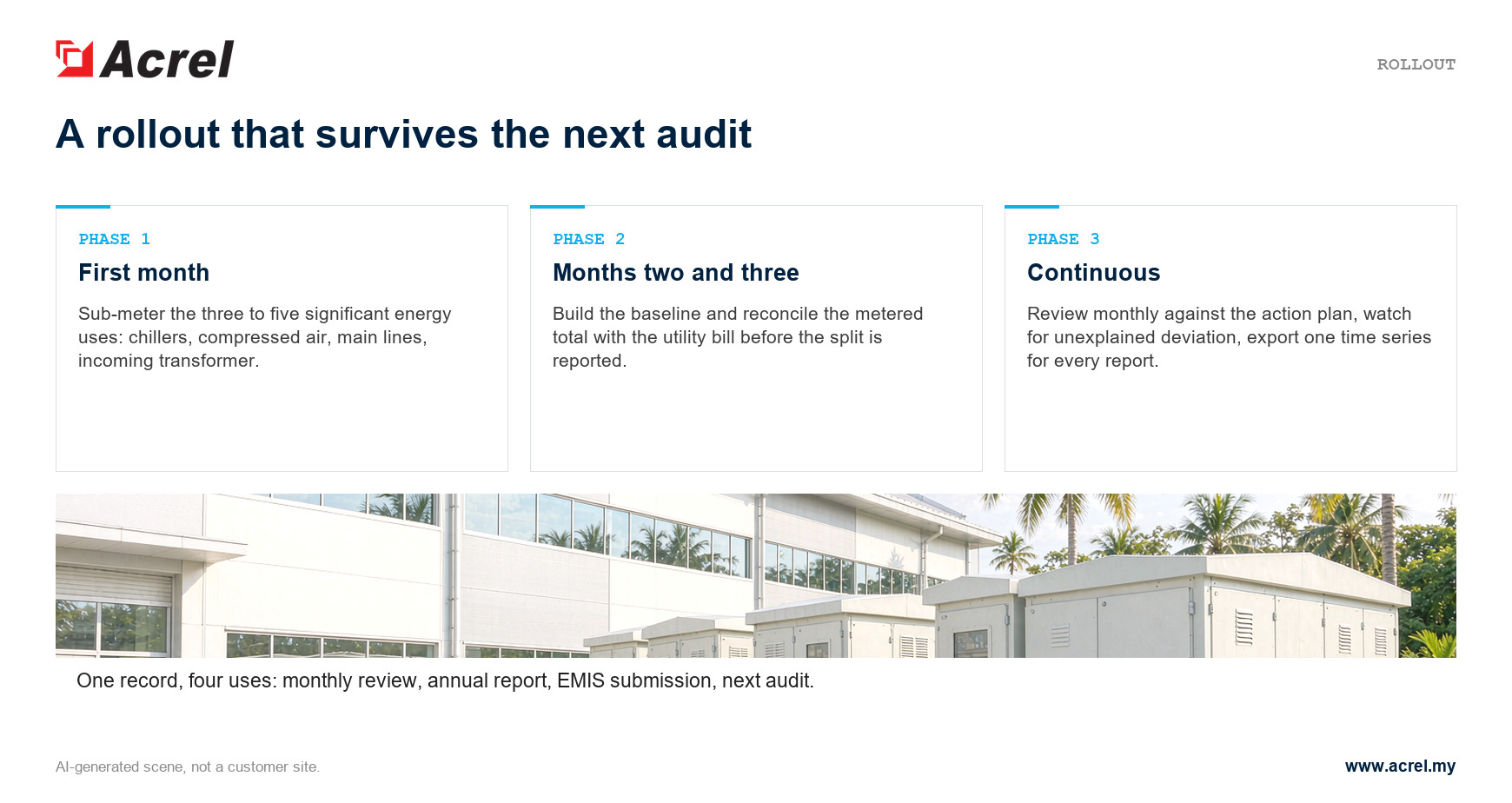
A rollout that survives the next audit

Phase 1
First month
Sub-meter the three to five significant energy uses: chillers, compressed air, main production lines, incoming transformer.
Phase 2
Months two and three
Align the tariff periods with the utility bill and reconcile the two totals before the split is reported.
Phase 3
Continuous
Review monthly, watch for the deviation that arrives without a project, export one series for every report.
07 · Objections

The three objections

“We already have the utility bill.”
One number per month for the whole site. It cannot separate the chiller from the compressed air, or show which hour the load moved.
“The next audit is years away.”
The data that makes an audit inexpensive is collected before it starts, not during the twelve months the auditor waits for.
“Wireless is for small installations.”
The radio is the transmission layer, not the record. RS485 remains, and the metered data is kept inside the instrument.
Next step
Send the facility type, the incoming current, and the number of circuits you want to sub-meter.
We will come back with a metering layout, the CT sizes, and the data path to your platform.

Post time: Sep-28-2026