

Where a wired meter is the expensive option
Sub-metering an existing board fails on two costs: the communication cable and the shutdown needed to fit it. The ADW300 addresses both — it is a three-phase DIN-rail energy meter that measures with external current transformers and publishes over radio, so the only work at the board is clipping CTs around the conductors.
It measures three-phase voltage, current, active / reactive / apparent power, power factor and frequency, total active and reactive energy in both directions, voltage and current harmonics up to the 31st, temperature on the A / B / C / N terminals and residual current. The full ranges and ordering codes are on the ADW300 product page.
Radio options, and the wired fallback
- LoRa on 470 MHz — up to 1 km in open space, backhauled by an AWT100 gateway.
- LoRaWAN — LW915 for the AU915 band (915–928 MHz), LW868 for EU863–870 MHz.
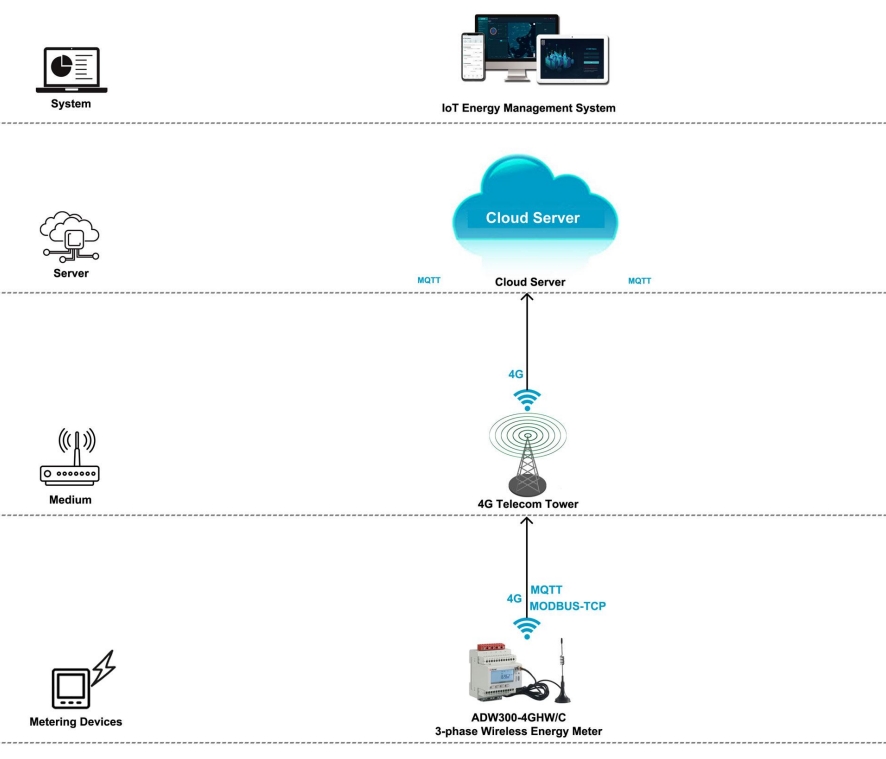
- Wi-Fi, NB-IoT, 4G and 2G for sites that already have coverage but no control cable.
- RS485 (Modbus-RTU) stays on the board as the wired fallback, with an infrared service port at 1200 bps for local reading.
Because the same Modbus-RTU register map is used, a site can start wireless and be pulled back onto a wired bus later without re-commissioning the meters.
What the platform gets per meter
- Real-time U, I, P, Q, S, PF and frequency, per phase and as a three-phase total.
- Active energy (positive and negative), reactive energy and the maximum demand with its timestamp — the input for a demand-charge discussion with the utility.
- THDv and the 2nd–31st harmonics, to catch a drive or UPS loading the transformer.
- Terminal temperature on A / B / C / N (±2 °C) and one residual-current channel, both usable as alarm sources before a hot joint becomes a fire.
- 4 switching inputs and 2 relay outputs for breaker position, fan status or a load shed.
Alarms are raised on under-voltage, over-voltage, over-current and phase failure and are delivered by the platform, not by the meter.
Three jobs it is specified for
- Factory sub-metering — split consumption by line, workshop or shift without trenching a bus through the plant.
- Tenant and dormitory circuits — kWh per circuit with a time stamp, which is what a split-billing dispute actually needs.
- Solar and storage — monitor PV output, grid import and export at the point of interconnection; the meter handles energy in both directions, which is the requirement for an export reading.
ADW300 technical data
| Parameter | Value |
|---|---|
| Rated voltage | 3×57.7/100 V, 3×100 V, 3×220/380 V, 3×380 V, 3×380/660 V, 3×660 V; 50 Hz |
| Current input | 3×1(6) A via CT; ADW300W 3×1(6) A or 3×20(100) A direct |
| CT options | D10 3×1.5(6) A, D16 3×20(100) A, D24 3×80(400) A, D36 3×120(600) A; Rogowski coil 1000 A / 200 mV or 333 mV |
| Accuracy | Active energy class 0.5S (ADW300), class 1 (ADW300W); IEC 62053-22:2003, IEC 62053-21:2003 |
| Starting current | 1‰ Ib (class 0.5S); 4‰ Ib (class 1) |
| Auxiliary supply | AC 85–265 V; power consumption <2 W |
| Temperature | 4 channels A / B / C / N, ±2 °C |
| Residual current | 1 channel |
| Switching I/O | 4 DI and 2 DO (alternate configuration) |
| Pulse output | Active energy pulse, 80±20 ms; 6400 imp/kWh or 400 imp/kWh |
| Wireless | LoRa 470 MHz, up to 1 km open space; 2G, NB-IoT, 4G, Wi-Fi; LoRaWAN LW915 / LW868 |
| Wired | RS485 Modbus-RTU, shielded twisted pair; infrared service port 1200 bps |
| Environment | Working −20 to 55 °C; storage −40 to 70 °C; ≤95% RH no condensation; <2000 m |
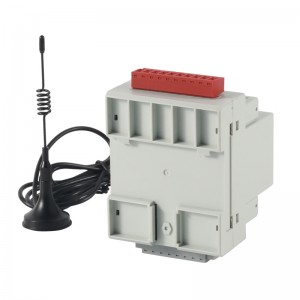
| Dimensions | 72 × 87.8 × 71.5 mm, DIN rail inside the distribution board |
Picking the current input
Three ways to bring current in, chosen by what the board allows:
- Direct — ADW300W 3×20(100) A, the simplest option up to 100 A.
- Opening-type CT — D24 covers 80(400) A and D36 covers 120(600) A; the CT opens around the conductor, so the busbar is not dismantled.
- Rogowski coil — 1000 A / 200 mV (or 333 mV) for large bare bars where no CT will fit at all.
Specify the primary current of each circuit when you enquire: the CT ratio decides the starting current and the accuracy you keep at light load.
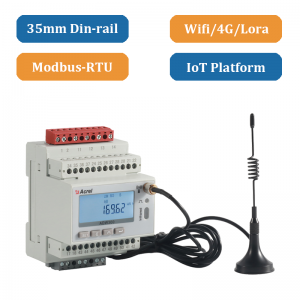
ADW300
1. Wi-Fi, 4G, NB-IoT, 2G or LoRa / LoRaWAN uplink
2. 4 DI & 2 DO, 4-channel terminal temperature, residual current
3. Voltage input up to 3×660 V; active energy class 0.5S
Post time: Jun-06-2025


