

Why does one 30-minute peak set your whole TNB bill?
Your production did not change, but the bill did. Maximum demand is the highest 30-minute average power in the month, and it sets the demand charge.
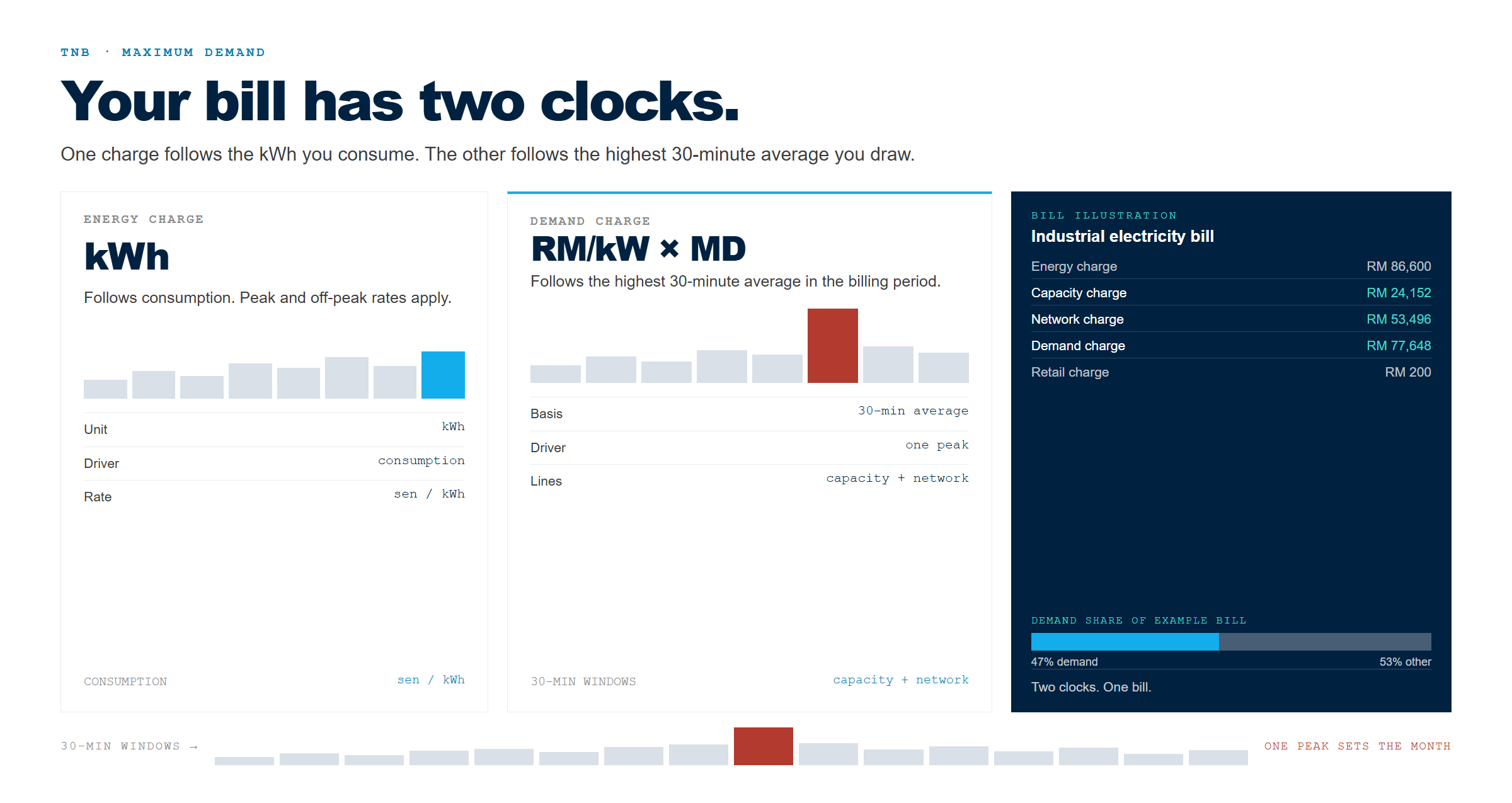
Your bill is tracking two different things
A TNB bill has an energy charge in kWh and a demand charge in RM/kW: the capacity and network lines multiplied by the same maximum demand (MD).
MD is the highest 30-minute average, not the highest instantaneous reading: kWh in the window ÷ 0.5 h = kW. One busy half-hour can set the MD for the billing period.
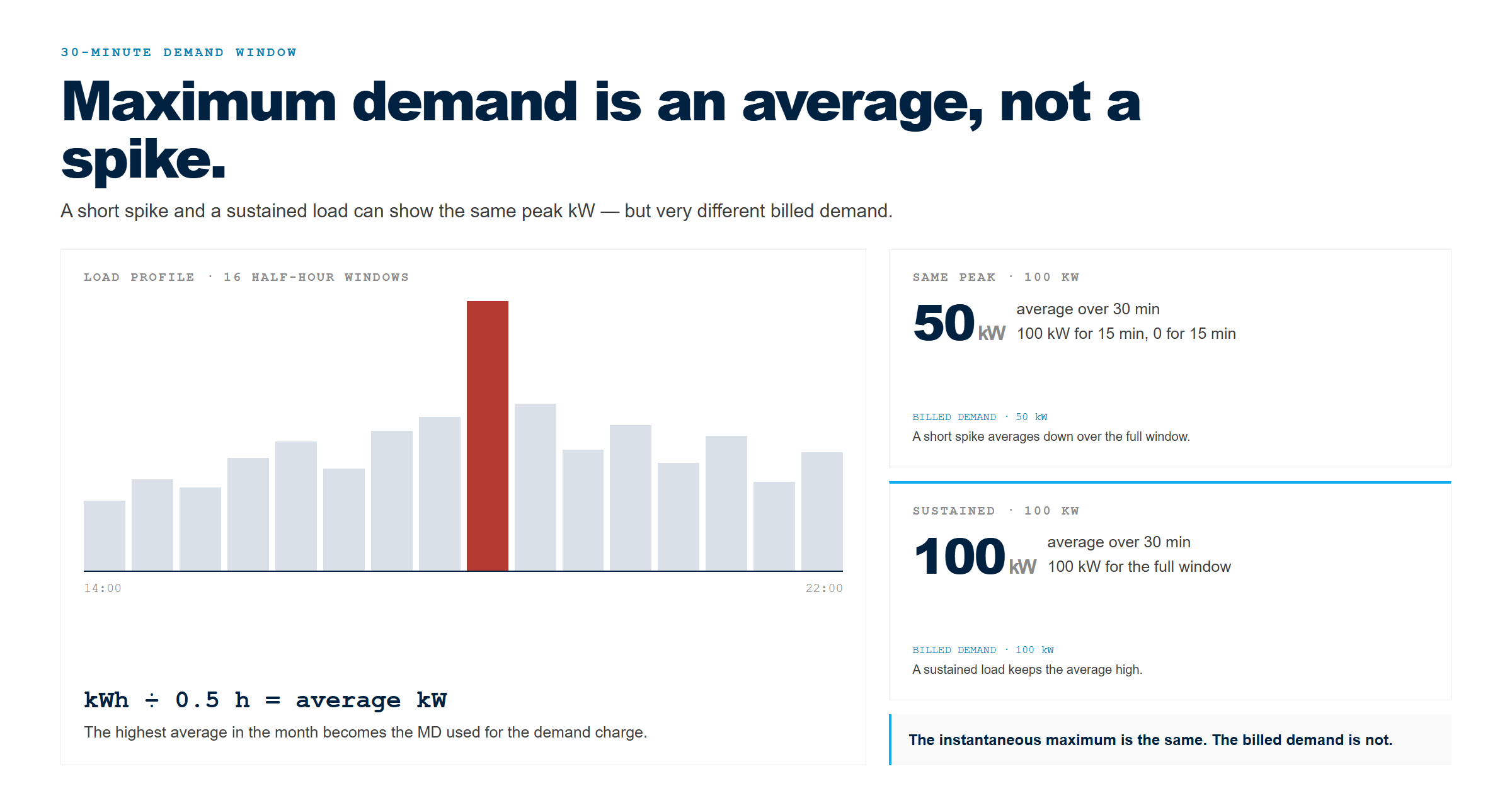
One busy half-hour can set the month
A short spike and a sustained load can show the same peak kW but different MD. 100 kW for 15 minutes averages 50 kW; for 30 minutes, 100 kW.
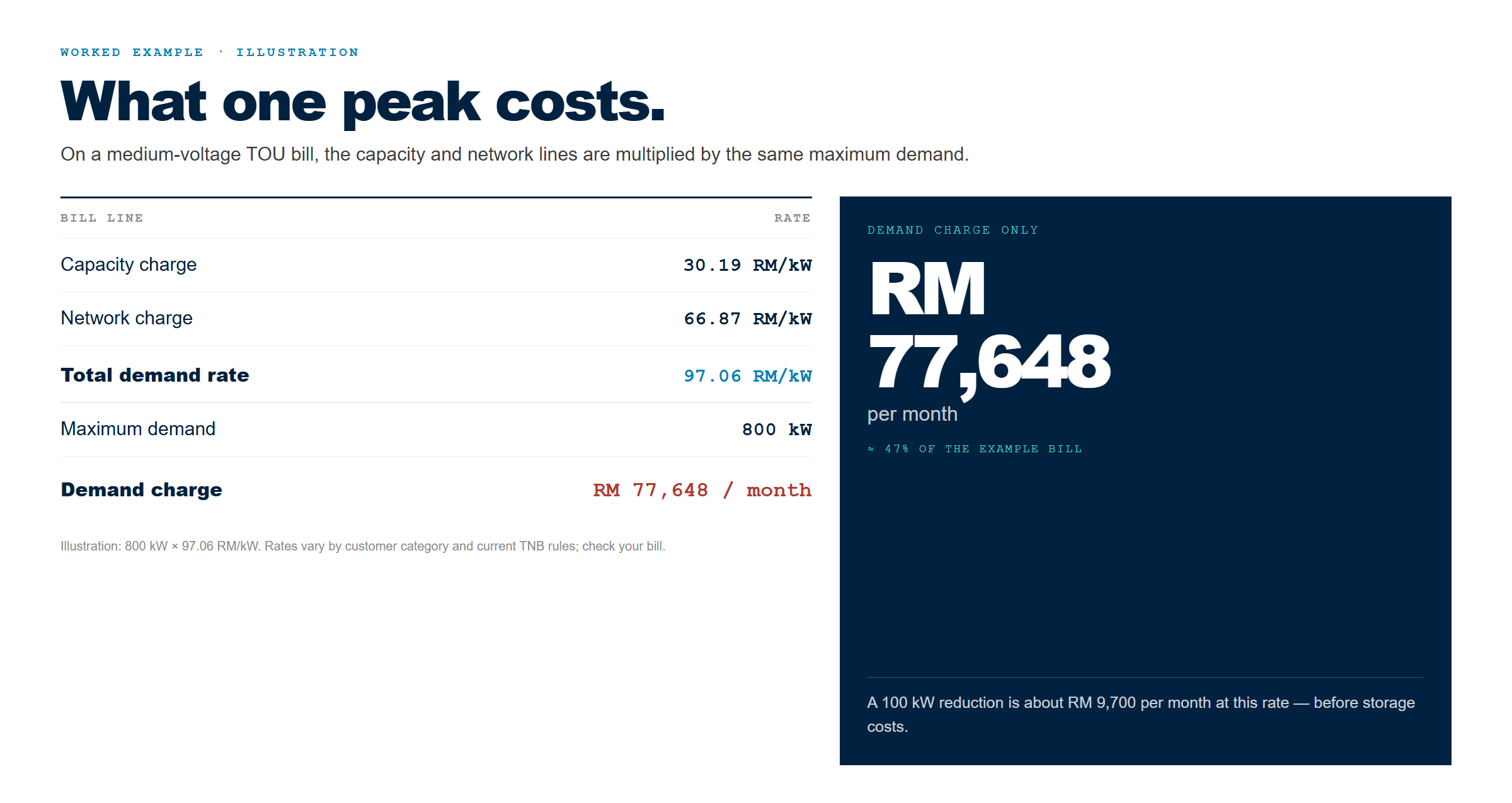
On a medium-voltage TOU bill, capacity and network charges can add up to roughly RM90–100 per kW per month. At about RM97/kW, an 800 kW MD is about RM77,600 per month.
One afternoon of simultaneous starts can set that number for the month. Read the bill and the 30-minute load curve together, not a single meter reading.
Check the RM/kW lines, not just kWh. The demand charge is the one a battery can shave.
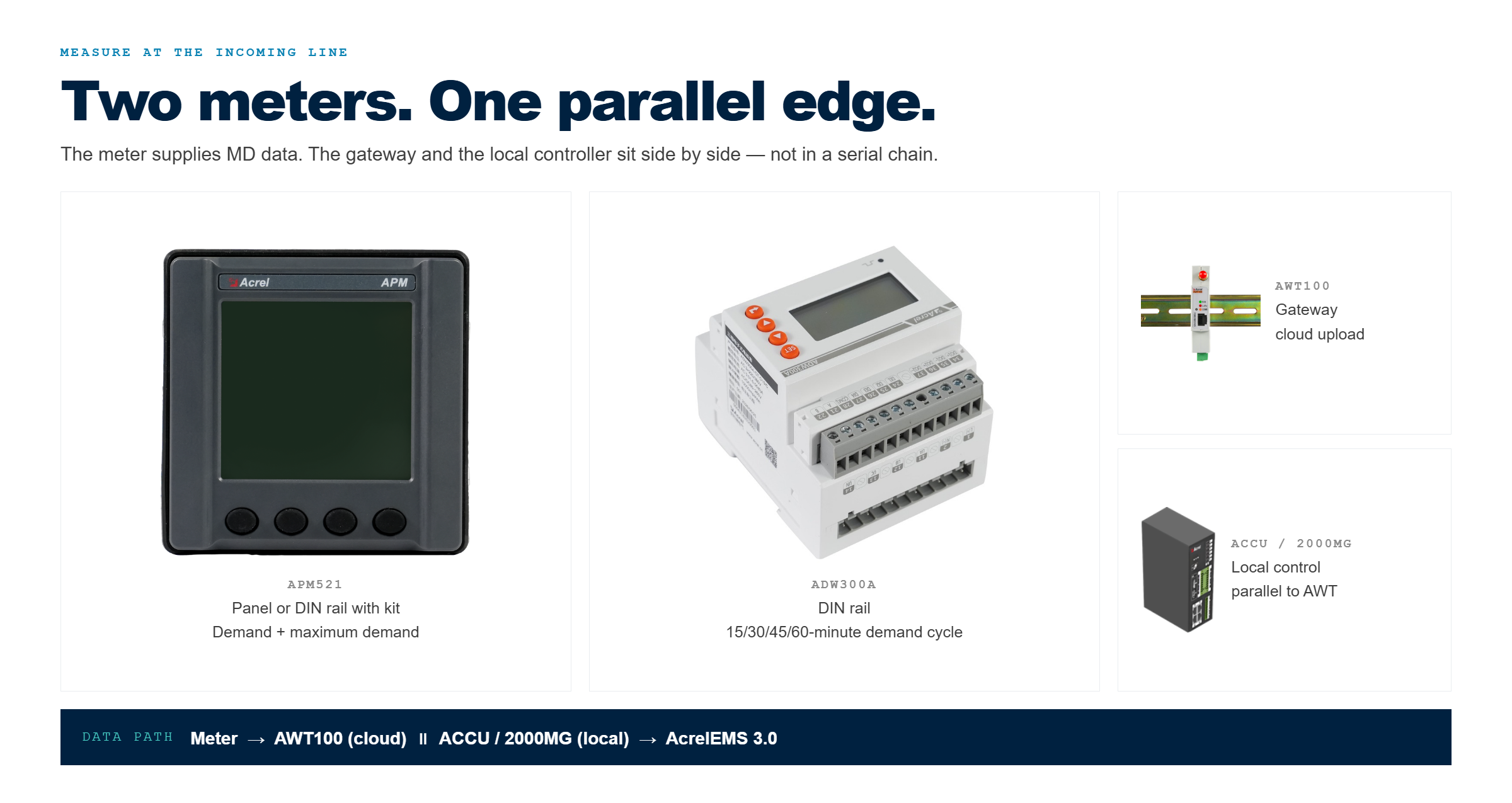
Measure at the line, then shave the peak
At the incoming line, use a meter that calculates demand on a defined window. APM521 ↗ is a multifunction meter with demand functions; ADW300A ↗ is a DIN-rail meter with a selectable 15/30/45/60-minute cycle. APM521 can be panel- or DIN-rail mounted with the right accessory.
Data can go to an AWT100 ↗ for cloud upload, or to a local controller (ACCU series or Acrel-2000MG) ↗ for local control. They are parallel edge options, not a serial chain. Both can exchange data with AcrelEMS 3.0 ↗; the peak-shaving decision stays local.
Size in kWh, not just kW
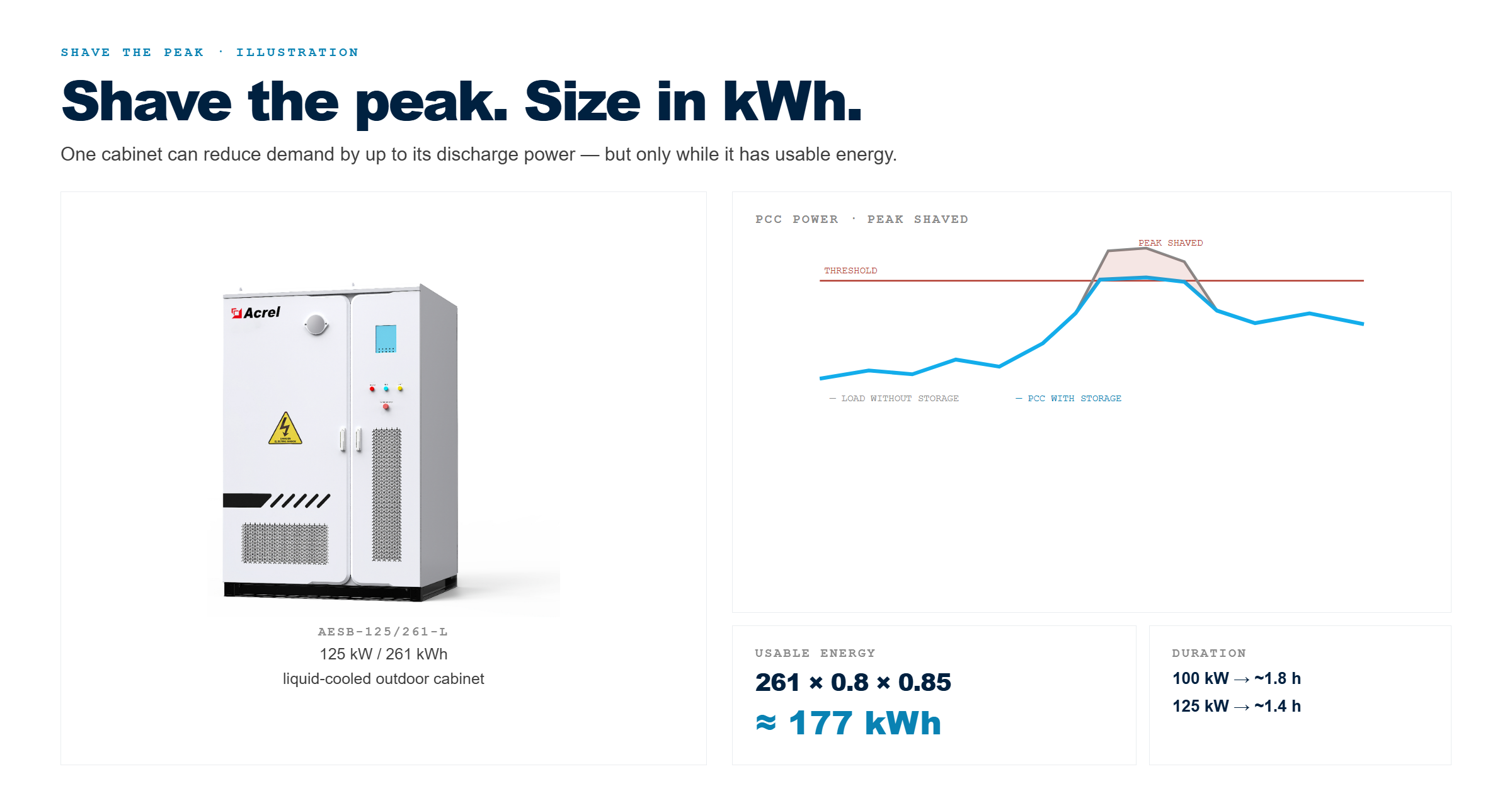
A battery cabinet does not cut production. When demand approaches the threshold, the AESB-125/261-L (request datasheet) ↗ discharges to hold the PCC below it. One cabinet can reduce demand by up to 100–125 kW, but only while it has usable energy.
Size in kWh: 261 × 0.8 × 0.85 ≈ 177 kWh usable, about 1.4–1.8 hours at 100–125 kW. Two to three months of interval data show whether one cabinet is enough.

What to send for a first check
Send the latest TNB bill with the capacity and network lines, two to three months of 15- or 30-minute load data, the single-line diagram and transformer rating, and the cabinet space and fire clearances.
We will check whether demand charges apply and estimate the peak energy above a target.
Send the bill, not a guess.
Jack Ren · Sales Engineer, Acrel Malaysia · jack@acrel-electric.com · WhatsApp +86 18702113209
Illustrative example only. Tariffs and billing windows vary; verify against your bill. Not a completed Malaysian reference.
Post time: Nov-03-2026


