

ACREL MALAYSIA · SOLAR EPC FIELD NOTE
Solar PV Power Factor in Malaysia
Why It Falls After Rooftop PV and What EPCs Should Check First
Start with the grid meter
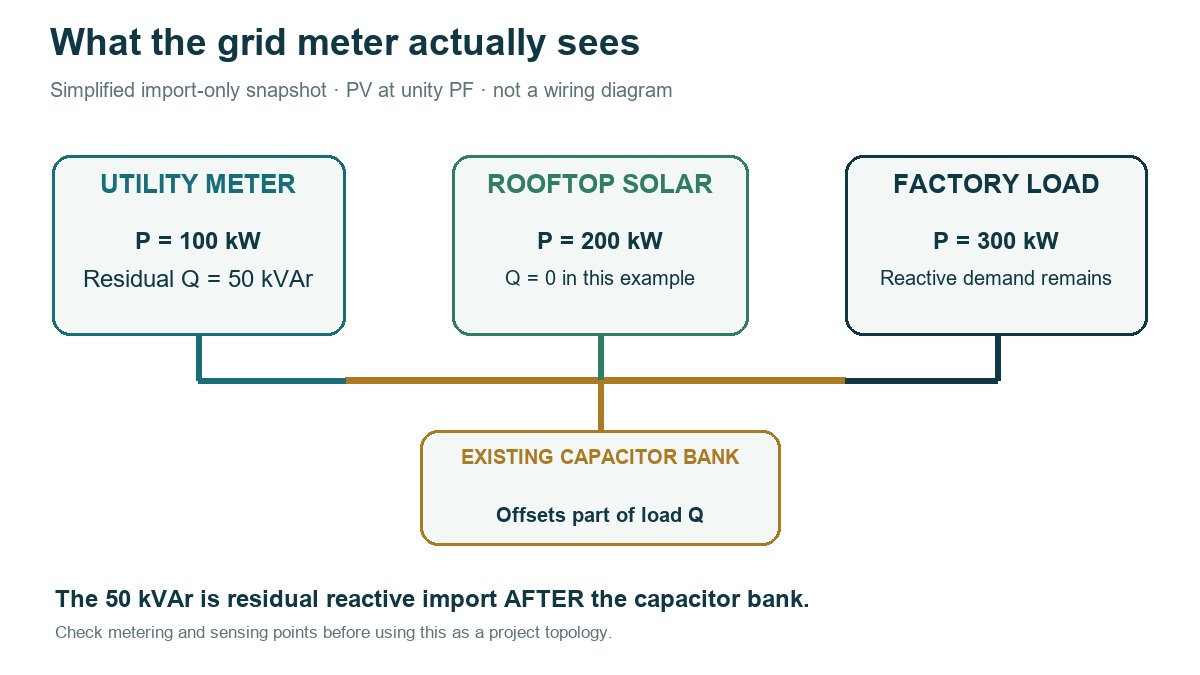
Some commercial and industrial sites see lower PF at the utility meter after adding rooftop PV. PV supplies part of the active load, so grid import falls. Motors and transformers still need reactive power; the grid supplies what the existing capacitor bank does not cover. A bank that met the old PF target may now fall short.
For a simple example with grid import and no harmonics, displacement PF = P / sqrt(P² + Q²). P is active power imported at the utility meter. Q is the reactive power still supplied by the grid after the capacitor bank has compensated the motors and transformer.
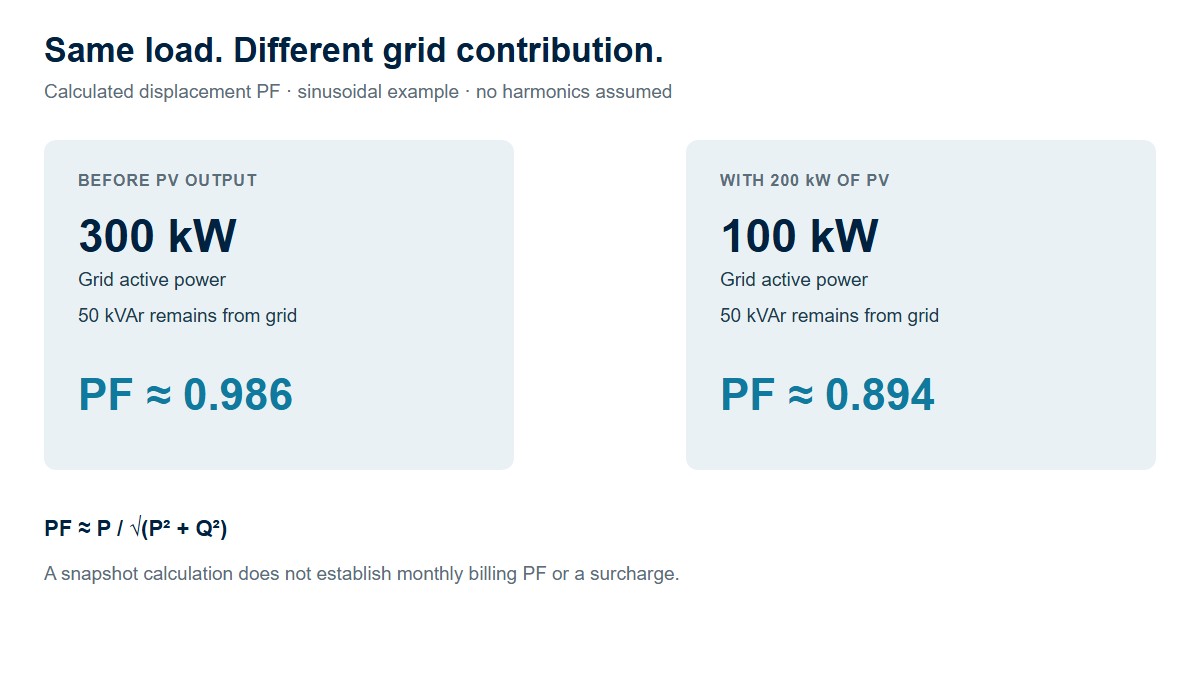
Before PV, assume 300 kW of grid import and 50 kVAr of residual reactive power. PF is about 0.986.
Now suppose PV produces 200 kW at unity power factor while the load and compensation remain unchanged. Grid active-power import falls to 100 kW, but residual reactive import stays near 50 kVAr. Displacement power factor is then about 0.894.
The example assumes unity-PF inverter operation, which prioritises active generation to offset grid purchases. Actual settings must follow grid-connection requirements. Motors and transformers still need reactive power for their magnetic fields; the grid supplies any shortfall after the capacitor bank.
When PV output matches the active load, grid active import approaches zero. If the grid still supplies reactive power, PF approaches zero in this simplified model. The comparison is for the same period, not whole-day energy totals.
This does not happen at every rooftop PV site. What matters is when actual PV output approaches the daytime load, not a comparison of nameplate ratings alone. For example, a factory with a daytime load near 200 kW and 200 kWp of rooftop PV still needs its measured midday PV output and load profile checked before anyone can say how far grid import will fall.
Billing depends on energy over the month, not one reading
TNB calculates monthly power factor from active energy (kWh) and reactive energy (kVArh) accumulated over the billing period. It is not the arithmetic average of instantaneous readings. A meter showing 0.95 at noon cannot stand in for the monthly bill.
Where production and PV output overlap during the day, PV reduces active energy imported at the meter. If residual reactive energy does not fall with it, the billing-period ratio of active to reactive energy changes and monthly power factor may fall. Whether a surcharge follows depends on the full month's meter data and the threshold for that account.
For Peninsular Malaysia, TNB publishes power-factor surcharge thresholds below 0.85 for supply below 132 kV and below 0.90 for supply at 132 kV and above. The 0.894 above illustrates a drop; by itself it would not trigger the 0.85 threshold. Check any separate contractual target against the actual account rather than applying one site's requirement to another.
Four reasons the existing compensation falls short
Many factories installed their capacitor banks before adding PV, so the original sizing did not cover the later operating pattern. If power factor falls after connection, check the following four possibilities. More than one may be present at the same site.
| Cause | What you see on site | Why it happens |
|---|---|---|
| Capacity | All steps in during production, power factor still low | Equipment and the transformer still need reactive power; original capacity did not cover the post-PV operating point at the grid meter |
| Step resolution | Power factor oscillates above and below target | Grouped switching gives large steps, so the bank under- or over-compensates |
| Controller | No output, or switching blocked | An older controller may lock out with bidirectional power or distortion; assess a four-quadrant controller, but still check capacity and bank condition |
| Resonance and switching | Capacitors hot, bulging or failed; contactors worn | Harmonics and system impedance may resonate; changing PV output may increase switching and damage capacitors or switches |
In the example, 300 kW and 50 kVAr give PF 0.986. With grid import down to 100 kW, keeping that PF requires residual Q to fall to about 16.7 kVAr. The motors and transformer still need reactive power. If all capacitor steps were already in use, the bank cannot supply the extra roughly 33 kVAr; a controller setting cannot create that capacity. Confirm the sizing from site data.
What to check before quoting
The table below lists the inputs needed for sizing, not a fixed bill of materials. Agree the logging interval, instrument capability and installation method with the technical team.
| Item | What to collect |
|---|---|
| Metering point and transformer | Supply voltage, transformer rating, no-load reactive demand, single-line diagram |
| Existing capacitor bank | Total kVAr, step sizes, number of steps, switching method, controller model and sensing point |
| Reactive demand | kVAr and PF profiles covering representative production, shutdown and changing-PV-output periods |
| Bill | Monthly kWh and kVArh, the utility’s power factor figure, any surcharge applied |
| Harmonics | THD, dominant orders, capacitor resonance risk |
| PV | Capacity, connection point, whether the inverters are set to absorb or inject reactive power |
Log representative production, shutdown and changing-PV-output periods at the grid metering point, then compare them with the electricity bill. APView500 is one possible instrument for recording and analysis; the technical team must confirm whether it fits and where to install it.
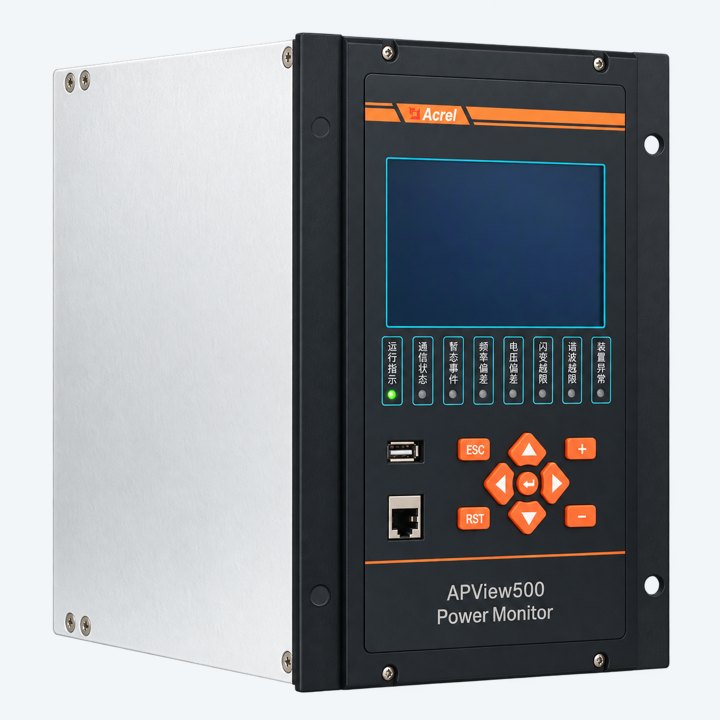
The recorded active-power, reactive-power and PF profiles guide SVG sizing.
What actually fixes it
If reactive compensation is the issue, check capacity first, then control precision and response time.
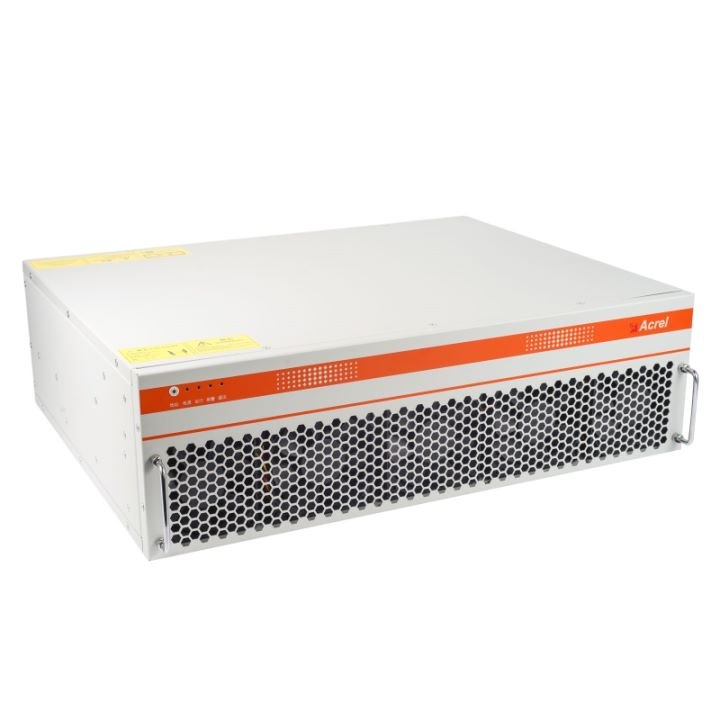
A capacitor bank switches in fixed steps, so it can overshoot or undershoot. Traditional mechanical switching also takes time; while it lags a load or PV change, the utility meter keeps recording reactive energy. An SVG responds faster and adjusts continuously without switching capacitor groups. Check the sensing point, capacity and control strategy before promising a PF target.
Sizing follows the measured reactive demand, not the PV capacity. Two sites with the same PV array can need very different compensation if their loads differ.
A four-quadrant power-factor controller suited to PV operation may resolve some sensing or lockout problems. It does not remove the risk of harmonic resonance in the capacitor bank. Cloud-driven changes in PV output may also increase capacitor-step switching and damage capacitors and switching devices. Check measured harmonics and switching records; whether harmonics need separate treatment after an SVG retrofit must be assessed on site.
This article covers SVG reactive compensation. Check any harmonic problem separately using measured data and the selected model's capabilities; better PF alone does not prove harmonic treatment.
The aim is to supply the required reactive power on site and reduce reactive import at the grid meter.
Prepare the technical brief
For a project review, send the single-line diagram, site location and supply voltage, PV capacity and inverter settings, recent bills with kWh and kVArh, a reactive power log covering production and shutdown, any available harmonic data, and the existing capacitor bank details. Include the project stage and who approves the equipment selection.
For Malaysia project enquiries, contact Jack Ren at Acrel Malaysia: jack@acrel-electric.com. Mobile, WhatsApp and WeChat: +86 18702113209. Website: www.acrel.my.
Sources
Calculated example only. Model, rating and account requirements require site review.
Post time: Oct-29-2026


