

What is UL certification?
UL certification is a safety certification run by Underwriters Laboratories in the United States. It is not required by law, but buyers, electrical inspectors and panel builders in North America ask for the mark, and a UL-listed component shortens the approval path for the charging pile or cabinet that houses it.
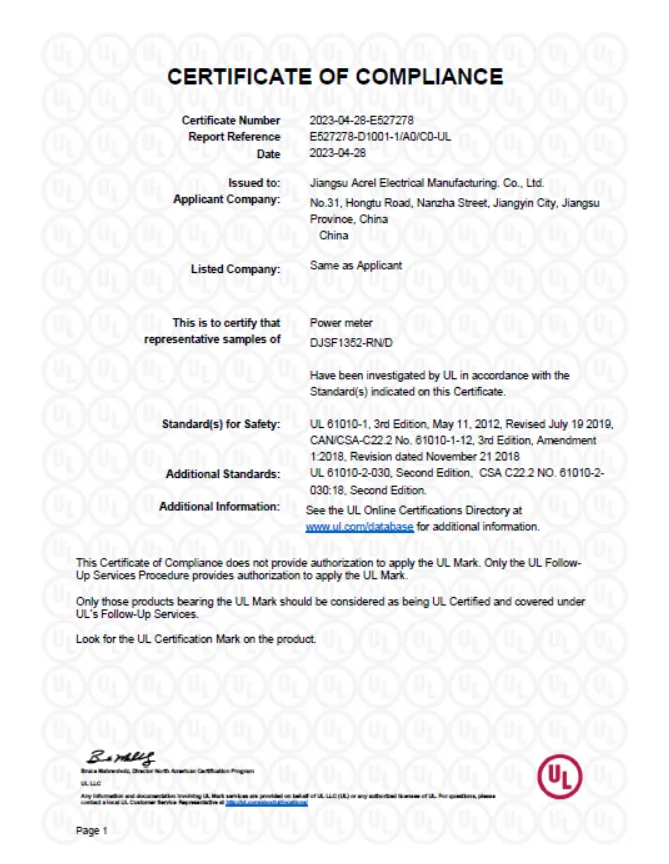
For a DC energy meter the certification is about insulation, clearance, temperature rise and the housing, which is why the certificate is issued per product series rather than per order. A copy of the certificate can be sent on request.
Acrel DIN-rail DC energy meter
Acrel DJSF1352-RN/D has been certified by UL. Certificate number: 2023-04-28-E527278.
Product page, full specification and downloadable manual: DJSF1352-RN DIN-rail DC smart energy meter.
The meter takes two independent DC inputs, so one unit can meter two chargers, two battery strings or two distribution buses. Current is never passed through the meter: it comes from an external shunt (75 mV at rated current) or from a Hall sensor (0-5 V or 4-20 mA). Voltage is connected directly or through a voltage sensor that outputs 5 V.
Scaling the inputs
Two settings convert the secondary signal into engineering values. In.PI is set to the rated current of the shunt or Hall sensor: a 300 A / 75 mV shunt takes 300, and a 0-300 A / 0-5 V Hall sensor takes 300 as well. In.PT is set to 1 for direct voltage, or to the primary-to-secondary ratio for a sensor: a 1500 V / 5 V sensor takes 300.
Wiring choices that change accuracy
A shunt can be wired three-conductor or four-conductor. For the 0.5 accuracy class the four-wire connection is the only option, because it keeps the lead resistance out of the measurement. Where the shunt is inserted in the negative leg, the parameter neg.t must be set to on, otherwise every reading carries the wrong sign.
A single or dual-supply Hall sensor can be powered from the meter: it provides plus and minus 12 V with 100 mA of load capacity.
Technical Parameters
| Item | DJSF1352-RN/D |
|---|---|
| DC inputs | 2 independent channels, measured simultaneously |
| Current input | External shunt 75 mV, or Hall sensor 0-5 V / 4-20 mA |
| Voltage input | Direct connection, or through a 5 V voltage sensor |
| Current terminals | Channel 1: 4 and 5 | Channel 2: 6 and 7 |
| Voltage terminals | Channel 1: 11 and 12 | Channel 2: 13 and 14 |
| Hall supply from meter | ±12 V, 100 mA |
| Display | 8-digit LCD |
| Communication | RS485 and infrared |
| Protocols | Modbus-RTU, DL/T 645-2007 |
| Switch output | 2 relay outputs, 2 A / 30 VDC or 2 A / 250 VAC |
| Switch input | 2 dry contact inputs |
| Pulse output | One second-pulse output and one energy-pulse output |
| Energy rollover | Counted energy clears automatically at 1000000.000 kWh |
Typical use: DC energy metering at EV charging piles, battery storage, solar strings, and DC distribution in mining, civil buildings and building automation.
Application on site
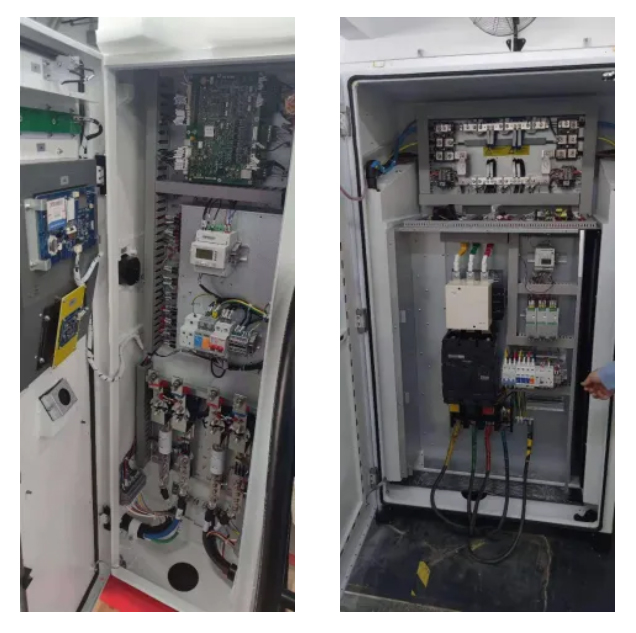
Commissioning notes from the application manual
- With nothing connected to the bus, the A-B terminals should read about 4.5 V. If they do not, check the meter supply before checking addresses.
- Channel 2 always takes an address one higher than channel 1, on Modbus and on DL/T 645 alike. The 645 serial number is 12 digits by default.
- Voltage, current and power are 16-bit signed registers; energy is 32-bit unsigned. Reading energy as a signed value produces a wrong total that looks like a meter fault.
- Some PLCs and configuration tools need the 40001 offset, where register address 0 is addressed as 40001.
- For bus problems modpoll is recommended over modscan, because modscan does not let the data type be corrected locally.
- Charging-pile integrators on DL/T 645 normally use 2400 baud with even parity. If the bus is silent, read the meter communication parameters before rewiring.
Two readings that are not faults
- Correct wiring but inverted values: the shunt is in the negative leg. Set neg.t to on.
- A small current shown with no load: set a current shielding value. 3 A of drift on a 300 A shunt is 1.0 percent. The same rule covers voltage, where 10 V on a 1000 V rated input is 1.0 percent.
What to tell us before we quote
Rated DC current and voltage of the circuit, whether a shunt or a Hall sensor is used and its output, the required accuracy class, the communication protocol and baud rate, the auxiliary supply, and whether the project needs the UL documentation with the offer.
Post time: May-18-2023


