

Dashboards Do Not Dispatch — What a Microgrid Coordination Controller Actually Does
A site installs a monitoring platform, the dashboard looks impressive, and the energy bill does not move. The reason is the same every time: a platform shows what happened; something else must decide what happens next.
Why the dashboard is not enough
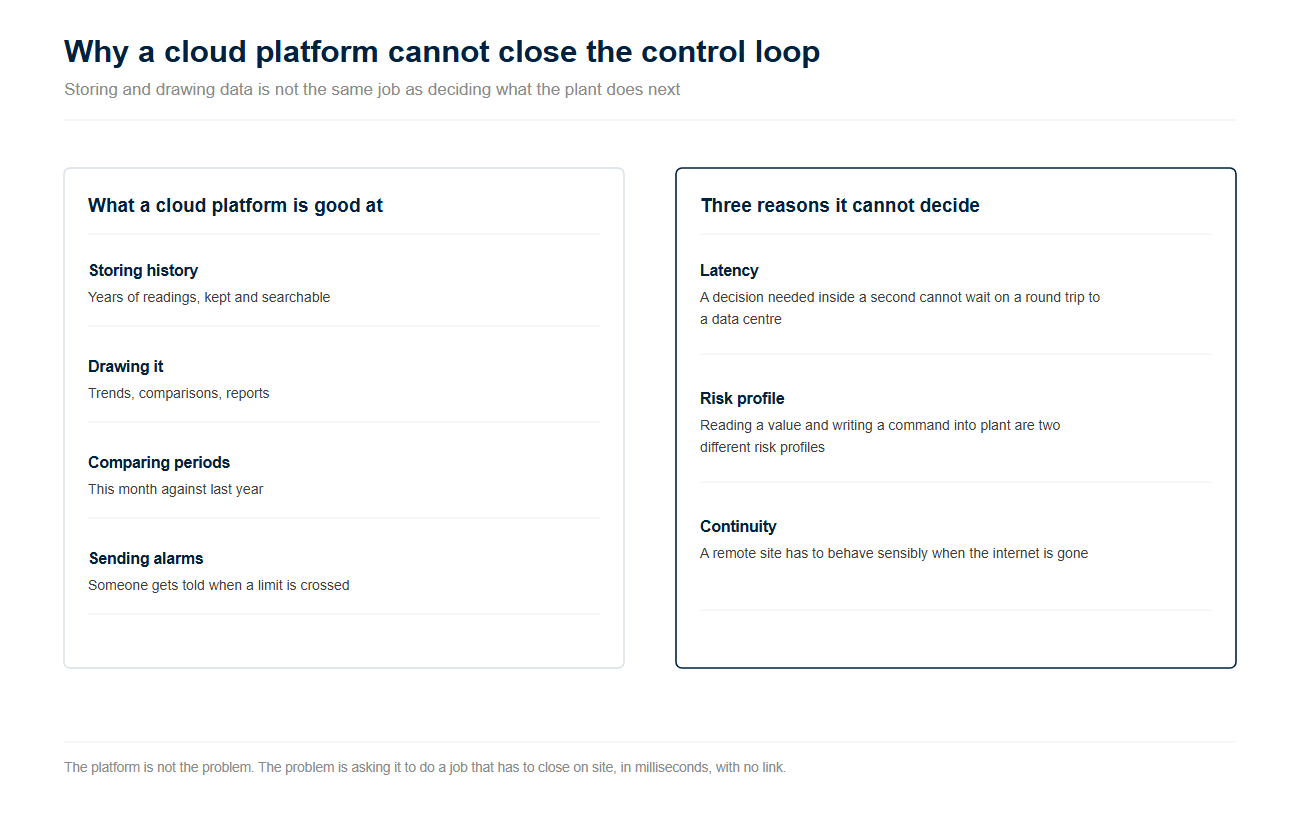
Cloud platforms are good at four things: storing data, drawing it, comparing periods and sending alarms. They are not good at deciding, for three practical reasons:
|
Latency
A second is a long time
A decision needed within a second cannot wait on a round trip to a data centre
The control loop has to close on site
|
Consequence
Read, or write?
Reading a value and writing commands into plant are different risk profiles
One is safe to do remotely; the other is not
|
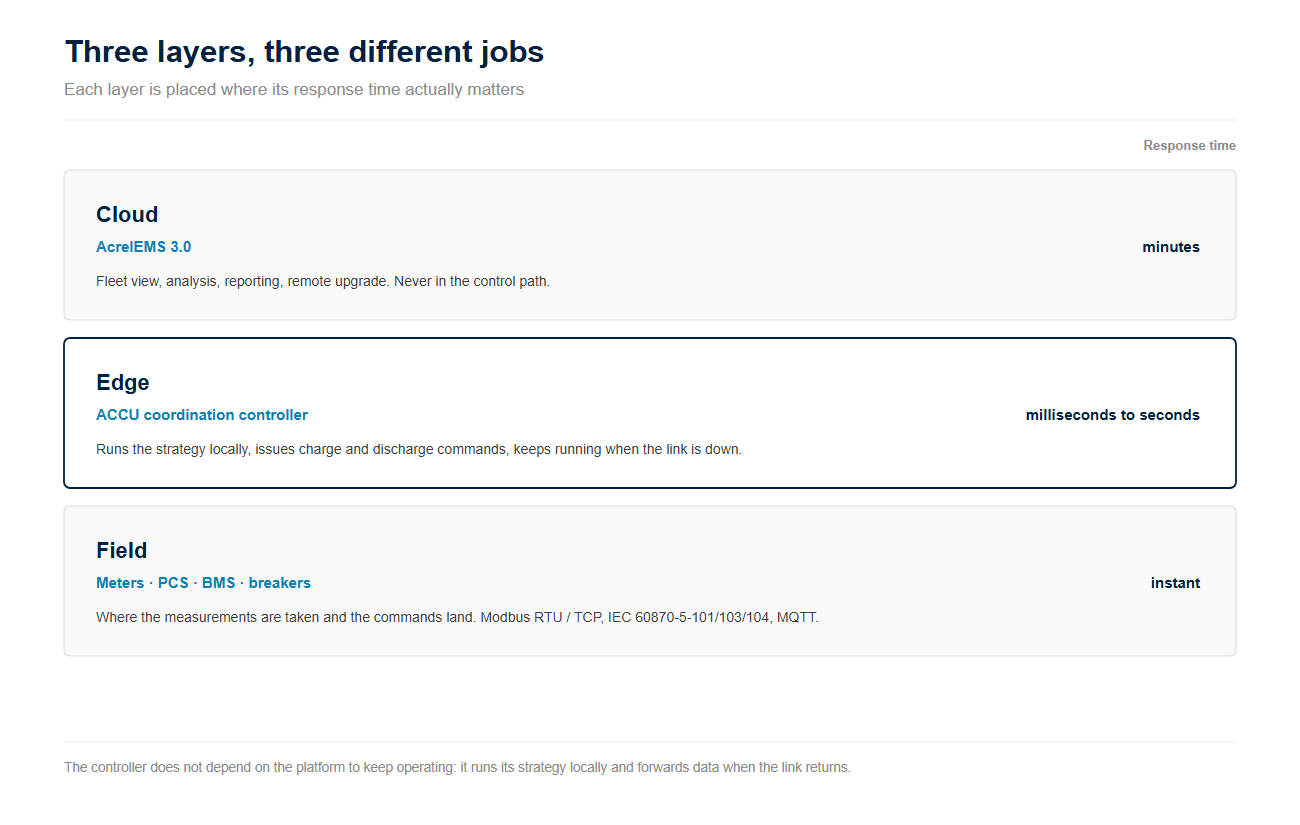
The architecture that resolves this is standard: the cloud layer analyses and reports, the edge layer decides and commands, the field layer measures and executes. A platform reads and reports; a controller decides. That single distinction separates a site that looks good on a screen from one whose energy bill actually falls.
Three layers, three different jobs
Reaction time separates the three layers, and that decides which layer a function belongs on.
The controller runs a loop on a fixed cycle, and every step is local.
The strategies it runs
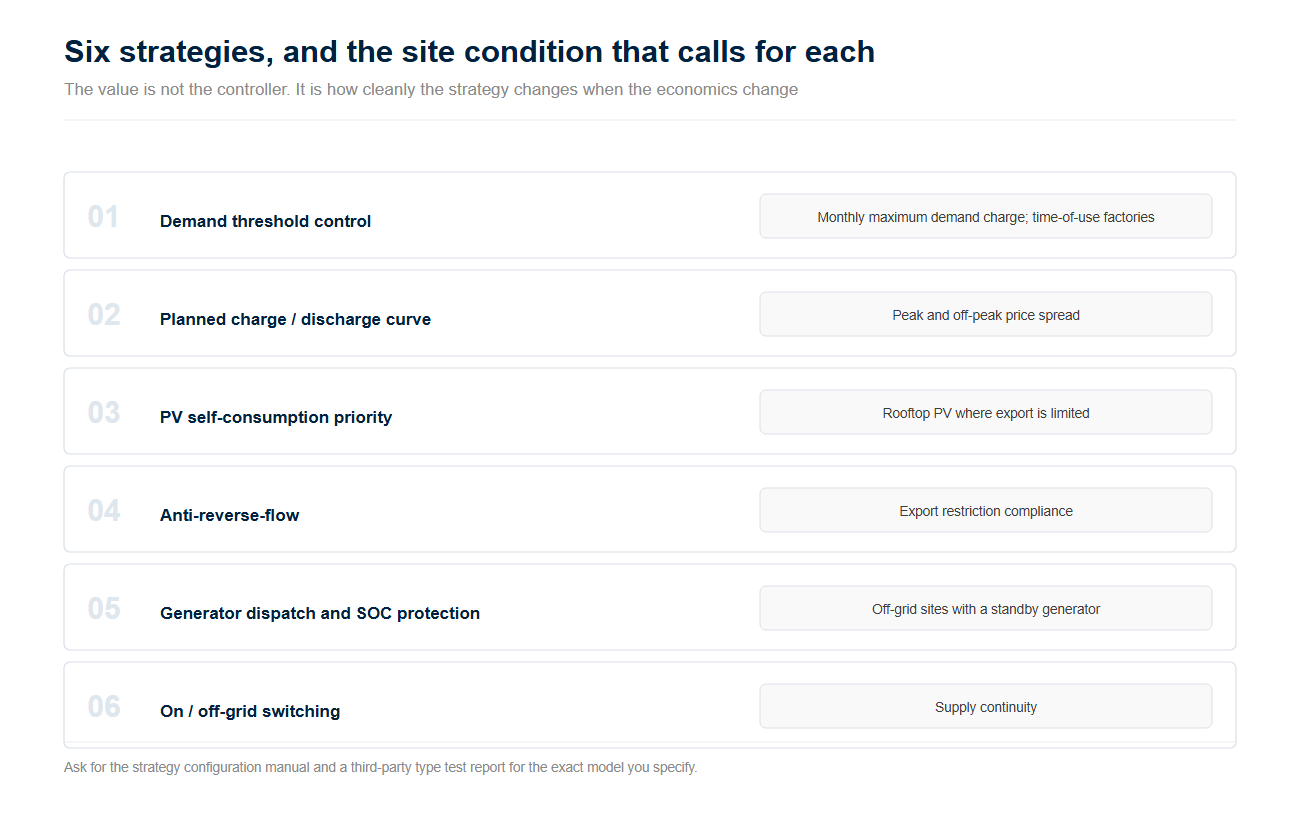
The value is not the controller but the strategies it executes, and how cleanly they change when the economics change. Six are common:
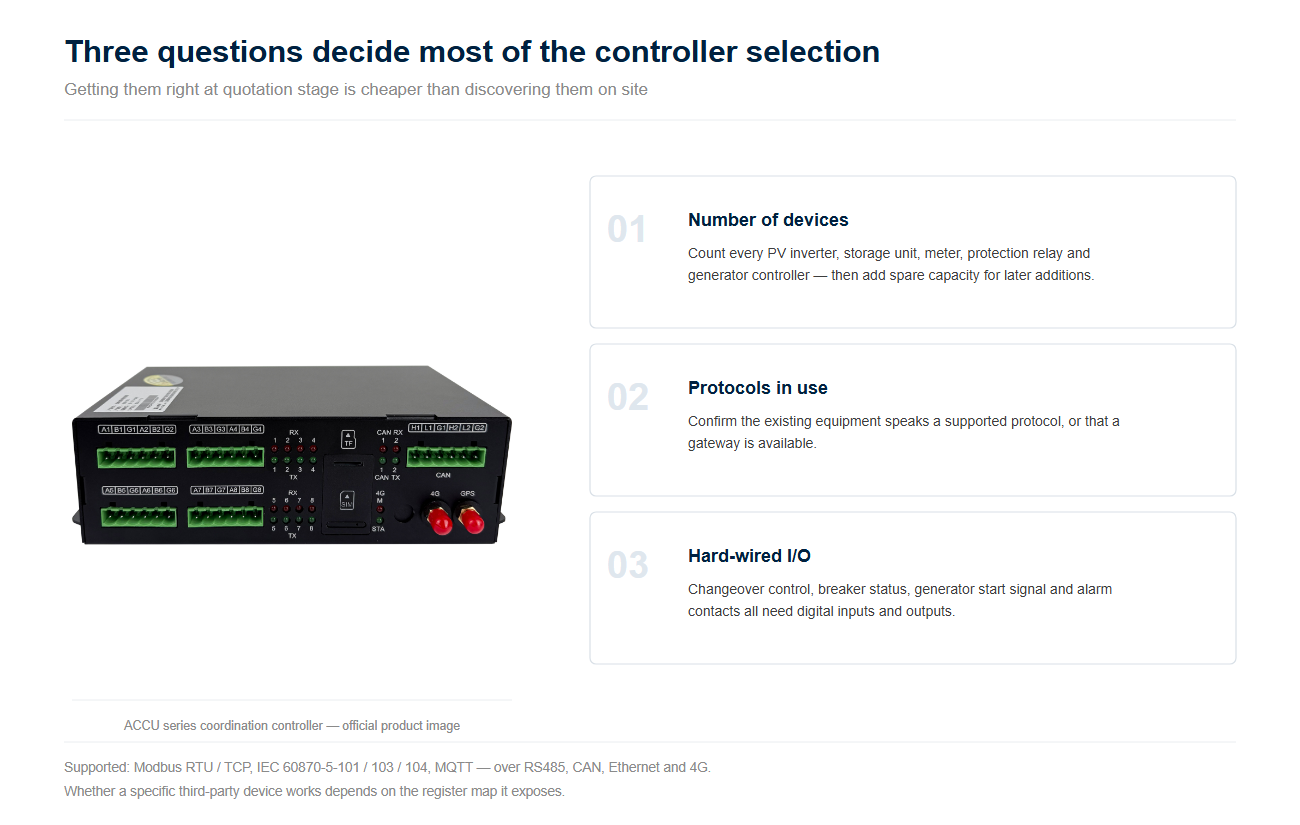
A controller is only useful if it can talk to the equipment on site, which rarely comes from one supplier. The ACCU series supports Modbus RTU and Modbus TCP, IEC 60870-5-101 / 103 / 104 and MQTT, with RS485, CAN, Ethernet and 4G interfaces and digital inputs and outputs. The digital I/O lets the controller operate a changeover or read a breaker status directly. At site level, Acrel-2000MG monitors and controls PV, storage, charging and loads together; above both, AcrelEMS 3.0 provides the cloud view.
Choosing between the models
Three questions decide most of it, and getting them right at quotation stage is cheaper than discovering them on site.
Ask for the strategy configuration manual and a third-party type test report for the exact model you specify. The controller does not depend on the platform to keep operating: it runs its strategy locally, stores data on site and forwards it when the link returns — on a remote site, that is the difference between a working system and one that is not.
CHECK DEVICE BY DEVICE Third-party inverters and batteries integrate over Modbus RTU / TCP, IEC 60870-5-101 / 103 / 104 or MQTT — whether a specific device works depends on the register map it exposes.
This article is technical information, not a commercial offer. Protocol support and interface counts are taken from Acrel published literature for the ACCU series. Certification and type test reports are issued per model; confirm the applicable document for the model you specify. Local approval in Malaysia should be confirmed with the relevant authority.
Post time: Oct-15-2026


