

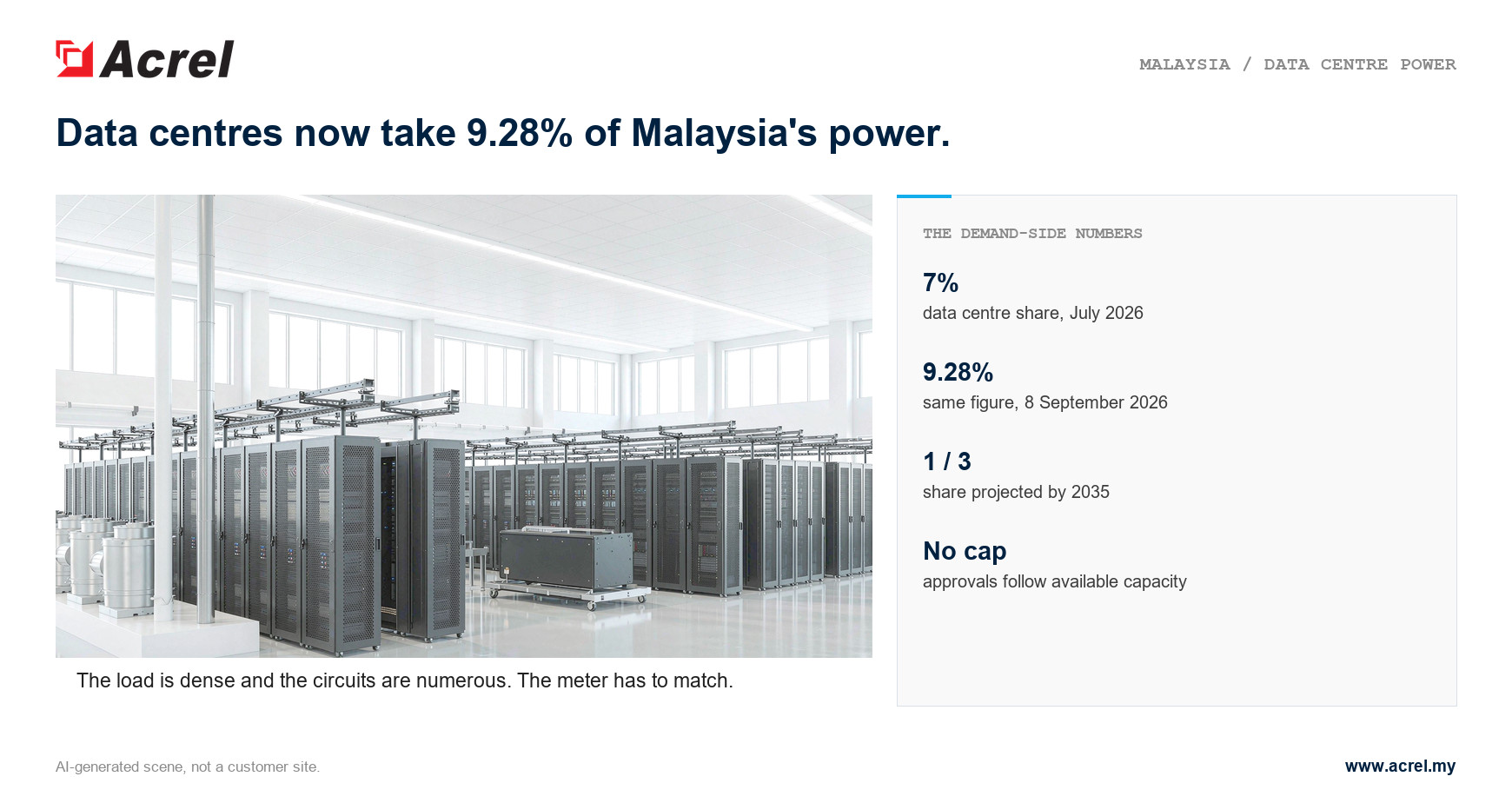
On 8 September 2026 the Energy Commission put a number on what the industry had been estimating for two years. Data centres now account for 9.28% of Malaysia’s total electricity consumption, its chief executive officer said at the Energy Regulatory Insights conference — up from 7% in July. That is the demand side. The supply side is what matters to whoever stands in front of a live panel: the Commission has set no cap on data centre consumption.
From 7% to a third
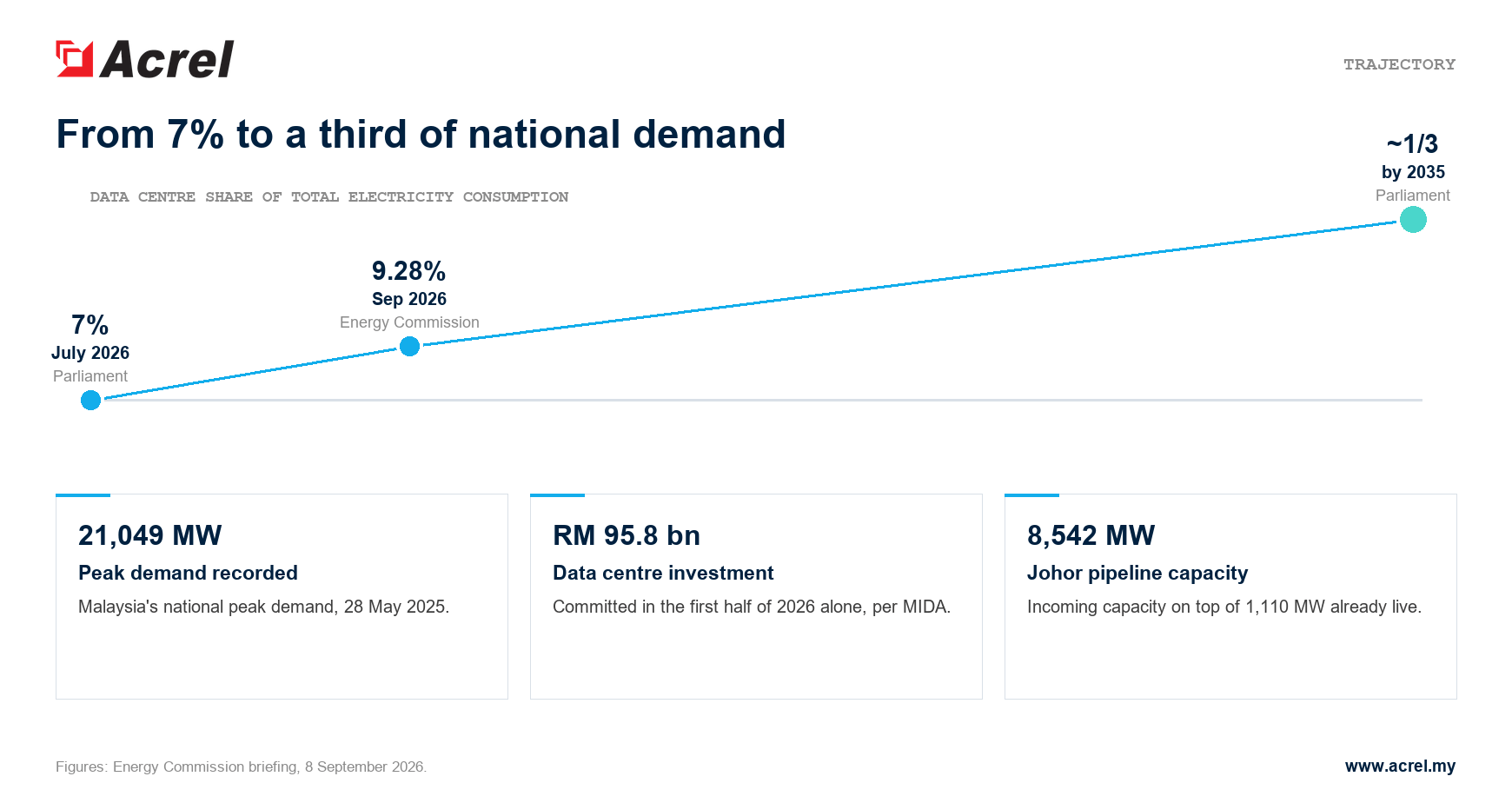
The 9.28% is a snapshot, not a ceiling. The Commission said the number moves with the weather, because cooling load does, and that more facilities come online in November — pushing consumption up again before it settles.
The direction of travel is the more useful number. When the figure was 7%, the Deputy Prime Minister told Parliament that data centres were expected to consume around one third of Malaysia’s electricity supply by 2035. Two months later that trajectory had added 2.28 percentage points.
What the Commission did and did not say
Three things are worth separating from the headline.
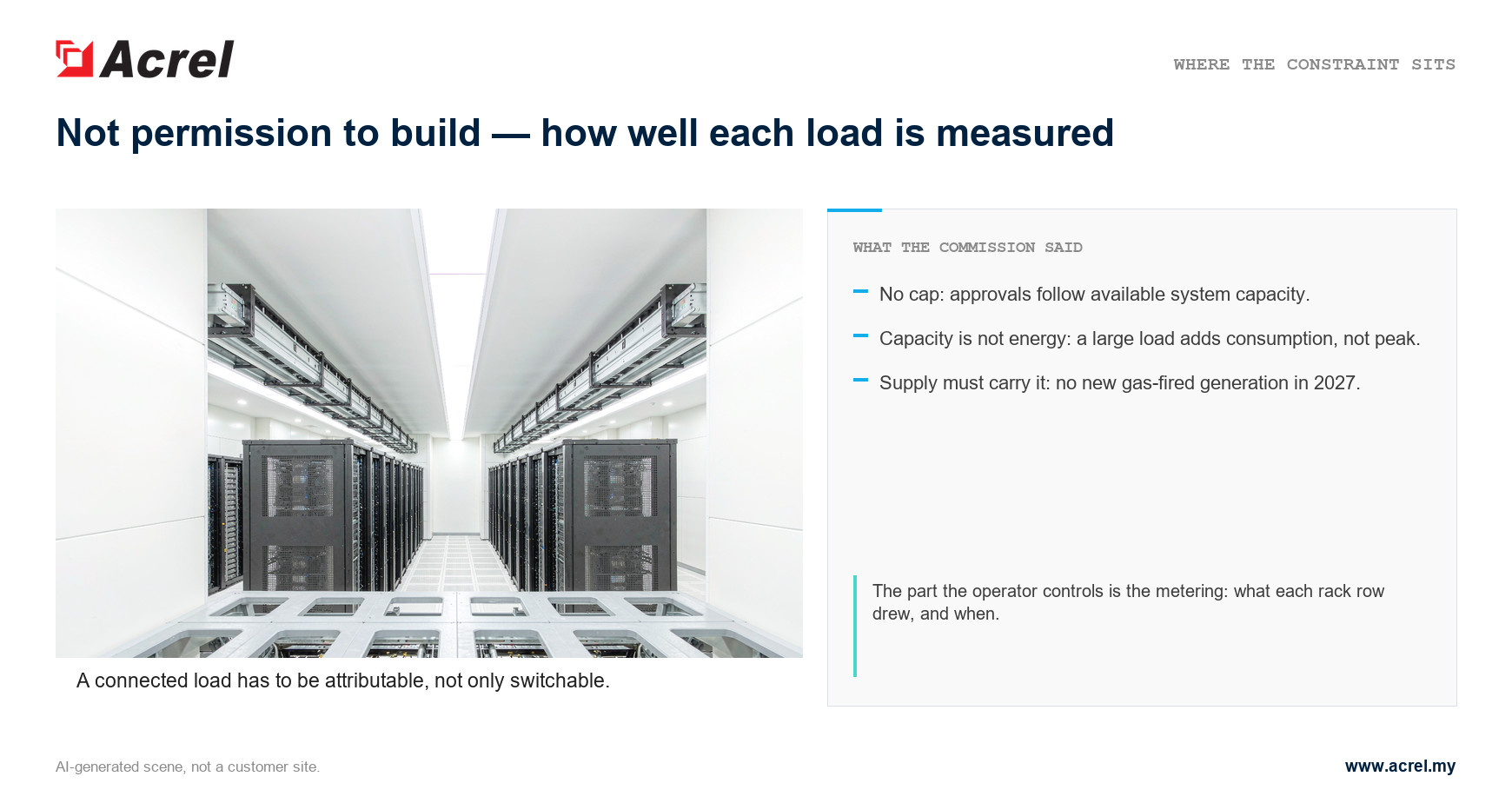
Asked whether data centre electricity use would be limited, the Commission said no specific limit applies, and approvals rest on the power system’s available capacity.
Peak demand barely moves when a large load connects, because a data centre adds consumption rather than peak capacity.
No additional gas-fired generation comes online in 2027, so existing capacity has to be optimised. Gas is about 55% of installed generation capacity.
Together they describe a market where the constraint is not permission to build, nor megawatts available. It is how well each connected load can be measured, attributed and defended.
Why this lands on the meter
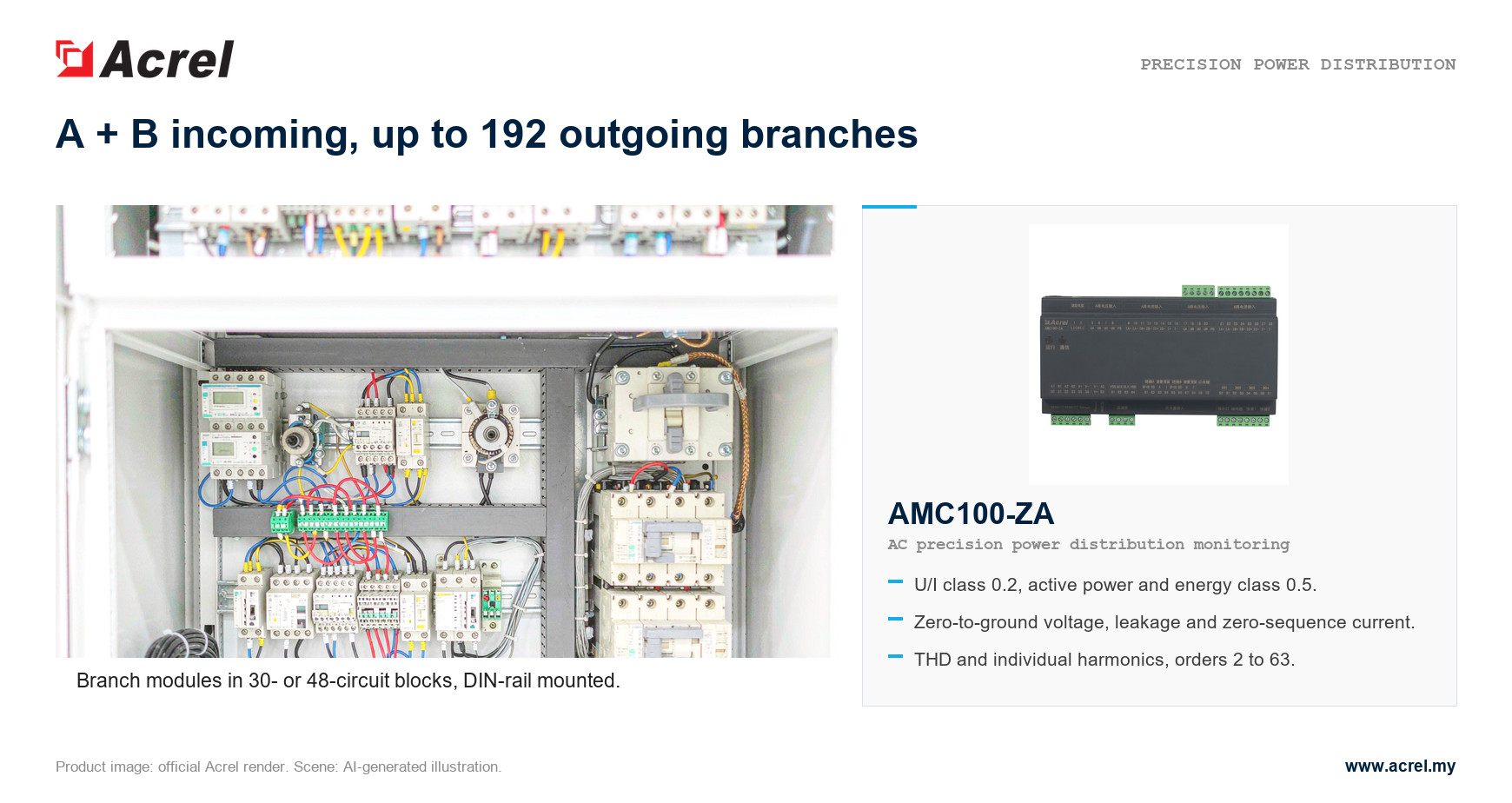
Every efficiency story becomes a metering story, because measurement starts somewhere physical. In a data centre that somewhere is unusually specific: the load is dense, the circuits are numerous, and the two feeds to each rack row are supposed to stay independent all the way down. That is the design intent of the AMC100 precision power distribution monitoring device — built to watch A and B dual three-phase AC incoming lines and up to 192 outgoing branches in real time.
What the incoming module actually measures
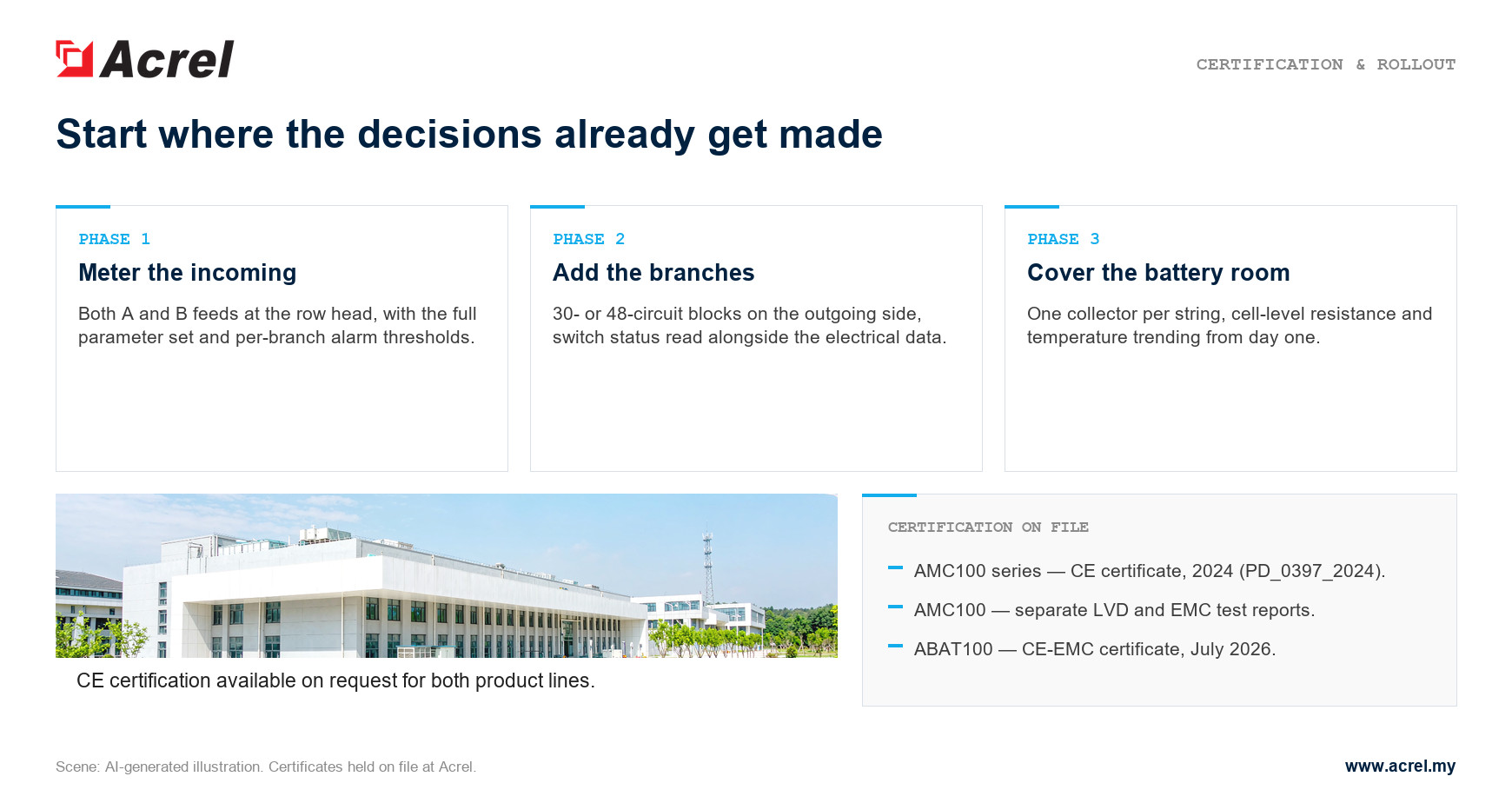
AMC100-ZA sits at the head of the row. It carries the full electrical parameter set for both incoming lines — voltage, current, frequency, active and reactive power, power factor, active and reactive energy — and adds the parameters a data centre asks about specifically.
The 192 outgoing branches are measured in 30- or 48-circuit blocks, with switch status read alongside the electrical parameters. Every channel has its own alarm threshold, and a limit event triggers the sound and light alarm immediately rather than waiting for someone to open a trend page.
The DC side, and the batteries behind it
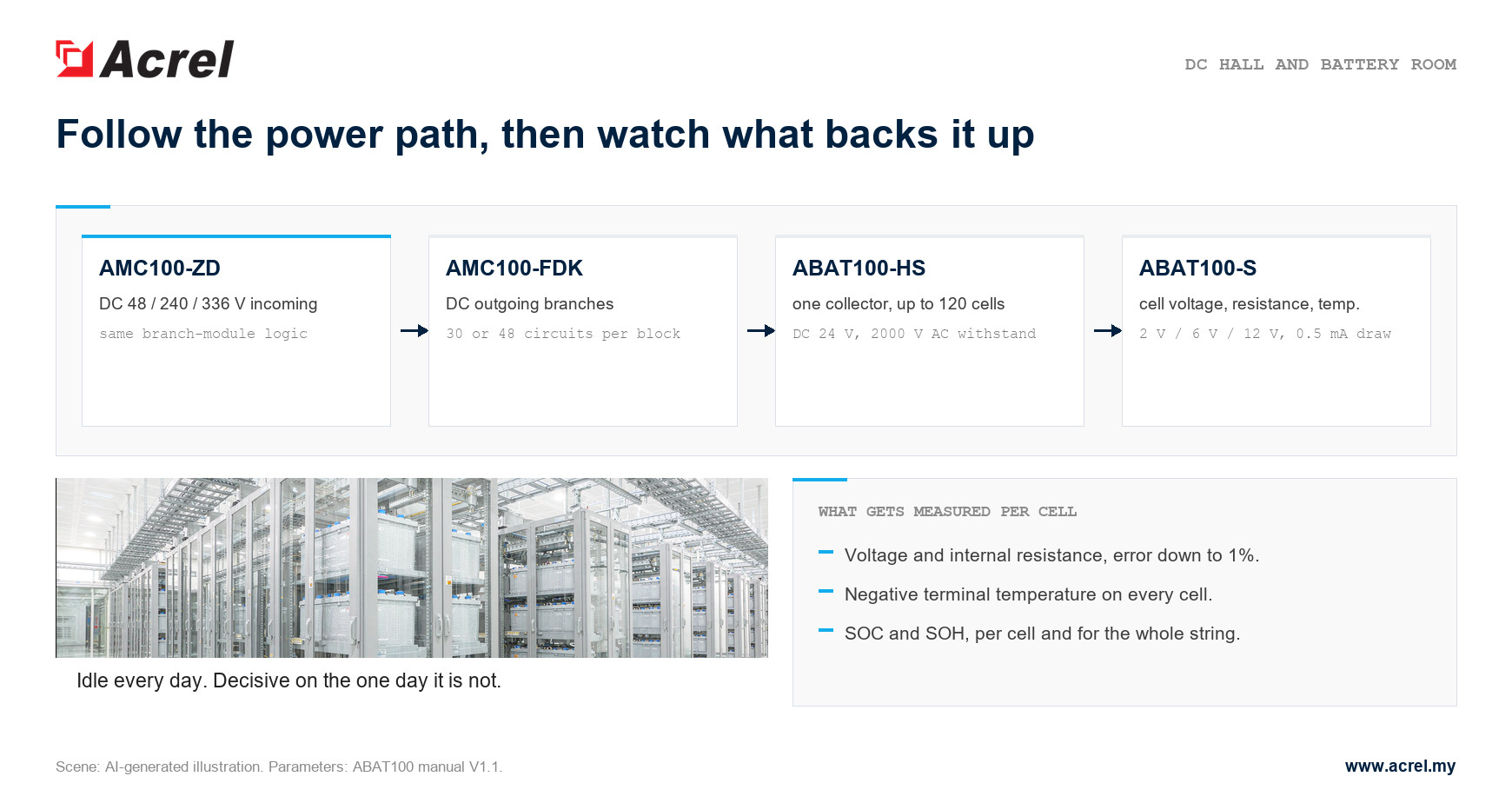
Not every row is AC. A high-density hall increasingly runs DC, and the monitoring device follows the power path rather than the other way round. AMC100-ZD is the DC counterpart to ZA: A and B dual DC incoming lines at 48 V, 240 V or 336 V, with the same branch-module logic on the outgoing side, so an AC hall and a DC hall are documented in one system.
Behind both is the battery room — idle every day, decisive on the one day it is not. ABAT100 monitors it continuously rather than annually.
Two objections, and the certification
A building management system reports what its own sensors see. It does not give you the full parameter set at the incoming line, per-branch alarm thresholds, or the harmonic detail behind a power factor that has started drifting. The metering layer is where that comes from.
Branch modules connect to modules and CTs by plug-in harness, and the ABAT100 Hall sensor clamps around the battery circuit rather than interrupting it. Retrofitting into an operating row is the normal case, not the exception.
Both product lines hold third-party certification, available on request. AMC100 series holds a CE certificate issued in 2024 (PD_0397_2024) with separate LVD and EMC test reports, and ABAT100 holds CE-EMC certification issued in July 2026 with CE-LVD and CE-EMC reports from the same programme.
Send the hall layout, the number of incoming feeds, the branch count per row and whether the power path is AC or DC. We will come back with a metering layout, the branch module count, the battery string arrangement, and the data path into your BMS or DCIM.
Post time: Oct-08-2026


