

ACREL MALAYSIA · SOLAR EPC FIELD NOTE
Rooftop Solar and TNB Power Factor Surcharge: What a Factory Should Check First
A rooftop PV system can operate normally while the power factor at a factory's utility meter falls during some operating periods. For a factory supplied by TNB, a surcharge depends on the monthly average power factor on the bill and the threshold for that account's supply voltage.
To understand the cause, also check whether the existing compensation system covers the plant's reactive demand when PV is generating.
A low spot reading does not establish a surcharge
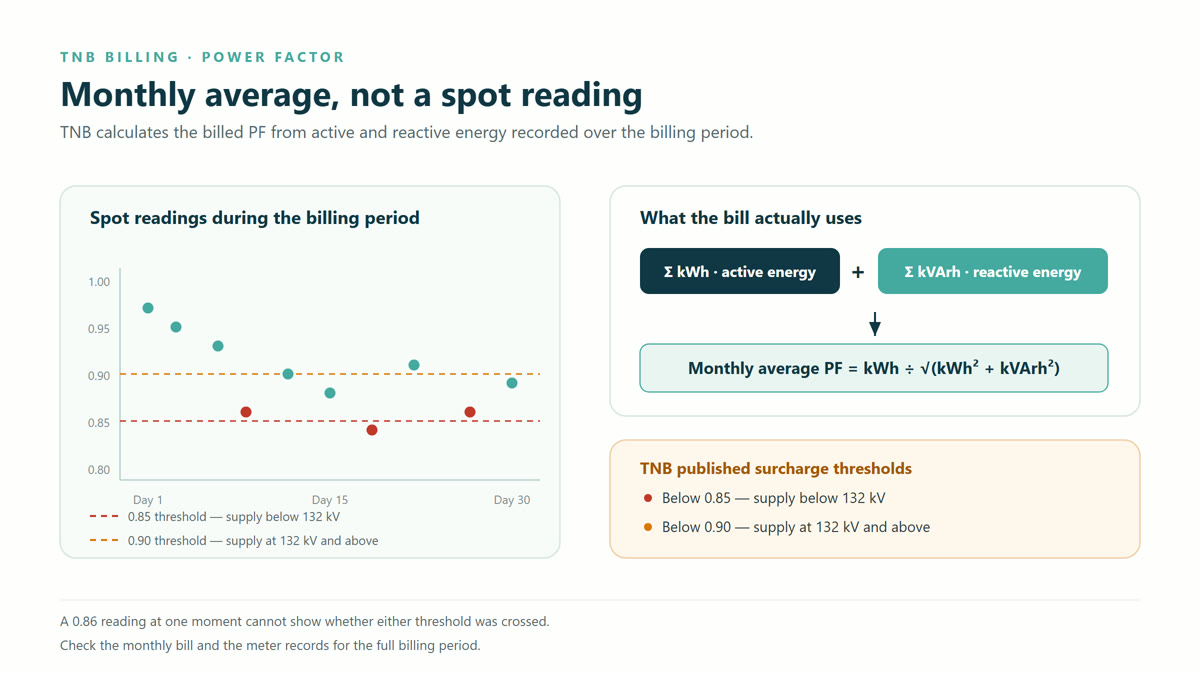
TNB calculates the monthly average power factor from active and reactive energy recorded over the billing period; it is not an arithmetic average of spot readings. The published surcharge thresholds are below 0.85 for supply below 132 kV and below 0.90 for supply at 132 kV or above. For supply below 132 kV, the published calculation starts at 1.5% of specified bill components for each 0.01 below 0.85, with a different step below 0.75. Check the account's supply voltage, billed monthly average and applicable terms before estimating any cost.
For illustration, suppose the utility meter shows 0.86 during a period when PV output is near its rated capacity. This is a hypothetical spot reading, not a customer measurement or the month's assessed value. Although 0.86 is numerically above 0.85 and below 0.90, it cannot establish whether either surcharge threshold was crossed. Check the monthly bill and the meter records for the full billing period.
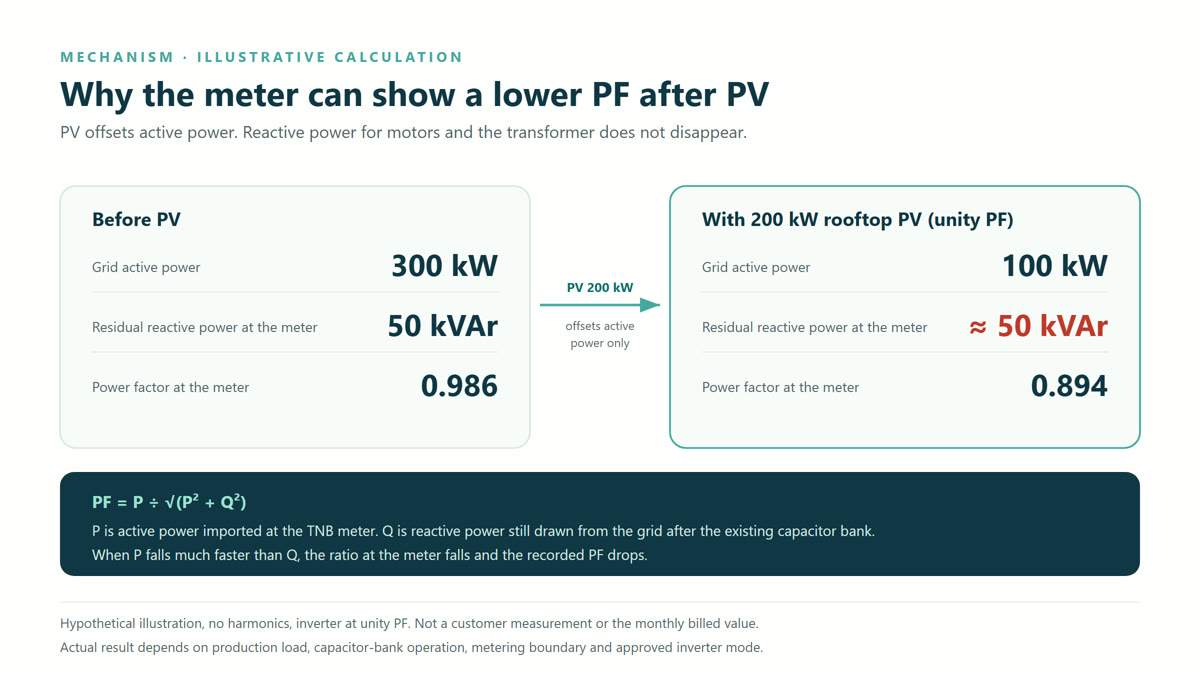
Why grid-side power factor may fall after PV
Assume the PV inverter operates at unity power factor. Its output reduces the active power drawn from the grid, while motors and the transformer can still require reactive power. If the existing capacitor bank does not cover that demand, the grid supplies the remaining reactive power. When grid-side active power in kW falls much more than reactive power in kVAr, the power factor shown at the utility meter can fall. Whether this affects the billed monthly average depends on the whole billing period.
This mechanism is a starting point, not a site diagnosis. Production load, capacitor-bank operation, the metering boundary and the inverter's approved operating mode can change the result. An EPC contractor should review representative grid-meter trends alongside the production schedule and PV output before specifying equipment.
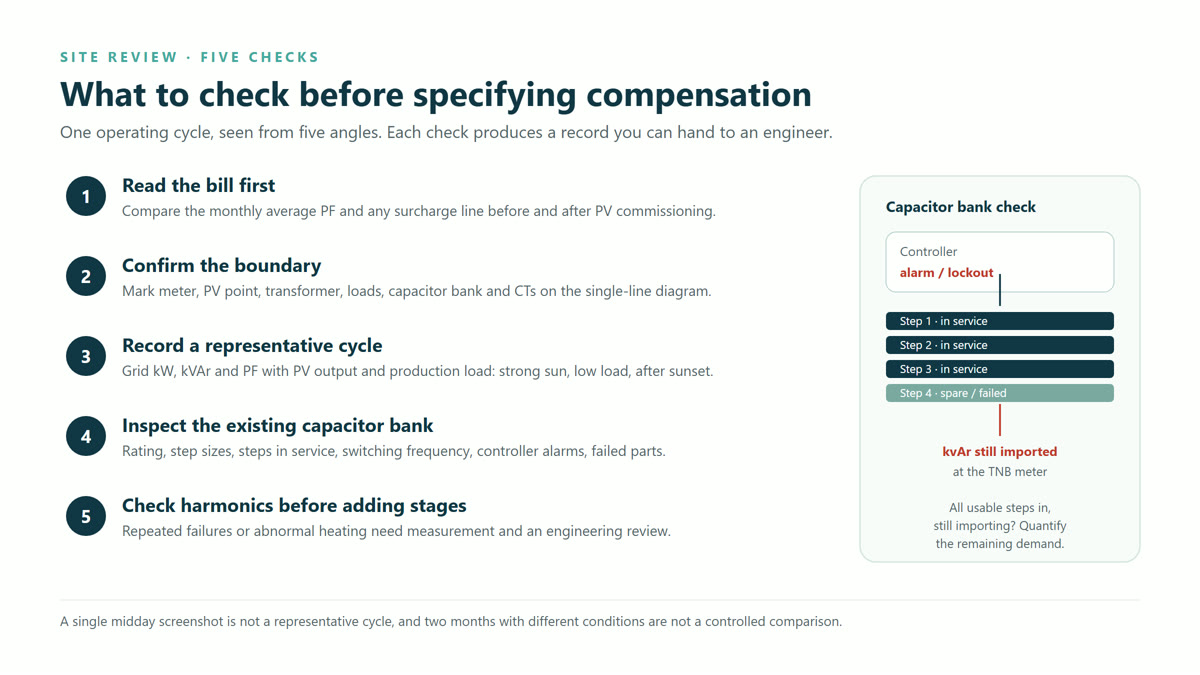
Five checks before choosing a compensation solution
Work through the checks below before discussing equipment. Each one produces a record that an engineer or EPC can review.
1. Read the bill first
Compare the monthly average power factor and any surcharge line before and after PV commissioning. Production and PV output vary, so two months with very different operating conditions are not a controlled comparison.
2. Confirm the boundary
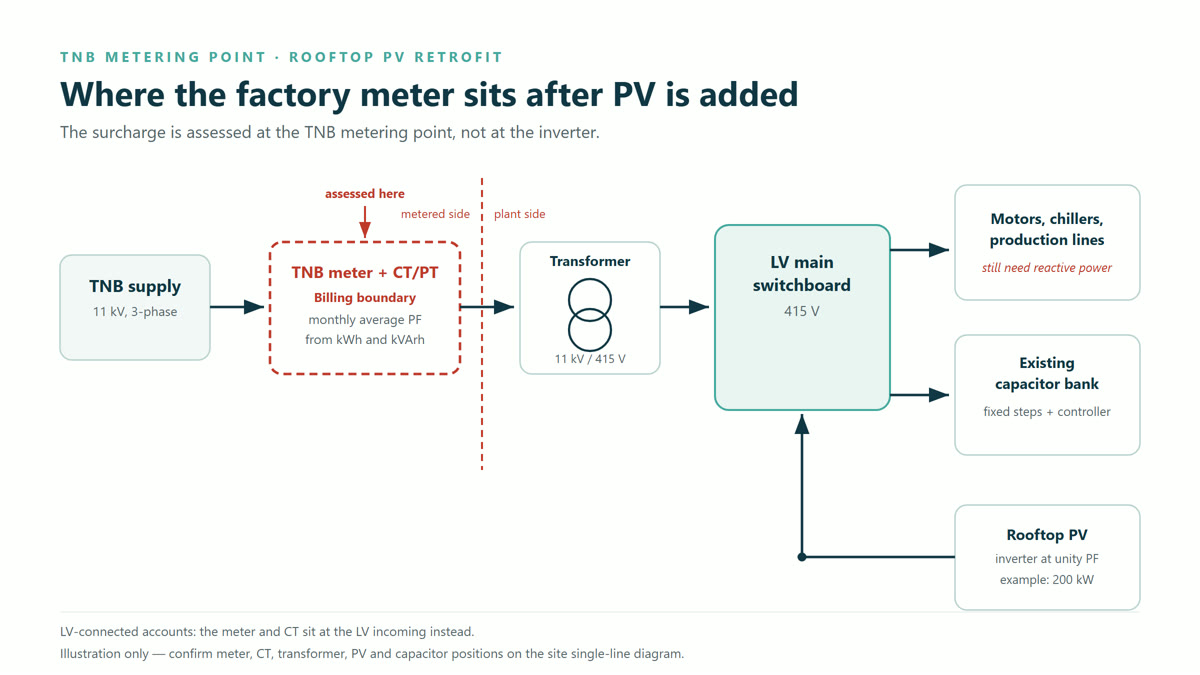
Mark the TNB meter, PV connection, transformer, loads, existing capacitor bank and current-transformer positions on the single-line diagram. Use the account's supply voltage for the surcharge threshold.
3. Record a representative operating cycle
Trend grid-side kW, kVAr and power factor alongside PV output and plant load, including strong sun, light production and after sunset. A single midday screenshot cannot show the whole pattern.
4. Inspect the existing capacitor bank
Record its rated capacity, step sizes, steps in service, switching frequency, controller alarms and failed capacitors or contactors. If all serviceable steps are engaged while the utility meter still shows substantial reactive import, have an engineer quantify the remaining compensation requirement.
5. Check harmonics before adding capacitor stages
Repeated component failures or abnormal heating require measurement and an engineering review of harmonic and resonance conditions. Adding capacitors without that review may make the problem worse.
Turn the findings into a project requirement
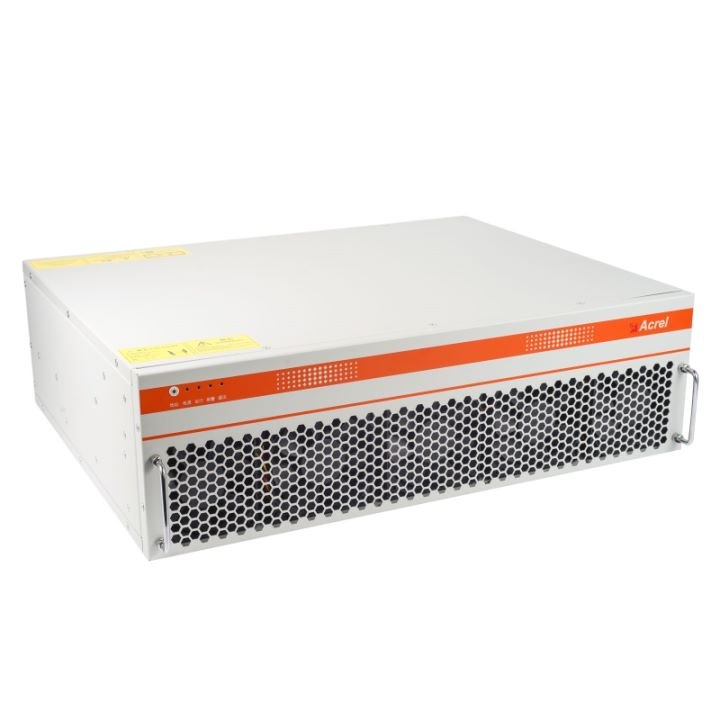
If measurements confirm that the existing bank lacks capacity, or that its switching steps cannot follow changing reactive demand without under- or over-compensation, an ANSVG static var generator is one possible solution for continuous reactive-power control. Size it from the measured requirement and operating range, not from the PV array's kW rating. Controller settings, harmonics, protection and installation conditions still need engineering review.
For an owner or EPC team, record grid-side kW, kVAr and power factor trends at the agreed metering point, the capacitor-bank step status and the bills after commissioning. Compare electrical measurements under similar operating conditions, then review the billed monthly average and any surcharge separately. A change in total bill amount alone does not prove the compensation result because production, PV output and tariffs may also change.
Prepare the project brief
For a Malaysian factory or solar EPC project, send Jack Ren a one-line diagram, existing capacitor-bank details, representative grid-meter trends and a recent itemised electricity bill. Account identifiers can be removed for an initial discussion.
Contact Acrel Malaysia at jack@acrel-electric.com, WhatsApp/WeChat +86 18702113209, or www.acrel.my.
Sources checked 30 October 2026
Rule details, thresholds and calculation steps should be confirmed against the current TNB and Energy Commission documents for the specific account.
Post time: Oct-30-2026


